AI Marketing Without Losing the Human Voice
AI speeds up almost everything in marketing. But there's one thing it does badly, and your customers notice instantly.

Short answer
The rule is simple: AI speeds things up and the human gives the voice, in that order. Use it for what it does well —speed, first drafts, data patterns— but never let it talk to your customers on its own, inventing facts or translating word for word. Someone who knows your audience reviews everything before it goes live; skip that step and you lose trust.
Picture a Cuban restaurant in Hialeah. The owner has spent 15 years making the same masita de puerco his mother made back in Camagüey, and he calls every customer who walks in by name. One day he hires someone to run his social media, and suddenly his Instagram starts sounding off. Cold. Flawless captions, not a single typo, but they could belong to any restaurant in any city on earth. The posts say things like "indulge your palate with our exquisite culinary offerings." Nobody in Hialeah talks like that. And his regulars, without being able to say why, feel that something changed.
That's almost always AI running without supervision. And it's the mistake we see most right now.
At Brito we use artificial intelligence every single day. We don't hide it. It saves us hours, helps us spot patterns in the data, hands us first drafts in seconds. But there's one line we don't cross: AI speeds things up, the human gives the voice. And for a brand that runs on trust, voice isn't a detail. It's everything.
What AI actually does well
Let's be honest: AI is an incredible tool for certain things. Denying it would be dishonest. Where it truly shines is in speed and volume, not soul.
- First drafts. Spinning up 15 versions of an ad in a minute so you have something to choose from, instead of staring at a blank page.
- Data analysis. Combing through months of campaign results to find which day and hour convert best, something that would take hours by hand.
- Targeting. In AI advertising, Meta's and Google's systems find the right person better than any manual list we could build ourselves.
- Repetitive work. Rewriting the same promo in five formats, sorting comments, translating a base draft so we can polish it after.
- Ideas when you're stuck. Sometimes you just need a nudge to get moving, and that's where AI delivers.
All of that is real, and we use it without guilt. AI is a lightning-fast assistant. The trouble starts when people mistake it for a strategist or, worse, for the voice of the brand.

What AI should not do on its own
There are things a machine shouldn't touch without a human watching over it. Not because it can't produce words, but because it produces words that sound like nobody.
It shouldn't talk to your audience as if they were all the same. A family in Homestead, an executive in Brickell, and a young couple in Doral are not "the Miami market" in the abstract. They buy differently, talk differently, trust differently. Left alone, AI flattens them all into the same textbook tone.
It shouldn't make things up. You ask it about your business and, if it doesn't know, it invents an answer with total confidence. Prices that don't exist, services you don't offer, the wrong hours. And it sounds so sure of itself that if nobody checks, it goes live.
And it shouldn't translate word for word. This is the cardinal sin. Copy written in English and pushed into Spanish one word at a time isn't real Spanish; it's English in a costume. Your customers can smell it in two seconds.
Ready to apply this to your business?
The tells of "a machine made this and nobody checked"
Your customer will almost never tell you "this was made by AI." They just stop feeling the brand is theirs, and they leave quietly. These are the tells that give it away, the same ones we hunt for in every review.
- Literal translation. Phrasing that reads like an appliance manual instead of the way people actually talk here.
- Zero warmth. Text that's correct but cold, without a joke, without a wink, without the warmth of a real conversation between neighbors.
- No local context. Nothing about Miami, nothing about the neighborhood, nothing about life as it's actually lived here. It could be from Madrid, Bogotá, or some random app.
- The same Spanish as everyone. That neutral dubbing Spanish that belongs to no country and therefore connects with none.
- Suspicious perfection. When everything is so polished it feels artificial, people get suspicious. Real connection comes with a few imperfections.
Here's the hard truth: AI used badly sounds fake, and in a market that runs on trust and word of mouth, sounding fake costs you customers. It's not a grammar problem. It's a trust problem.

How they work well together: AI that speeds up, a human who decides
The right approach isn't choosing between AI and a human. It's putting them in the right order. Here's how we see it:
- AI writes the draft. Fast, in volume, no ego.
- The human edits, cuts, and adds the voice. This is where the text goes from correct to yours.
- The human decides the strategy. What we say, to whom, why, and when. That doesn't get automated.
- The human guards the culture. It has to sound like Miami, like your customers, like your business, not like a polite robot.
Something similar is happening in AI search. More and more people ask an assistant instead of typing into Google, and those answers are built from content across the web. If yours sounds generic and voiceless, you blend in with everyone else. If it sounds authentic, like a real person who knows their community, you stand out. That's why local SEO and the human voice now work together: the machine finds you, but the person is the one who decides to stay.
It's the same logic across everything we do, from AI advertising to web design to BritoCRM: the tool runs, the human leads. Technology never replaces the judgment of someone who knows your customer by name.

So where does this leave you?
If you feel like your social media or your ads have turned cold, that they sound correct but no longer sound like you, there's probably AI running with nobody adding the voice. It's not that AI is bad. It's that it was left on its own.
We're not afraid of AI, and we don't sell it as magic. We use it to move faster, and on top of that we add the judgment, the culture, and the voice that no machine has. If you want an honest read on how your brand sounds today, no strings attached, start with the free diagnostic. We'll tell you plainly what's working, what sounds like a robot, and what we'd do differently. No inflated promises. Just the truth, which in the end is the only thing that builds trust.
Twenty years building brands in New York, Las Vegas and Miami, where he's based today. He leads a Miami team that shoots commercials on cinema cameras and runs proprietary AI infrastructure. He believes great marketing starts with truly understanding the customer — and that honesty, often frowned upon in this industry, is what separates partners from vendors.
View profile→Questions about your business?
The first conversation is an assessment, not a sales pitch. Let's talk.
Or explore our Search + AI (SEO & AEO) service
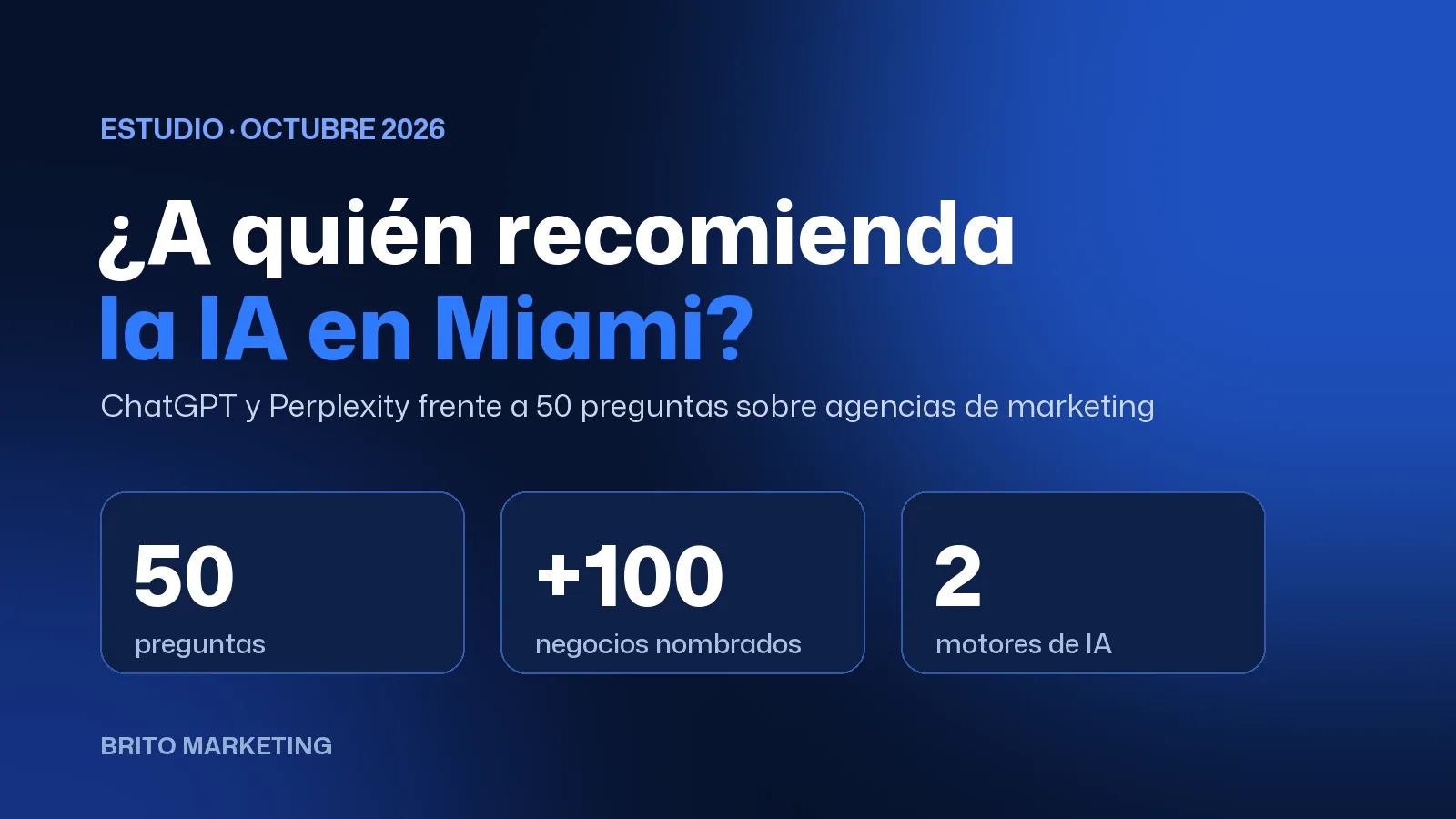
Study: Who ChatGPT and Perplexity Recommend When You Look for a Marketing Agency in Miami (October 2026)
We asked ChatGPT and Perplexity the same 50 questions, in English and Spanish. The AI named more than 100 different businesses, none in more than 4 answers, and for city searches it almost always picked someone from that city. Data, method and limits.

SEO or Paid Ads: Which Should You Invest In First?
On a tight budget you can't do everything at once. Here's an honest take on when to start with ads, when to start with SEO, and why a mix usually wins.