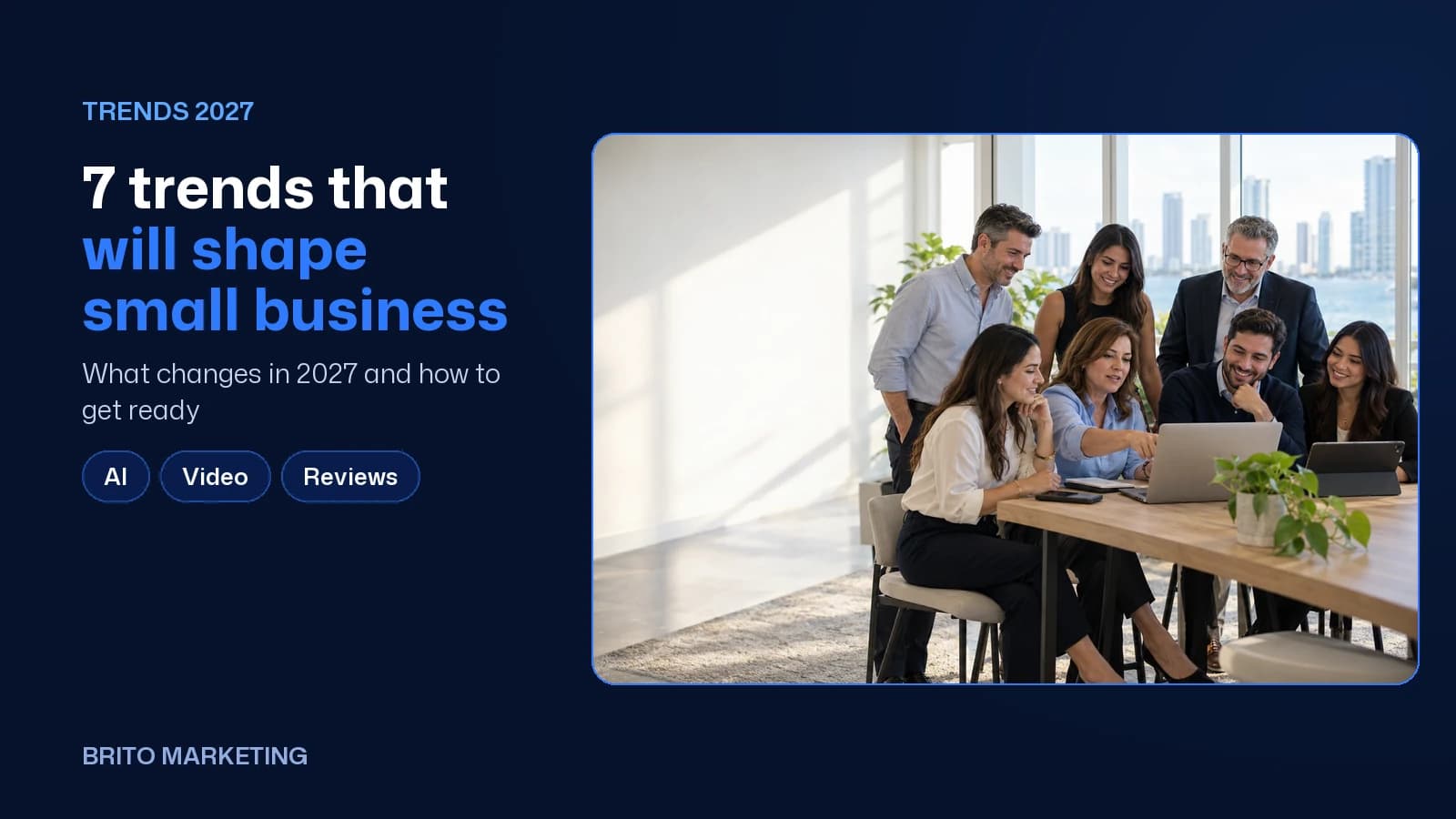
7 Trends That Will Shape Small Businesses in 2027
AI that recommends businesses, searches that end without a click, short video, fresh reviews, bilingual service, automation and privacy. What the 2025–2026 data shows and what to get ready for.
Short answer
Seven things will matter most in 2027: AI tools recommending your business, Google answering questions without a click, short video, recent reviews you actually reply to, serving customers in English and Spanish, automated follow-up, and asking permission before you use anyone’s data. The common thread is that customers make up their minds before they ever call you.
If you run a service business in South Florida, whether it’s a clinic, a law office, a contractor or an insurance agency, the way people find you has shifted fast. A few years ago, someone searched Google, opened three websites and called the one they liked. Now they ask ChatGPT, read the summary Google puts on top, watch a 40-second video and check whether your latest reviews are from this month or last year. Here are the trends that already show up in the 2025 and 2026 data, and what’s worth getting ready for in 2027.
1. AI is already recommending businesses
In BrightLocal’s 2026 consumer survey, 45% of Americans said they’d used ChatGPT or another AI tool to get a local business recommendation, up from just 6% a year earlier. That jump made AI the third most popular source for business recommendations (BrightLocal, 2026).
So where does an AI tool get the names it suggests? From whatever is published about you: your Google Business Profile, your reviews, your website, directories and third-party articles that mention you. If that information is thin or doesn’t match from one place to the next (a different phone number on every site, hours from three years ago), you’re giving the AI fewer reasons to bring you up. In October 2026 we ran the test on our own industry and wrote it up in our study of who ChatGPT and Perplexity recommend in Miami.
- Ask ChatGPT and Gemini today, “Which [your service] would you recommend in [your city]?” Write down who comes up and why.
- Make sure your name, address and phone number read exactly the same on Google, your website, Facebook, Yelp and your industry’s directories.
- Give every service its own page on your site that explains what you do, who it’s for, which areas you cover and how long it takes, plus the questions people really ask on the phone.

2. More searches end without a click
Pew Research Center tracked the actual browsing of 900 U.S. adults during March 2025. When Google showed an AI summary, people clicked a traditional search result on 8% of visits. Without one, they clicked on 15%. And the links inside the summary itself got clicked on just 1% of those visits (Pew Research Center, 2025).
For an owner, that means part of the decision now happens without anyone visiting your website. Pew also found that longer searches, the ones phrased as a question or a full sentence, are the most likely to trigger a summary. Those are exactly the questions a customer with a problem types: “How long does a root canal take?” or “What do I do if the other driver has no insurance?” If your content answers questions like that in a few clear lines, you improve the odds that the summary pulls from you, and that the person remembers your name when it’s time to call.
3. Short video is your first impression
According to Pew, 84% of U.S. adults use YouTube, 71% use Facebook, half use Instagram and 37% use TikTok. Among Hispanic adults, Instagram use climbs to 62% (Pew Research Center, 2025). That’s where your customers spend their downtime, and most of what they see there is video.
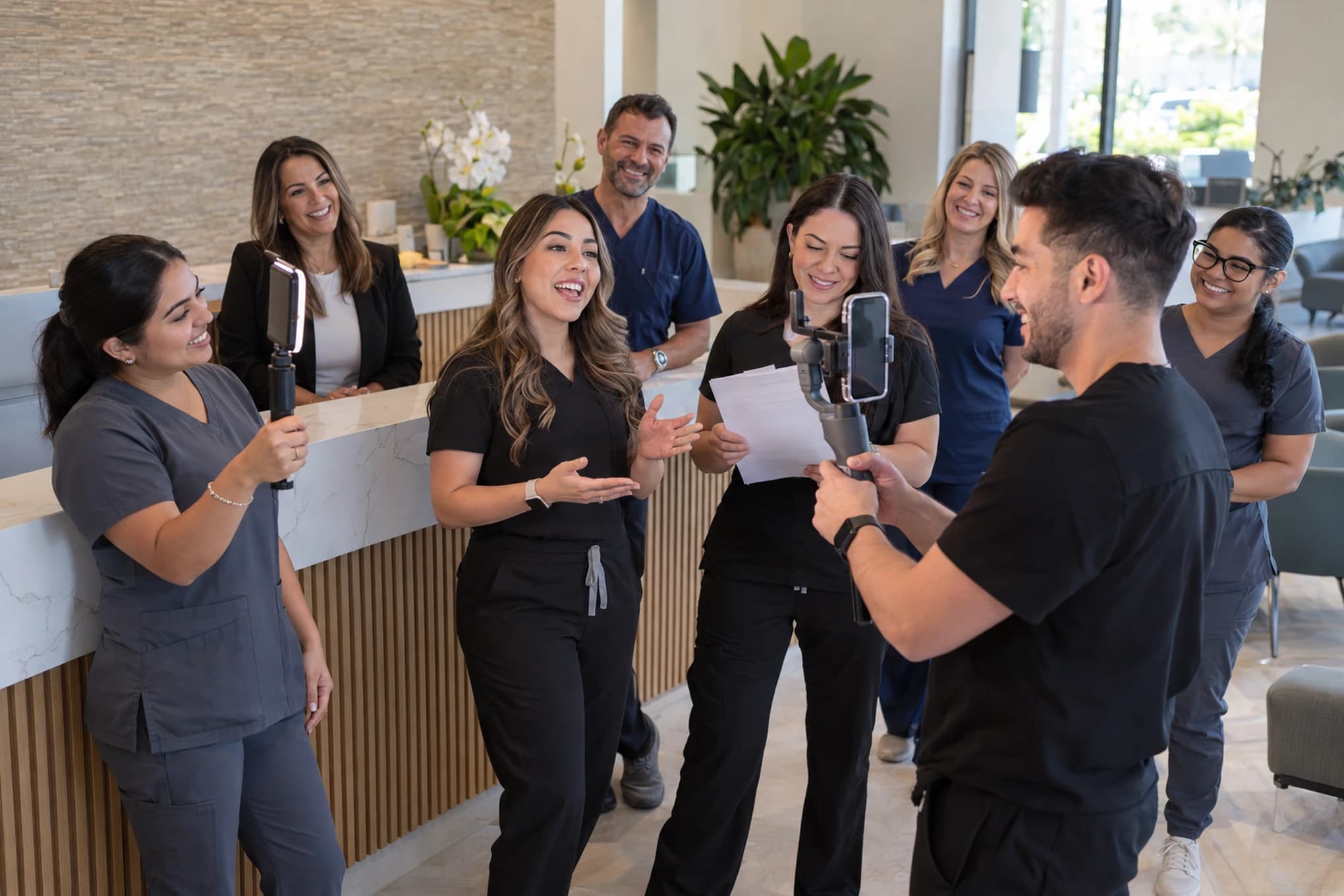
The video that works for a service business is rarely a commercial. It’s your front desk lead explaining what to bring to a first visit, your site supervisor showing how you protect a house before demo day, your agent spending one minute on what a policy covers and what it doesn’t. Real people from your team, in your space, answering what customers want to know. If you want a simple way in, here’s how to get started with video in Miami.
4. Reviews: recent, answered and on more than one site
Having 300 reviews from four years ago doesn’t cut it anymore. People check the dates, and AI tools read those reviews too when they decide who to recommend. What’s worth building for 2027 is a routine: ask for the review the same day you deliver the service, with a direct link, and reply to each one with something specific to that customer. BrightLocal found that generic or templated replies turn off half of consumers, so pasting “Thanks for your review!” a hundred times works against you.
Ready to apply this to your business?
5. Truly bilingual, from first ad to final invoice
The U.S. Hispanic population reached 70.1 million as of July 1, 2025, or 21% of the country, according to the Census Bureau (Census Bureau, 2026). And based on 2024 American Community Survey data, about 44.9 million people age 5 and older speak Spanish at home (USAFacts, using Census data, 2024).
In South Florida, plenty of businesses already have someone at the front desk who speaks Spanish. The gap is usually everywhere else: an English-only website, intake forms only in English, appointment reminders in a language the customer never picked. For 2027, it’s worth walking through every step, from the ad to the invoice, so a customer can get all the way through in the language they’re comfortable with. And the Spanish should sound like someone local wrote it, not like it went through a translation app.
6. Automation and AI inside the office
In the Federal Reserve’s Small Business Credit Survey, fielded from September to November 2025, 46% of employer firms said they already use AI, and another 15% planned to start within 12 months. The most common use was writing or marketing (83%), and 71% of firms using it said it boosted productivity (Federal Reserve Banks, 2026).
In a service business, you feel it most in follow-up. The lead who filled out a form at 9 p.m. on a Friday and didn’t hear back until Tuesday. The estimate that went out and never got a second touch. A well-built CRM replies in minutes, sends the appointment reminder, asks for the review and flags anyone who’s gone days without an answer. If you’re shopping for one, here’s what a CRM for a Hispanic-owned business should include.
7. Privacy and permission over volume
The more you automate, the more customer data you handle. Marketing texts, automated calls and forms that collect personal information all fall under federal and Florida rules, and healthcare adds HIPAA on top. The practical move for 2027 is to ask for consent clearly on every form, keep a record of when and how each person gave it, and make opting out as easy as opting in.
There’s an upside, too. A contact list of people who agreed to hear from you responds better than a purchased one, and it leaves you less exposed to a complaint. If you use AI tools, check what data you’re feeding them and where it’s stored before you paste in a patient’s or client’s information.

| Trend | What most businesses do today | What to have in place for 2027 |
|---|---|---|
| AI recommendations | No idea what ChatGPT says about them | Consistent info everywhere and pages that answer specific questions |
| Zero-click search | Track website visits only | Also track calls, directions and messages that come from Google |
| Short video | Post whenever they remember | One or two videos a week featuring the team |
| Reviews | Ask once in a while | Ask the day of service and reply to every one |
| Bilingual | Spanish at the front desk, English everywhere else | Website, forms, messages and invoices in both languages |
| Automation | Follow-up by hand and by memory | A CRM that replies, reminds and flags |
| Privacy | Consent not recorded | Clear consent, saved and easy to withdraw |
Where to start
- This week: ask two AI tools about your type of business in your city, and Google your own name. Write down what shows up and what’s missing.
- This month: start requesting reviews the same day you deliver the service, and reply to every review from the last 90 days, one by one.
- This quarter: film four short videos with your team answering the four questions you hear most, in English and in Spanish.
Taken all at once, that’s a lot for someone who also has to serve customers, make payroll and put out fires. That’s why at Brito we run it all as one connected system: marketing, video we shoot ourselves, BritoCRM and AI all pulling toward the same goal, which is sales, in English and in Spanish. We’ve been doing it from Miami since 2006. In Miami-Dade and Broward we come to your business; if you’re farther away, we meet by phone or video call. If you’d like to know which of these seven is your weakest spot, you can request a free assessment and we’ll go over it with you, no strings attached.
Frequently asked questions
Do I have to be on TikTok in 2027?
Not necessarily. Pew puts TikTok use at 37% of U.S. adults, compared with 84% for YouTube and half for Instagram. Start where your customers already are, and post the same short video on two or three platforms.
Is AI going to replace my receptionist?
The better use is taking the repetitive work off her plate: confirming appointments, answering after hours and reminding people about follow-ups. That frees your receptionist for what AI does worst, which is calming a worried customer and getting the appointment booked.
If people click less, is a website still worth it?
Yes. Your website is one of the sources Google and AI tools read when they summarize and recommend. What changes is how you measure it: besides visits, count the calls, direction requests and messages that come from search.
I’m short on time. Which trend should I tackle first?
Reviews. Asking the same day and replying takes a few minutes, and it helps with Google, with AI tools and with the customer comparing you to someone else, all at once. After that, set up automatic lead follow-up.
Twenty years building brands in New York, Las Vegas and Miami, where he's based today. He leads a Miami team that shoots commercials on cinema cameras and runs proprietary AI infrastructure. He believes great marketing starts with truly understanding the customer — and that honesty, often frowned upon in this industry, is what separates partners from vendors.
View profile→Questions about your business?
The first conversation is an assessment, not a sales pitch. Let's talk.
Or explore our Growth & Strategy service

Brito Marketing: More Than an Agency, a Complete System for Your Business
Hiring Brito Marketing gets you strategy, advice, mentorship, tailored ads and every service in one place, with a team that knows your business inside out.
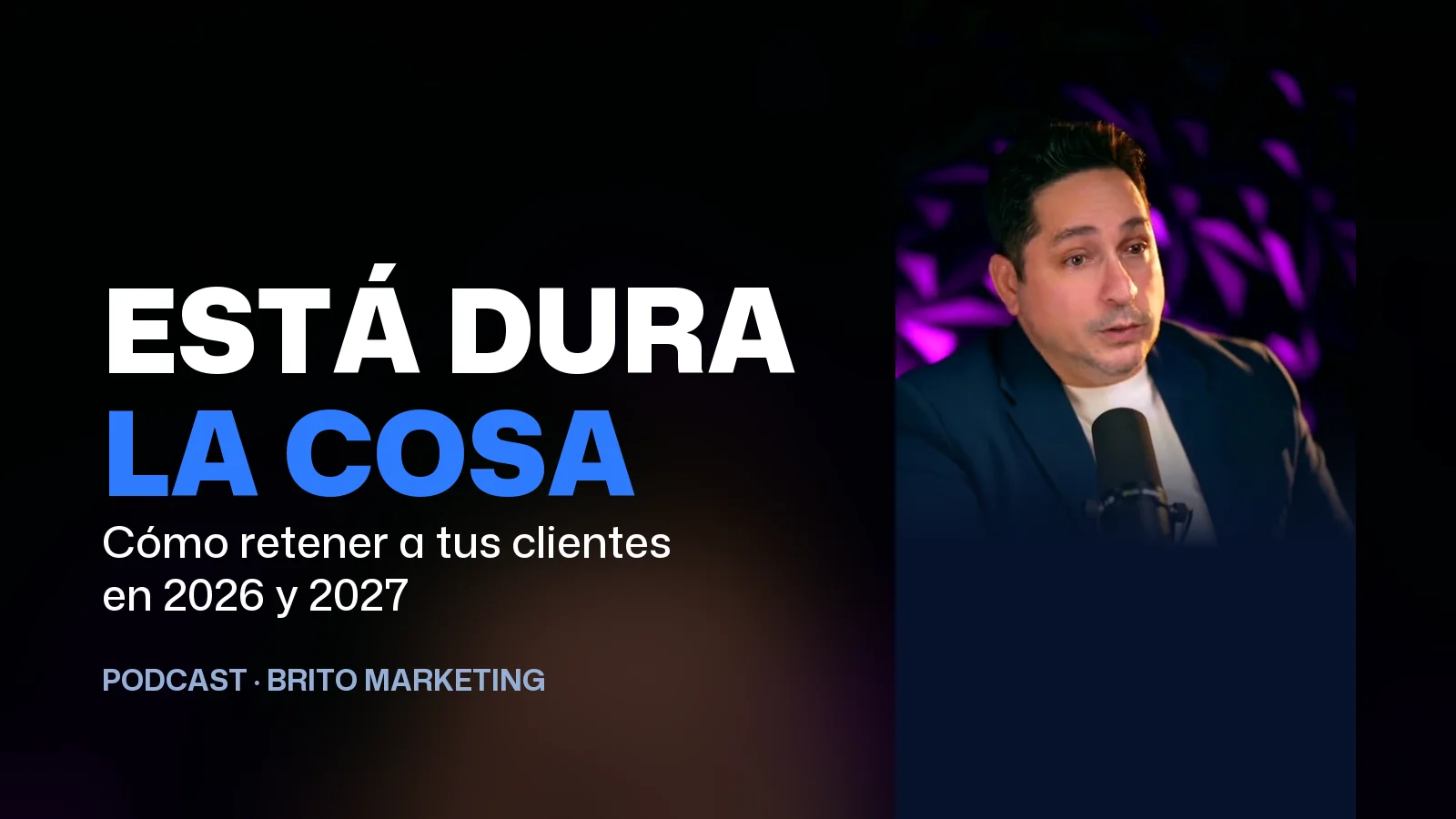
Fewer New Customers in Miami? How to Keep the Ones You Have With Service and Loyalty
Foot traffic is down and new customers are scarce. In a tough economy, what decides whether a customer stays isn't a $10 discount: it's how you treat them. Four fronts for 2026 and 2027, from our video podcast.