
Local SEO: How to Show Up First When People Search Your Business in Miami
When someone searches “near me”, showing up first is everything. Local SEO makes your business the first choice in your area of Miami.
Short answer
Local SEO is the set of signals telling Google your business is relevant, nearby and trustworthy for searchers in your area. The levers that move the needle most: your Google Business profile, real reviews, consistent NAP, honest local content and a fast site. In Miami, showing up in both Spanish and English doubles your opportunity.
The local customer doesn't search “the best restaurant in the world”. They search “the best restaurant near me”. And when they do, Google shows a handful of businesses — the ones that worked their local presence best. Being there is the difference between you getting found and your competitor two blocks away getting found instead.
What local SEO really is
It's the set of signals that tell Google your business is relevant, close and trustworthy to whoever searches in your area. It's not magic or tricks: it's a well-built Google profile, real reviews, consistent information, and a site that loads fast and Google understands.
The levers that move the needle most
- Your Google Business profile: complete, with the right category, real photos and up-to-date hours.
- Reviews: quantity, quality, and whether you respond. A review with a reply counts double.
- Consistent NAP: name, address and phone identical everywhere — your site, Google, directories.
- Local content: pages that talk about your service in your area, with genuinely useful information, not filler.
- A fast, semantic site: if it loads slow or Google can't read it, everything else loses strength.
The bilingual edge
Miami searches in English and in Spanish, and each language carries nuance that a one-language team will miss. “Abogado de inmigración” and “immigration lawyer” bring different audiences, and showing up well in both languages doubles your surface of opportunity. That fluency isn't improvised; it's built.
How long it takes
Serious SEO takes months, not days. To be honest, the first movement shows up between eight and twelve weeks in, and it grows from there. No serious agency guarantees the top spot overnight — what we guarantee is real, measurable and honest work, and we show you progress with data.
If you want to know where your business stands today in your area's local searches, we'll run an audit and tell you exactly what you need to climb.
How Google picks those three on the map
Google boils it down to three things: relevance (how well you match what they searched), distance (how close you are to whoever's searching), and prominence (how well-known and trusted you are, online and off). Distance you can't move — a shop in Homestead won't rank first for someone standing in Aventura. But relevance and prominence you can. A barber in Westchester swore his competitor «paid to rank first». He paid nothing: right category, a pile of replied-to reviews, fresh photos every week. That's prominence, and it's built.
Your Google profile, from the inside
Almost everyone claims the profile, uploads a logo, and walks away. Google rewards the opposite — a living profile. These are the parts almost nobody uses that actually move the needle:
- Primary category: the most specific one that describes you, not the broadest. «Cuban restaurant» carries different weight than «restaurant»; secondary categories cover the rest of what you offer.
- Real, fresh photos: your space, your team, your finished work. Stock photography fools no one, least of all a Miami customer.
- Services: write them all out, with the real name of each in Spanish and English, the way people search.
- Questions and answers: anyone can ask on your profile; get ahead of it and answer the usual ones yourself, honestly and without making things up.
- Posts: Google lets you post updates, like on a social feed. A bit of news, a real promo, holiday hours. It tells Google the business is alive.
- Attributes and language: check the ones that apply and make it crystal clear you serve customers in Spanish. In Miami that's not a detail, it's a reason to call.
NAP: the boring detail that sinks half of Miami
Name, address, phone. Sounds trivial, but it's where the most businesses lose points without knowing it. You moved and the old address still sits in twenty directories. One site says «Ste 200», another «Suite 200». You changed the phone on Google and the old one's still on Yelp. Every contradiction is a doubt you plant in Google — and in the AI, which reads the same thing. When they doubt, they don't put you first. So fixing it on Google isn't enough: same name, same address, same phone, identical down to the comma, on Google, Apple Maps, Yelp, Facebook, Bing and your industry's directories. It's boring, which is why almost nobody does it right — exactly why it pays off for you to.

Ready to apply this to your business?
The review engine: earning them without buying them
Reviews are among the heaviest factors, but how you get them can land you in trouble. Google bans paying for reviews, giving anything in exchange, or asking only your happy customers while filtering out the rest — that's called review gating, and it's banned too. It's not just ethics: if they catch it, Google removes them or penalizes the profile. The good news: the right way is also the simplest:
- Ask when they're happiest: right when the customer is pleased, not three weeks later.
- Make it easy: send the direct review link, don't make them hunt for it.
- Ask in their language: if a customer talked to you in Spanish, ask in Spanish — a Spanish review also helps you get found in Spanish.
- Reply to all of them, good and bad: a calm reply to a complaint says more about you than ten stars.
- Never pay or give anything for reviews, and never ask only the happy ones: it's against the rules and it shows.
Local content by neighborhood, without the filler
If you genuinely serve several areas — Doral, Kendall, Brickell — an honest page per area helps, as long as it says something real: where you are, how to get there, what you handle there. And since your customer searches in both languages, that page wins by living in Spanish and English, written for each, not rush-translated. What Google punishes is cloning the same page twenty times, just swapping the neighborhood. That's not local content, it's filler, and you can spot it a mile away. One good page for your area beats twenty empty ones.
Two languages, two searches: how to work each one
Writing each page for its own language starts earlier: with the words people actually type. Your customer doesn't search in Spanish for a word-for-word translation of what they'd search in English. Sometimes they use the name the service goes by back home; sometimes they mix both languages in the same search. That's why at Brito we research each language's searches separately, based on how your customers really talk, rather than translating the English list. And each version is written by someone who thinks in that language: machine translation shows in the tone, and your customer picks up on it before Google does.
Then comes the part nobody sees, and it's what decides whether Google shows searchers the page in the right language:
- Hreflang tags that go both ways: the Spanish page points to its English counterpart, and the English page points back. If the signal only runs one way, Google may ignore it.
- A default version, the x-default tag, for people searching in a language that's neither of the two.
- Each version declares itself canonical, with its own tag. If your Spanish page names the English one as canonical, Google treats it as a copy and may leave it out.
- If you redirect visitors based on their browser language, do it only for people, never for Google's crawler, and always keep a visible language switcher. Google needs to reach every version, and your customer needs to be able to pick theirs.
The technical basics and the signals from your area
The technical foundation, demystified
Even the most carefully built profile can't make up for a site Google can't read. Have someone check these:
- The site works fully on a phone — not just shrunk down to fit the screen.
- It loads fast and doesn't jump around while it loads; Google measures this with its Core Web Vitals.
- An XML sitemap submitted to Google Search Console, and a robots.txt file that isn't accidentally blocking the pages you want found.
- One main heading per page, a unique title and description on every page, alt text that describes each image, and the entire site on HTTPS.
- LocalBusiness structured data with the name, address, phone number and hours from your profile, plus your service area and links to your other profiles: it's your NAP written for machines, and it has to match letter for letter.
Directories and local signals
Two things are almost always missing. First, your name: your profile should carry your business's real name — the one on your sign and your paperwork — with no keywords tacked on, like “cheap plumber Miami”; Google doesn't allow it and can suspend the profile. Second, your community directories: the chamber of commerce, your professional association, your neighborhood guides. They confirm you really exist in the area, and they need to carry identical details too.
You prove your area off your site, too. Write about what's happening in your neighborhood when it touches your service; shoot video in places your customers recognize; team up with neighboring businesses that complement yours, like a painter and a remodeling contractor, so you mention and link to each other naturally. When you write about rules or paperwork, cite the official source (the county, the state, or the board that licenses your trade) and put your name on it. That builds more authority than a bought link, which breaks Google's rules anyway.

The most common mistakes — and how to fix them this week
- Wrong or too-generic category: go into your profile and pick the most specific one that fits. It's the five-minute fix with the biggest impact.
- Stock photos: delete them and upload ten real photos of your own — space, team, finished work.
- NAP out of sync after a move or a new number: check Google, Apple Maps, Yelp and Facebook, and make them identical.
- Bought reviews, or reviews asked only of happy clients: stop, and do it right — ask your real customers, in their language, and reply to all.
- Zero pages for your area, or twenty cloned ones: write a single honest page for the area where you actually work.
- You've never searched yourself: look yourself up today on Google Maps and ask ChatGPT for «the best [your trade] in [your neighborhood]», in Spanish and English. That's your honest starting point.
If you'd rather have someone handle it for you, see how our Miami SEO company works on your profile, your reviews and your website, in English and Spanish.
Frequently asked questions
How much does local SEO cost?
It depends a lot on your competition, how aggressive you want to be, and whether you do it yourself or hire it out. Claiming your profile and cleaning up your NAP consistency you can start yourself for free; the ongoing work — reviews, content, and directories in both languages — is usually where it pays to invest. In an audit we tell you what your specific case needs before we talk numbers.
Can I show up on the map if I work from home or don't have a storefront?
Yes. Google lets you hide your address and set a "service area" — the parts of Miami you actually cover. You need a real address to get verified, but it doesn't have to be public or a walk-in spot. Everything else — reviews, the right category, and consistency — works the same.
What do I do about a fake or negative review?
You can report to Google the ones that break its rules — fake, from someone who was never your customer, or abusive — and it sometimes removes them, though not always. For a real negative review, the best move is to reply calmly and in public: whoever reads it later judges how you responded more than the complaint itself. Never argue or offer something to get it taken down.
Do I need my website in both Spanish and English to show up in both languages?
If you serve customers in both languages, yes. Google tries to show people pages in the language they searched in: your profile and reviews help, but the page that answers a Spanish search has to exist in Spanish. You don't need a separate website. One version of each page per language on the same domain is enough, linked to each other with hreflang and written by someone who thinks in that language, not run through a machine translator.
Twenty years building brands in New York, Las Vegas and Miami, where he's based today. He leads a Miami team that shoots commercials on cinema cameras and runs proprietary AI infrastructure. He believes great marketing starts with truly understanding the customer — and that honesty, often frowned upon in this industry, is what separates partners from vendors.
View profile→Questions about your business?
The first conversation is an assessment, not a sales pitch. Let's talk.
Or explore our Search + AI (SEO & AEO) service
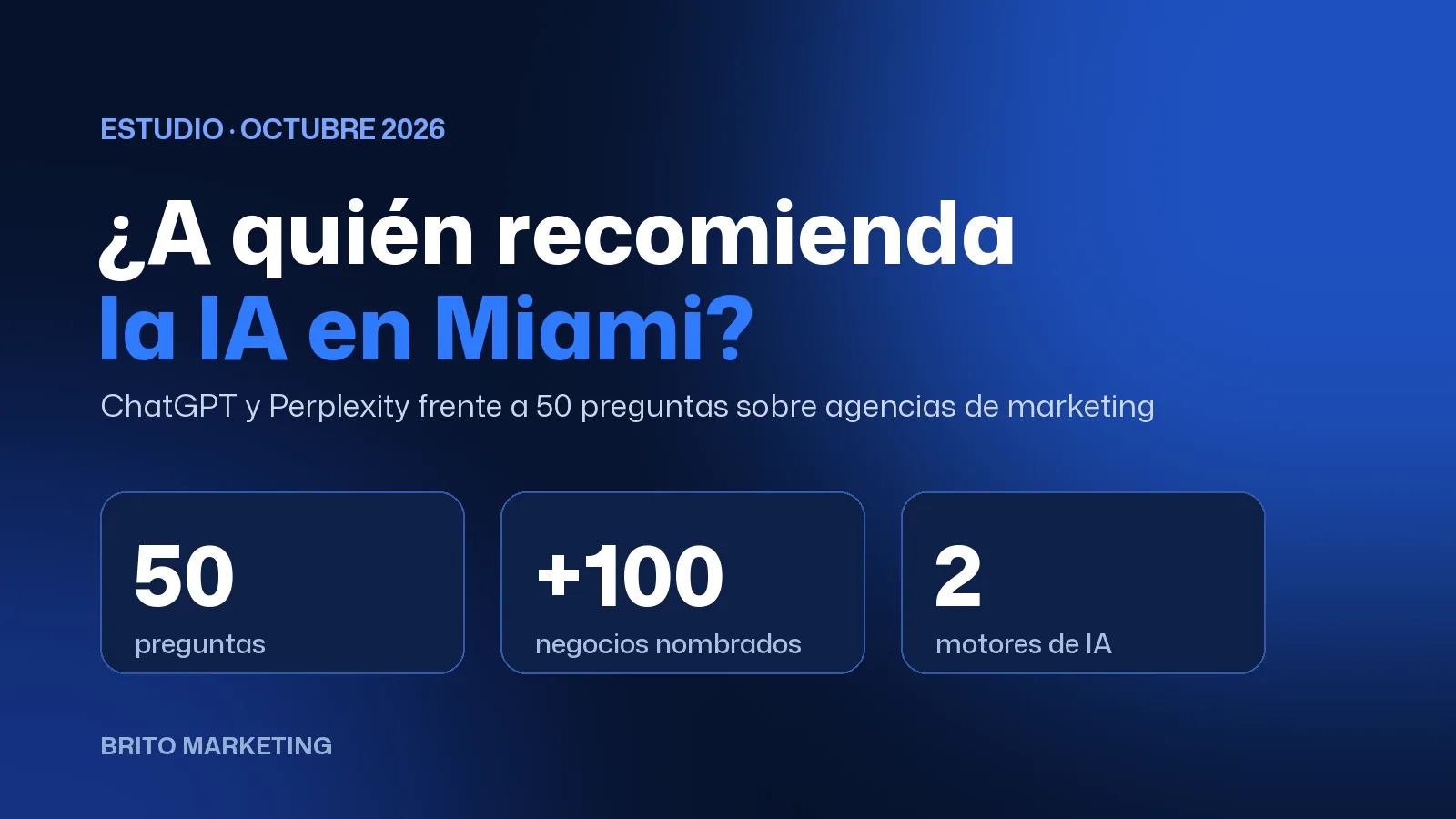
Study: Who ChatGPT and Perplexity Recommend When You Look for a Marketing Agency in Miami (October 2026)
We asked ChatGPT and Perplexity the same 50 questions, in English and Spanish. The AI named more than 100 different businesses, none in more than 4 answers, and for city searches it almost always picked someone from that city. Data, method and limits.

AI Marketing Without Losing the Human Voice
AI speeds up almost everything in marketing. But there's one thing it does badly, and your customers notice instantly.