Why Your Google Reviews Decide Whether AI Recommends You
AI can’t try your service, but it can read what your customers say about it. What it looks at in your reviews (how many, how recent, what they say and how you reply), where else people review you and what’s off-limits.
Short answer
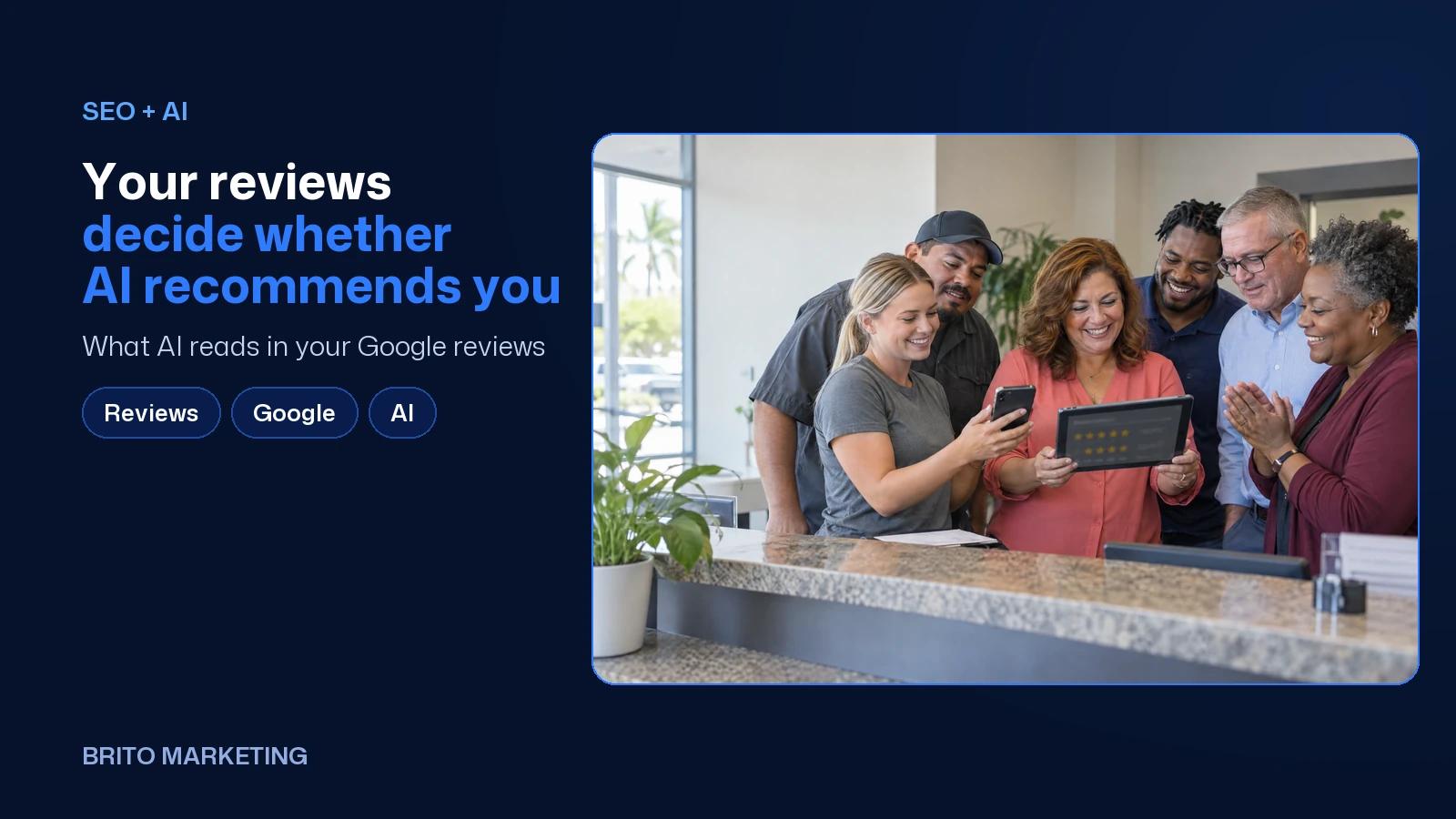
Because they’re one of the few things AI can read about you that you didn’t write yourself. Google factors in your reviews when it ranks the map, AI tools read your rating, your review count and what people say, and customers already read AI-generated review summaries. How many, how recent, what they say and how you reply all count.
Put yourself in ChatGPT’s or Gemini’s shoes for a second. Someone asks for a reliable electrician in Pembroke Pines. It can’t call anyone or look at a finished job. All it has is what’s published: websites, which all claim to be the best, and reviews, which customers wrote. Between those two sources, it makes sense that it leans on the second. That’s why reviews stopped being just a reputation issue and became a visibility issue.
The voice you don’t control carries the most weight
Google says so in its own help pages. Local results are ranked by relevance, distance and prominence, and prominence depends partly on how many reviews you have. “More reviews and positive ratings can help your business’s local ranking,” and there’s no way to pay your way up (Google Business Profile Help). AI tools cross-check that same information.
We saw it up close in October 2026, when we asked ChatGPT and Perplexity 50 questions about marketing agencies in Miami. ChatGPT often leaned on Google Maps listings, pulling the listing name, its rating and its review count, and the businesses recommended most often had plenty of reviews. It’s all in the full study.

1. How many you have and how recent they are
Volume matters, but dates matter just as much. According to BrightLocal, 74% of consumers look for reviews from the last three months, and 32% focus on the last two weeks. A business with 150 reviews and nothing new in a year sends a weaker signal than one with 60 that gets four a month. AI reads dates the same way a person does, so there’s no reason to expect it to see things differently.
The fix is a daily habit: ask every customer for a review on the day of service, with a direct link. If you’ve never done it or it feels awkward, here’s how to ask for reviews without making it weird.
2. What they say: the words count more than the stars
Five stars and no text tells AI that someone was happy. “They replaced my water heater in Miramar the same day, and the tech walked me through everything in Spanish” tells it what you do, where, how fast and in which language. That’s the kind of review that ties your business to specific questions like “Spanish-speaking technician in Miramar.”
You can’t write the review for your customer or ask them to say something nice. What you can do is make it easy for them to tell their story. In your message, remind them which service they got and say you’d appreciate hearing how it went, in their own words and in whichever language they prefer.
Ready to apply this to your business?
3. How you reply gets read too
Your replies are public, and they become part of what’s published about you. BrightLocal found 89% of consumers expect owners to respond, and half are put off by generic or templated replies. A good reply is short, uses the person’s name, mentions what you did in a natural way and, if the review is negative, owns the problem and offers to sort it out privately.
- Reply in the language the review was written in.
- Never share a customer’s private details in a reply. In healthcare, don’t even confirm the person is a patient. That counts as protected information too.
- Don’t paste the same line into every reply. People notice, and it cheapens all of your responses.
4. Google isn’t the only place people review you
Google is still the most-used site, but its share has slipped: 71% of consumers read reviews there, down from 83% a year earlier. Apple Maps nearly doubled, from 14% to 27%, and the average consumer checks six review sites (BrightLocal, 2026). AI tools read those other sources too. Check your profiles on Apple Maps, Yelp, Facebook and your industry’s own platforms, and make sure your details match on all of them.

What you can’t do
With this much riding on reviews, shortcuts are tempting. They’re not worth it. Google’s rules prohibit offering discounts, freebies or payment in exchange for reviews, and they also bar discouraging negative reviews or asking only the customers you think will leave good ones (Google content policy). And since August 2024, the FTC’s federal rule bans fake reviews, including AI-generated ones, buying reviews conditioned on being positive, and suppressing negative reviews through threats. The FTC can seek civil penalties against knowing violators (FTC, 2024).
| Signal | What the customer sees | What AI can read | What to do |
|---|---|---|---|
| Volume | Whether you look established | Whether there are enough opinions to trust | Ask every customer for a review |
| Recency | Whether you still do good work today | Whether the information is current | Ask on the day of service |
| Rating | Whether you meet their star minimum | Your rating next to your competitors’ | Fix problems before they turn into reviews |
| Text | Whether someone like them was happy | What you do, where and in which language | Remind customers which service they got |
| Replies | Whether you care what they say | How you treat your customers | Reply to every one with something specific |
| Other sites | Whether the good stuff holds up beyond Google | Whether several sources agree | Keep Apple Maps, Yelp and industry sites in shape |

Where to start
- This week: read your last 20 reviews and reply to any that haven’t been answered, one at a time and in the customer’s language.
- This month: write the message you’ll use to ask for a review on the day of service, with the direct link, and have the whole team send it to every customer.
- This quarter: check your profiles on Apple Maps, Yelp and your industry’s sites, then ask ChatGPT about your service in your city. If you don’t come up, go back to why ChatGPT won’t recommend your business.
Asking for and replying to reviews every day is exactly the kind of task that slips when things get busy. That’s why BritoCRM requests the review automatically after each service and keeps your reviews in the same place as your leads and appointments. At Brito we connect it to everything else: your website, video we shoot ourselves and AI, in English and in Spanish, from Miami since 2006. In Miami-Dade and Broward we come to your business; outside the area, we meet by phone or video call. If you’d like to see how your reviews stack up against your competitors today, you can request a free assessment, no strings attached.
Frequently asked questions
Can I delete a bad review?
You can’t delete it yourself. If it breaks Google’s policies (say it’s fake or from someone who was never a customer), you can report it from your profile. If it’s a genuine complaint, the best move is a good reply and fixing the problem.
Can I give a discount to customers who leave a review?
No. Google prohibits offering discounts, freebies or payment in exchange for reviews, and the FTC bans incentives tied to a positive review. Ask every customer, without offering anything in return.
How many reviews do I need before AI takes me seriously?
There’s no official number. As a reference point, BrightLocal found nearly half of consumers won’t use a business with fewer than 20 reviews. Rather than a fixed target, aim to get new reviews every month.
Does it help if my employees or family leave reviews?
No, and it can hurt you. Google treats it as a conflict of interest, and the FTC rule restricts reviews from officers and staff who don’t disclose their connection to the business. The only reviews worth having come from real customers.
Twenty years building brands in New York, Las Vegas and Miami, where he's based today. He leads a Miami team that shoots commercials on cinema cameras and runs proprietary AI infrastructure. He believes great marketing starts with truly understanding the customer — and that honesty, often frowned upon in this industry, is what separates partners from vendors.
View profile→Questions about your business?
The first conversation is an assessment, not a sales pitch. Let's talk.
Or explore our Search + AI (SEO & AEO) service
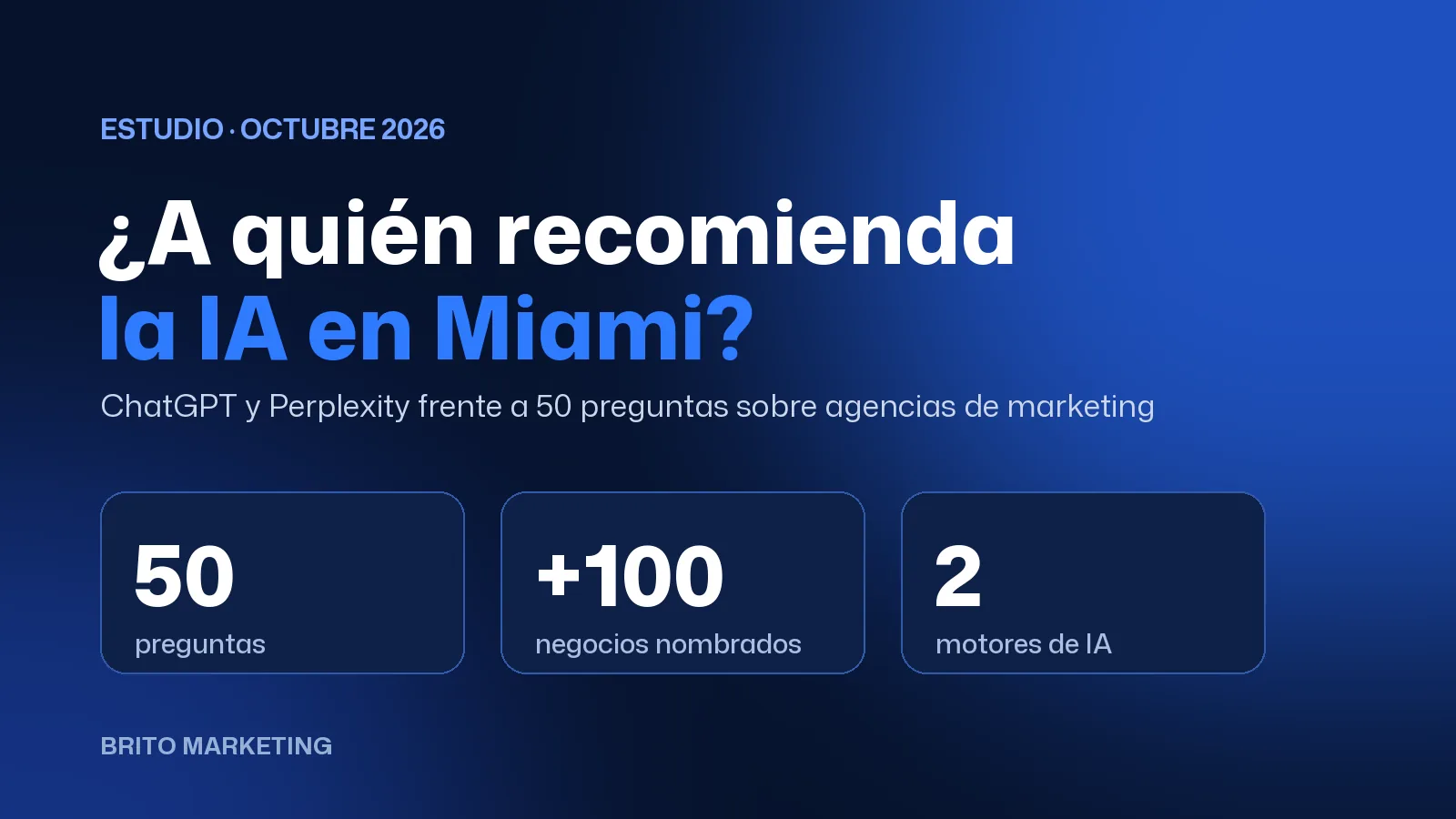
Study: Who ChatGPT and Perplexity Recommend When You Look for a Marketing Agency in Miami (October 2026)
We asked ChatGPT and Perplexity the same 50 questions, in English and Spanish. The AI named more than 100 different businesses, none in more than 4 answers, and for city searches it almost always picked someone from that city. Data, method and limits.

AI Marketing Without Losing the Human Voice
AI speeds up almost everything in marketing. But there's one thing it does badly, and your customers notice instantly.