Bilingual Marketing in 2027: Speak to Hispanic and American Customers Without Just Translating
Running your ad through a translator doesn’t make you bilingual. How to write each version for its own audience, let customers pick their language at every step and measure what works in each one.
Short answer
Bilingual marketing in 2027 means writing each version for the person reading it, not translating the same sentence twice. The facts, the offer and the brand stay identical in English and Spanish. What changes is the tone, the examples and sometimes the channel. And the customer picks the language at every step, from the ad to the invoice.
In Miami you see it every day: the English ad someone ran through a translation tool that came out in Spanish nobody actually speaks, or the Spanish website that stops at the homepage and drops you into an English-only form. Customers notice in about two seconds. And this isn’t a niche. The U.S. Hispanic population reached 70.1 million in 2025, or 21% of the country (Census Bureau, 2026).
Translating isn’t the same as talking to someone
A translation respects the words. Good copy respects the reader. Take “free estimate.” Translated literally into Spanish, it’s understandable, but a roofing company owner in Hialeah would put it more like “we’ll come out, look at your roof and tell you what it costs, no charge.” Same offer, said the way you’d say it at the kitchen table.
It cuts the other way too. Copy that started in Spanish and got translated into English tends to run long and stiff, full of phrasing no American would write. That’s why each version should be written by someone who thinks in that language, with the other person checking only that the facts match: prices if you publish them, hours, terms and anything you’re not allowed to promise.
- Decide once whether your brand uses the casual “tú” or the formal “usted” in Spanish, and stick with it on the website, in ads, in chat and on the phone.
- List the words in your industry the way your customers actually say them (in Spanish, “aseguranza” versus “seguro,” for example) and choose deliberately, not by dictionary.
- Have someone on your team read every Spanish piece out loud. If it sounds off spoken, it’s written wrong.

Not every Hispanic customer wants Spanish
This is the mistake on the other side. Pew found that 75% of Latinos can hold a conversation in Spanish well, but among third-generation-or-later Latinos, only 34% say they can (Pew Research Center, 2023). The son of Cuban parents who grew up in Kendall may want his appointment email in English, even if he speaks Spanish with his mom.
The fix is simple: don’t guess, ask. Put a clear language switch on your website, add one question to your form (“Which language should we use to contact you?”) and save the answer in a field in your CRM. From then on, every reminder, invoice and survey goes out in the language that person chose.
Same facts, different case
What you sell doesn’t change, but what matters most to each customer might. The best source here is your own staff. Your front desk knows what Spanish-speaking callers ask first and what English-speaking callers ask first. Have them jot it down for two weeks, then build each version around those real questions instead of assumptions about “the Hispanic customer.”
And don’t treat Hispanic as one country. South Florida is home to Cubans, Venezuelans, Colombians, Nicaraguans, Puerto Ricans and many more, each with their own vocabulary. A neutral, friendly Spanish works for almost everyone. Inside jokes and very local slang only work when you know exactly who you’re talking to. For the brand side of this, see our piece on bilingual branding that keeps your identity intact.
Video and social: shoot it twice
Pew puts Instagram use at 62% of Hispanic adults, compared with half of all U.S. adults (Pew Research Center, 2025). In that feed, a dubbed video or one with translated captions feels second-rate. If you have people on your team who are natural in each language, have each one record their own version. They don’t need to say the same thing word for word. They just need to answer the same question.
The language has to hold up the whole way
The Spanish ad is the easy part. The hard part is everything after it: the landing page, the form, the auto-reply, the WhatsApp message, the phone call, the reminder, the invoice and the review request. If a single step slips into English when the customer didn’t ask for it, you break the trust the ad just built. For the fast-reply piece, see how to answer WhatsApp in minutes. For email, there’s our bilingual email marketing guide.
| Step | Translated only | Built for each customer |
|---|---|---|
| Ad | The same line run through a translator | Two pieces of copy written by people who think in each language |
| Website | Spanish homepage, English everywhere else | Every page in both languages, each with its own URL |
| Form | English only | Asks for the preferred language and saves it |
| Phone and chat | Depends on who picks up | Language choice from the first message |
| Reminders and invoices | Whatever language the system defaults to | The language the customer chose |
| Reviews | Every reply in English | Reply in the language the review was written in |
| Tracking | One number for everything | Leads, appointments and sales split by language |
Track each language separately
Lump everything into one number and you’ll never know whether your Spanish is working. Split campaigns by language, tag every lead with the language it came in on and look separately at how many turn into appointments and sales. Sometimes the surprise is that the Spanish ad gets fewer clicks but more sales, because almost no one else is speaking to that customer well.

Where to start
- Walk through your own business in Spanish: search on Google, open the website, fill out the form and call. Note the step where the language switched on you.
- Add a preferred-language question to your form and save it in your CRM.
- Ask someone on your team who thinks in Spanish to rewrite (not translate) your three most-viewed pieces of copy.
Doing it right in two languages is close to double the work, which is why so many businesses stop at translation. At Brito we’ve done it from Miami since 2006, writing each version separately in English and in Spanish, with marketing, video we shoot ourselves, BritoCRM and AI all connected to sales. If you want to find the step where your language is slipping, request a free assessment and we’ll go through it with you, no strings attached.
Frequently asked questions
Can I use machine translation for my Spanish website?
As a first draft, yes; as the final copy, no. Someone who thinks in Spanish needs to rewrite it and check the facts, because customers spot tone and terminology mistakes right away.
Do I need two Instagram accounts, one per language?
Rarely. For most local businesses, one account that alternates English and Spanish posts works fine. What doesn’t work well is cramming both languages into one long caption.
Should my Spanish copy use “tú” or “usted”?
It depends on your brand and your customers; both can work. What matters is picking one and using it consistently on the website, in chat, in email and on the phone.
How do I know if my Spanish marketing is working?
Split your campaigns by language and record each lead’s language in your CRM. That lets you compare leads, appointments and sales in each language instead of looking only at clicks.
Twenty years building brands in New York, Las Vegas and Miami, where he's based today. He leads a Miami team that shoots commercials on cinema cameras and runs proprietary AI infrastructure. He believes great marketing starts with truly understanding the customer — and that honesty, often frowned upon in this industry, is what separates partners from vendors.
View profile→Questions about your business?
The first conversation is an assessment, not a sales pitch. Let's talk.
Or explore our AI Advertising service
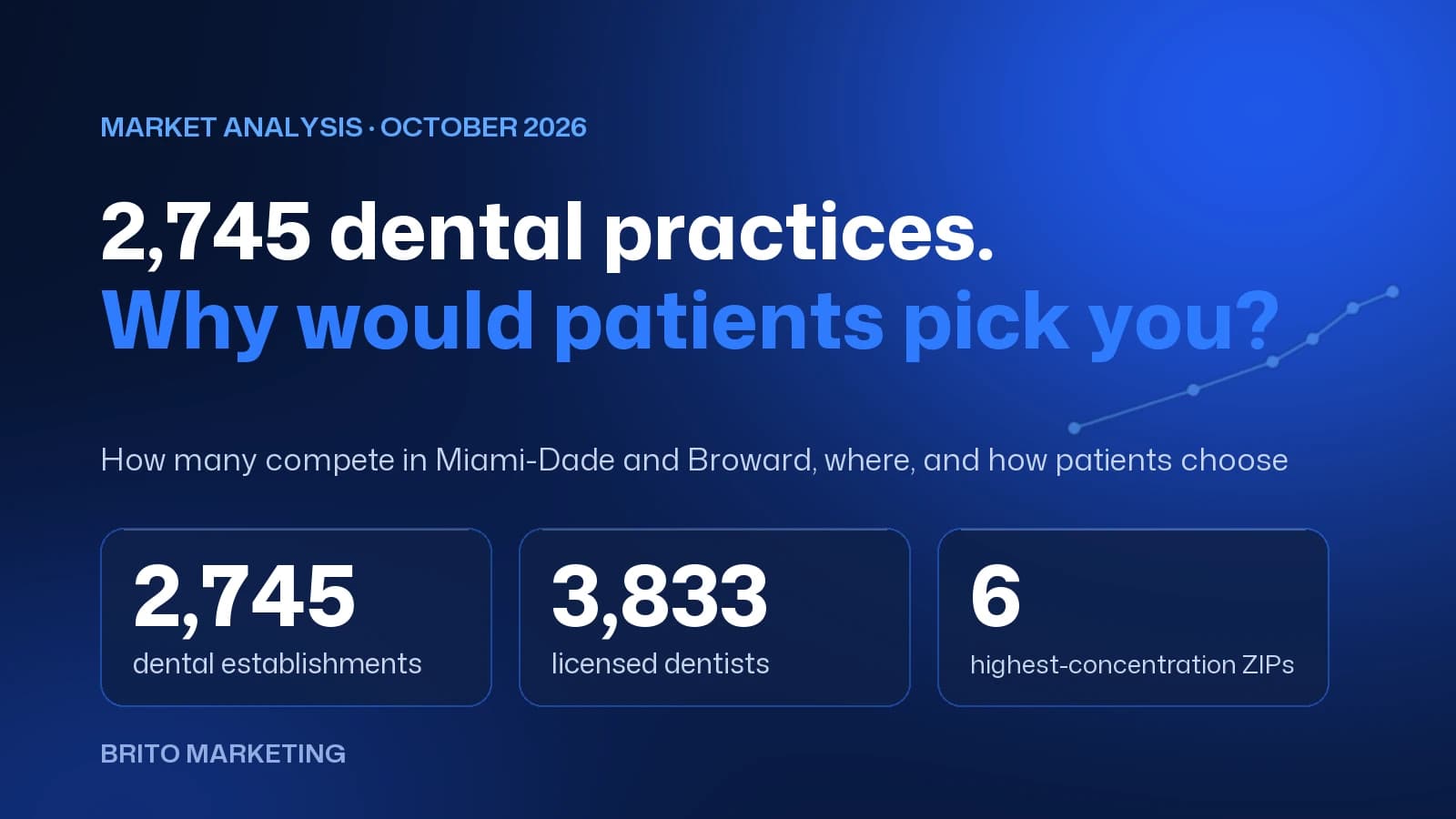
2,745 Dental Practices Compete in Miami-Dade and Broward: Why Would a Patient Choose Yours?
We measured the dental market in Miami-Dade and Broward with federal and state data: how many practices compete, which ZIP codes they cluster in and how patients choose today. There's no shortage of options, only of clear reasons to pick one.

Florida Lawyer Advertising Rules: What The Florida Bar Requires and How to Comply
What The Florida Bar's Rule 4-7 requires in a law firm's ads: name and city, language, testimonials, "expert" claims, actors, and filing with the Bar 20 days ahead. Every rule, with its number and source.