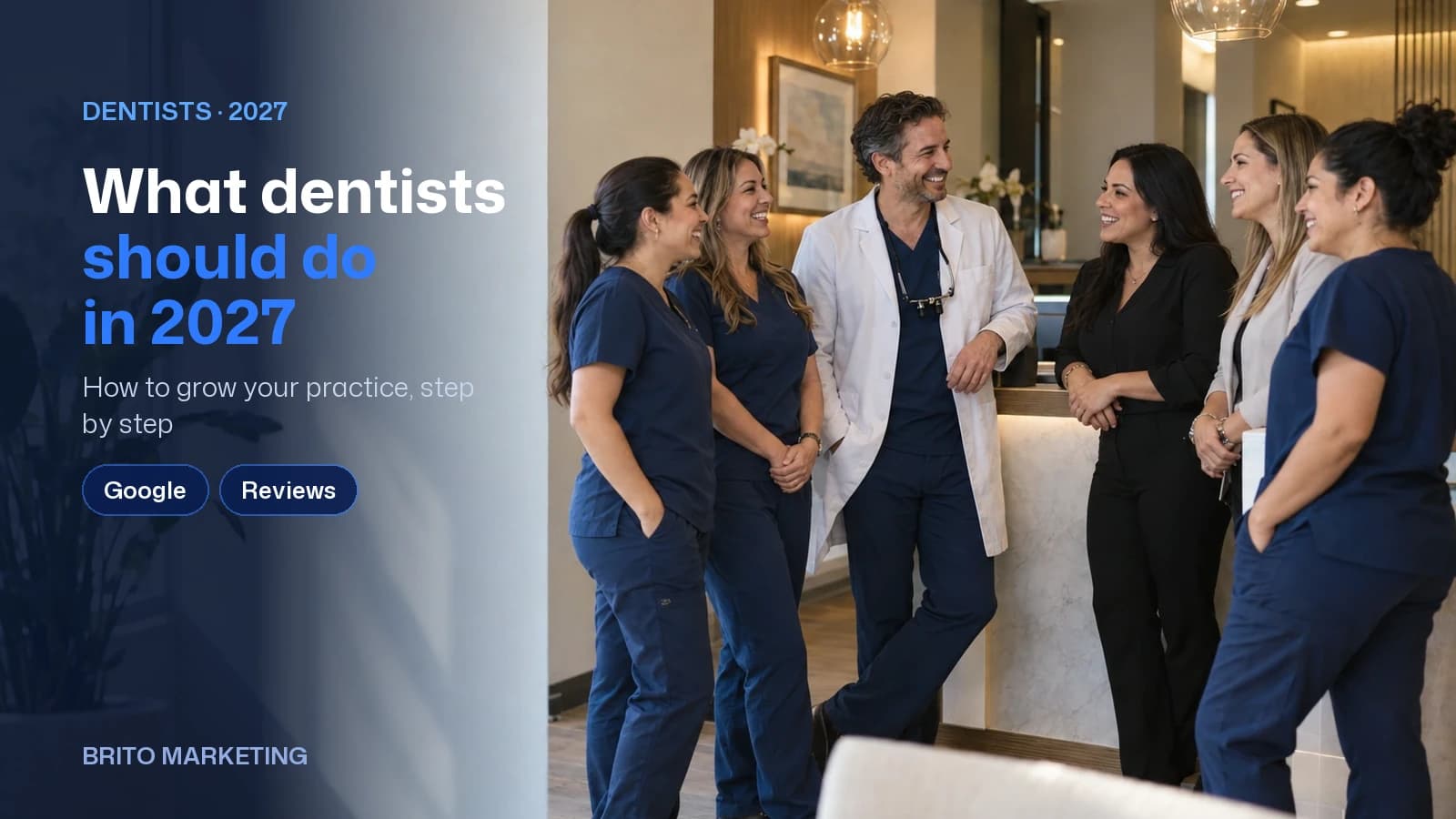
What Dentists Should Do in 2027 to Grow Their Practice
Google and AI search, video, fresh reviews, follow-up on every new patient, a full schedule, a HIPAA-compliant CRM and AI used the right way: what a dental practice should work on in 2027.
Short answer
In 2027, a dental practice grows when patients can find it on Google and in AI tools, when its reviews are recent, when every new patient gets a reply within minutes and real follow-up, and when its scheduling, CRM and AI work together and stay HIPAA compliant. In English and Spanish, without claims Florida law prohibits.
Dental practices in South Florida head into 2027 squeezed from two sides. On one side, costs and insurance: according to the ADA, a third of dentists say they don't have enough patients, and more than a third plan to drop some dental insurance networks in 2026. On the other, patients search differently now. They read recent reviews, watch videos, and more and more of them ask ChatGPT which dentist to see. Here's what's worth working on, one area at a time.
Marketing and visibility: Google and AI search
Your Google Business Profile is still the front door for almost every new patient, and in 2027 it deserves the same attention as your front desk. The right categories, real hours (holidays included), current photos of your team and office, a description for every service, and answers to the questions patients actually ask. If your team speaks Spanish, say so on the profile and on the website.
What's new is AI search. BrightLocal found that 45% of consumers now use ChatGPT or other AI tools to get local business recommendations, up from 6% the year before. Those tools read your website, your reviews and what other sites say about you. A site with a page for each treatment, explaining in plain language what it is, who it's for, what the visit looks like and which insurance you take, makes their job easy.
- Make sure your name, address and phone number match exactly on Google, your website, Yelp, Facebook and insurance directories.
- Build a page for each treatment (cleanings, implants, orthodontics, emergencies) in English and Spanish.
- Add an FAQ section built from the real questions your front desk gets on the phone.
- Ask ChatGPT, Gemini and Perplexity for a dentist in your area and note whether you show up and what they say about you.
All of this has to stay within the law. In Florida, every ad has to identify the dentist responsible, can't praise them or compare them with other practices, and can only use the word “specialist” with the credential to back it up. We walk through each rule, with citations, in our guide to Florida dental advertising rules.
Social media and video
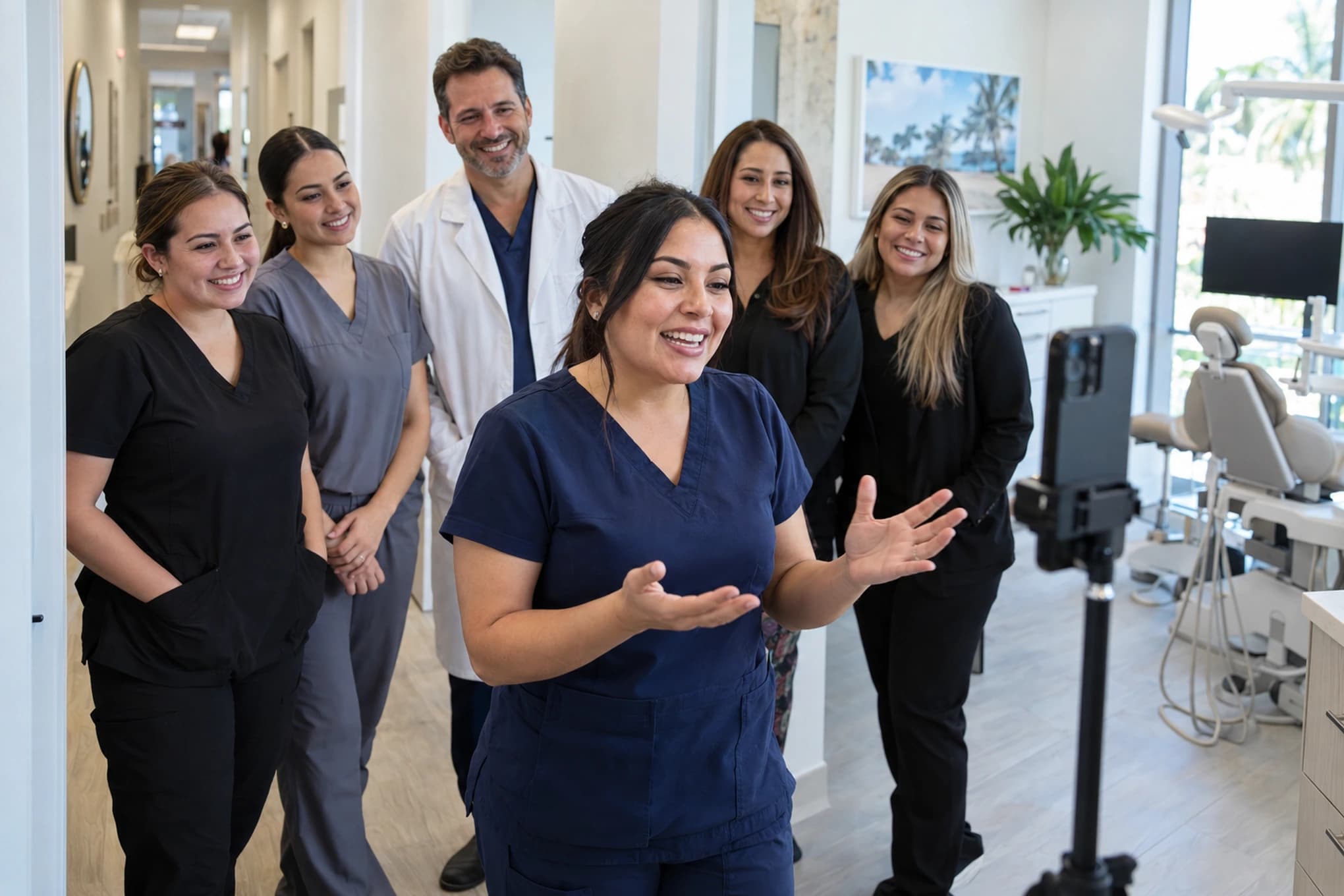
An ad won't win over a patient who's nervous about the dentist. Seeing the face of the person who'll treat them will. A 30-second clip of your hygienist explaining what happens at a first cleaning, or the dentist answering a common question, builds more trust than ten posts with stock photos. And that one video works on Instagram, TikTok, YouTube Shorts, your Google profile and your website.
- Record one common question a week, in English and Spanish, with your actual team.
- Show the place: the front desk, the waiting room, the technology you use.
- If you post patient cases, make sure they're from your practice, with written consent, unretouched, and never implying every patient gets the same result.
- You don't need every platform. Pick two and post consistently.
Before-and-after photos are where practices most often get into trouble. Florida law (§466.019) prohibits creating unjustified expectations of favorable results, so an edited photo, or an exceptional case presented as typical, can lead to problems with the Board of Dentistry.
Reviews and reputation
Having a lot of reviews isn't enough. They have to be recent. BrightLocal found that 74% of consumers look for reviews from the last three months, and 41% say they always read reviews before choosing a business, up from 29% the year before. A practice with 300 reviews and nothing new in eight months looks like a practice that stopped seeing patients.
- Ask for the review the same day as the appointment, by text with a direct link, in the patient's language.
- Reply to every review, good and bad, within a few days.
- When you reply, don't confirm the person is a patient or mention their treatment. HIPAA protects that information even when the patient posted it first.
- Don't offer discounts or gifts in exchange for reviews.
A negative review handled well, calmly, with no clinical details and an invitation to talk by phone, speaks to the next patient who reads it too. It often says more about your practice than ten five-star reviews.
Sales and new-patient follow-up
In a dental practice, the sale starts when the phone rings or a form comes in, and it's lost when nobody answers. The patient who writes in on a Saturday with a toothache isn't waiting until Monday. They're calling the next practice on the list. For 2027, measure how long it takes to respond to each new contact and get that time down to minutes, after hours included.
The other gap is the treatment plan that was presented and never accepted. That patient already trusted you enough to come in. Often they just need someone to call and clear up a question about insurance, financing or how long it takes. For Jonari Dental, tightening up intake and follow-up was part of what led to 337 qualified leads in 3 months.
- Auto-reply to every form and missed call, in English and Spanish, with a link to book.
- Call every new patient who didn't book within the first 24 hours.
- Follow up on every pending treatment plan at one week, one month and three months.
- If you leave an insurance network, give those patients plenty of notice and explain their options, such as an in-house membership plan.
Ready to apply this to your business?
Operations: a full schedule and a team that isn't burned out
An empty chair from a no-show is revenue you never get back. Text reminders with confirmation, a short-notice list to fill same-day gaps and a clear cancellation policy do more for your bottom line than a lot of ad campaigns. The same ADA survey found that about 40% of dentists plan to add staff. Before you hire, it's worth knowing where your team's time goes today.
- Send reminders at 48 and 24 hours, with a one-text option to confirm or reschedule.
- Keep a list of patients who can come in on short notice.
- Write down the front desk playbook: how to answer the phone, verify insurance and book.
- Review every month how many appointments fell through and why.

Systems and CRM
Your practice management software holds the clinical record. A CRM handles everything that happens before the patient sits in the chair and after they leave: where they came from, who called them, which plan is still pending, when their next cleaning is due. When that information lives in notebooks, the receptionist's WhatsApp and the dentist's inbox, patients slip away and nobody notices.
- Have every lead flow into the CRM automatically from your website, phone, Google and social accounts.
- Require the CRM and any tool that touches patient data to be HIPAA compliant, with a signed Business Associate Agreement (BAA) from the vendor.
- Track which channel brings patients who actually show up, not just the ones who call.
- Give each team member only the access they need.
Artificial intelligence: what to use it for, and what not to
AI can take a lot of repetitive work off your front desk. Used carelessly, it can also get your practice in trouble. Two things draw the line: HIPAA and clinical judgment. Anything that touches patient data has to run through tools with a contract and a BAA, and nothing that sounds like a diagnosis or a promise goes out without a person reviewing it.
Good uses
- Answering after-hours questions about hours, location, accepted insurance and how to book, and passing urgent cases to a person.
- Confirming appointments and alerting the short-notice list when a slot opens.
- Drafting review replies for someone on the team to check.
- Summarizing calls so the CRM shows what the patient asked for.
Bad uses
- Giving diagnoses, recommending treatment or saying how long a procedure will last.
- Pasting patient information into a free AI chat or any tool without a BAA.
- Publishing AI-generated copy or images that promise results or show “cases” that aren't from your practice.

| Quarter | Focus | What's done by the end |
|---|---|---|
| Q1 · January–March | Visibility | A complete Google profile, matching details across every directory, treatment pages in English and Spanish, and a legal review of your ads. |
| Q2 · April–June | Intake and follow-up | Auto-replies to forms and missed calls, a connected CRM with a signed BAA, and follow-up on pending treatment plans. |
| Q3 · July–September | Reviews and video | Same-day review requests, replies to every review, and one short video a week with your team. |
| Q4 · October–December | Schedule and measurement | Reminders with confirmation, a short-notice list, a review of which channels bring patients who show up, and a plan for 2028. |
Where to start
Before you change anything, look at your practice the way a new patient does. These three steps take a week:
- Search “dentist near me” and “dentista cerca de mí” on your phone, then ask ChatGPT the same thing. Note where you show up and what a patient sees.
- Fill out your own contact form on a Friday night and time how long it takes to hear back.
- Count how many reviews you got in the last three months and reply to any that are still unanswered.
Handling all of this at once, between patients, insurance and payroll, is a lot for any practice. At Brito Marketing, we work with dental practices across South Florida from Miami, in English and Spanish, connecting marketing, video, CRM (BritoCRM) and AI to the schedule, and making sure every ad follows Florida law. In Miami-Dade and Broward, we come to your office; elsewhere, we meet by phone or video call. If you'd like to see how we do it with other practices, take a look at our dental marketing work whenever you have a minute.
Frequently asked questions
Do I have to be on TikTok?
Not necessarily. What does make sense is having short videos with your actual team, and those same clips can go on Instagram, YouTube Shorts, your Google profile and your website. Pick two platforms where your patients are and post consistently.
Is AI going to replace my receptionist?
That's not what we'd recommend. AI is useful for after-hours answers, confirming appointments and working the short-notice list, so your receptionist can give more attention to the patients in front of them. Any tool that touches patient data has to be HIPAA compliant.
Can I post before-and-after photos?
Carefully. They need to be your own patients, with written consent, unretouched, and never implying everyone will get the same result, because Florida law (§466.019) prohibits creating unjustified expectations. If in doubt, read our guide to [Florida dental advertising rules](/blog/reglas-publicidad-dentistas-florida).
What do I do with my patients if I leave an insurance network?
Give them plenty of notice, explain what's changing and what their options are, like paying out of pocket, financing or an in-house membership plan. A CRM lets you reach each group of patients with the right message, in their language.
Twenty years building brands in New York, Las Vegas and Miami, where he's based today. He leads a Miami team that shoots commercials on cinema cameras and runs proprietary AI infrastructure. He believes great marketing starts with truly understanding the customer — and that honesty, often frowned upon in this industry, is what separates partners from vendors.
View profile→Questions about your business?
The first conversation is an assessment, not a sales pitch. Let's talk.
Or explore our AI Advertising service
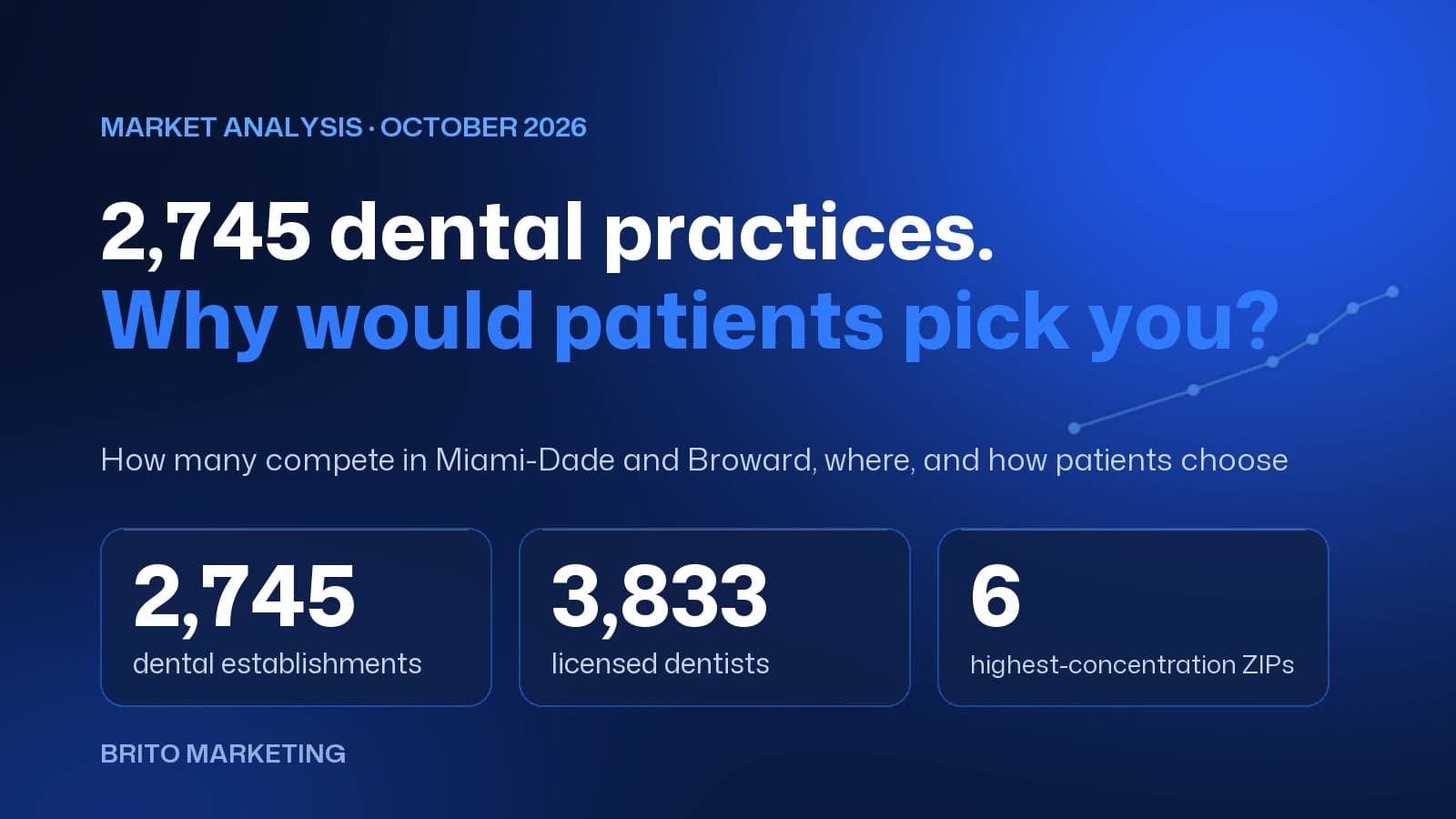
2,745 Dental Practices Compete in Miami-Dade and Broward: Why Would a Patient Choose Yours?
We measured the dental market in Miami-Dade and Broward with federal and state data: how many practices compete, which ZIP codes they cluster in and how patients choose today. There's no shortage of options, only of clear reasons to pick one.
Florida Lawyer Advertising Rules: What The Florida Bar Requires and How to Comply
What The Florida Bar's Rule 4-7 requires in a law firm's ads: name and city, language, testimonials, "expert" claims, actors, and filing with the Bar 20 days ahead. Every rule, with its number and source.