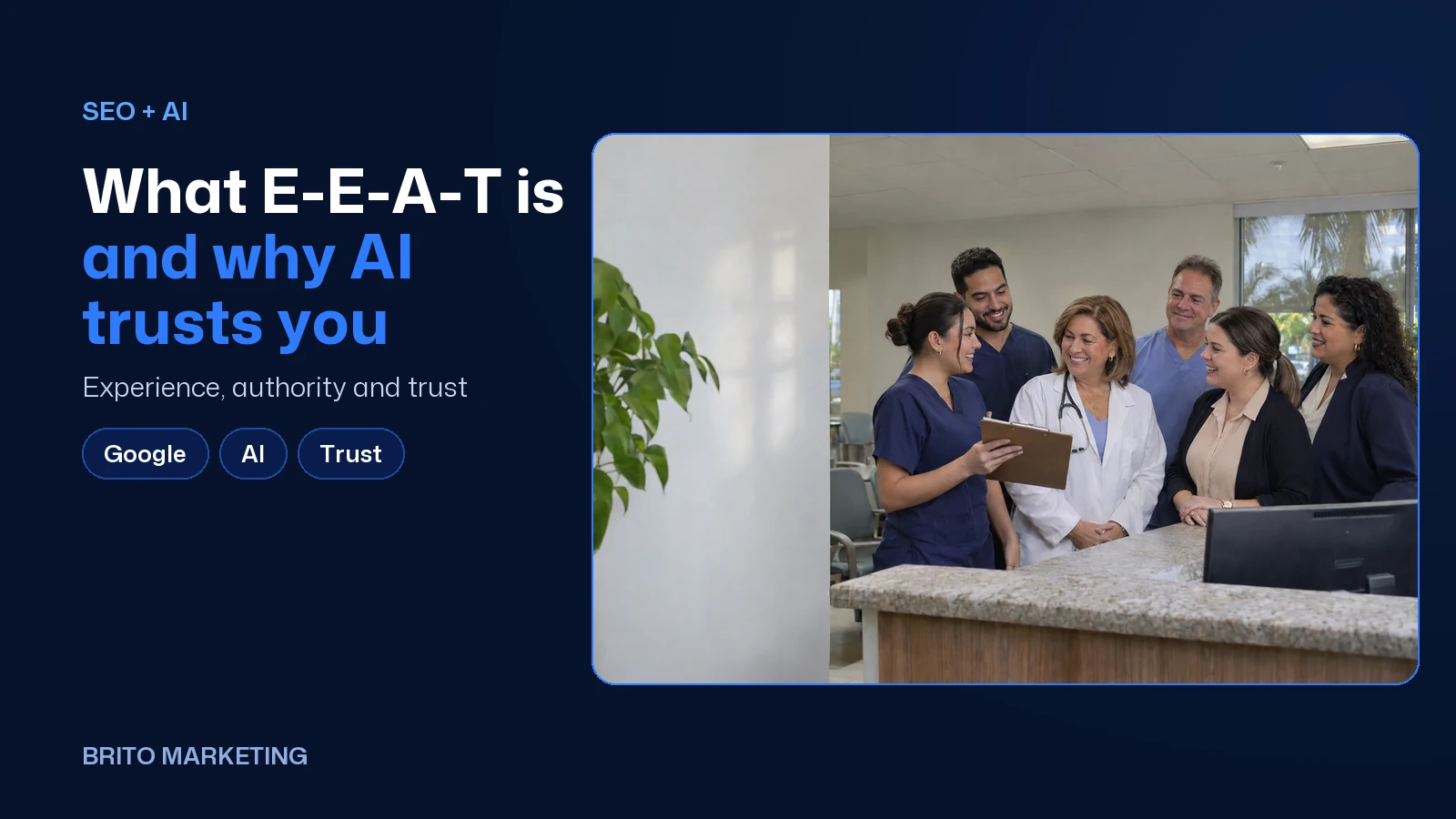
What E-E-A-T Is and Why Google and AI Trust Some Businesses More
Experience, expertise, authoritativeness and trust: what Google actually says about E-E-A-T in its own documentation, what it doesn’t say, and how a real local business shows each one.
Short answer
E-E-A-T stands for experience, expertise, authoritativeness and trust. Google says its systems look for content that shows those qualities, that trust matters most, and that E-E-A-T isn’t a ranking factor in itself. AI tools pick up on similar signals: who you are, what you’ve actually done and who vouches for you.
A lot has been written about E-E-A-T, and a good chunk of it is made up: “E-E-A-T scores,” “boost your E-E-A-T in 30 days,” “the secret ranking factor.” So this article sticks to what Google has published under its own name: its guide to creating helpful content, its official blog and its explanation of how it tests results. That’s enough to understand why, between two similar businesses, Google and AI tools trust one more than the other.
What Google actually says
In its helpful content guide, Google says its systems look for content that demonstrates experience, expertise, authoritativeness and trustworthiness, and that of the four, trust is the most important. The other three feed into it, but a page doesn’t have to show all of them. It also makes a point plenty of people skip: E-E-A-T isn’t a specific ranking factor. It describes what a mix of signals is trying to recognize (Google Search Central).
The acronym comes from the guidelines Google’s quality raters use. These are outside reviewers who check whether results are any good. Google says raters have no control over how pages rank and that their ratings don’t feed directly into the algorithm; they’re used to measure whether changes make Search better. So nobody can “raise your E-E-A-T.” What you can do is give Google, and every reader, reasons to trust you.
The first E: experience
Google added “experience” in December 2022 and explained it with plain examples: actually using the product, or having actually been to the place you’re writing about (Google Search Central). For a local business, that’s the stuff only you can tell: real photos of your work, a job in progress, how you handled the customer who came in with a strange problem, the questions people ask at your front desk.
- Your own photos of your team, your location and your work, instead of stock images.
- Specific examples on every service page: what happened, how you handled it, how long it took.
- Copy written by someone who does the work, even if someone else polishes it afterward.

The second E: expertise
Google asks whether content was written or reviewed by an expert or enthusiast who clearly knows the subject, and whether it contains easy-to-check factual errors. It also wants it to be obvious who wrote each page: a byline where readers would expect one, leading to information about the author. For a business, that means real names and titles, licenses and years in the trade on a team or About page.
Watch out for the shortcut. Google says fabricating author profiles, with fake names, AI-generated headshots or credentials that don’t exist, is deception. If the doctor reviewed the article, say the doctor reviewed it. If she didn’t, don’t.
Ready to apply this to your business?
The A: authoritativeness
One of Google’s questions is whether someone researching your site would come away thinking you’re well trusted or widely recognized in your field. You can’t write that on your own website. Other people have to say it: reviews, local press mentions, your industry association, the chamber of commerce, the directories where people look for you. Customers think the same way. More than half look for reviews that other customers back up, according to BrightLocal. We covered why reviews carry so much weight with AI.
The T: trust, the one that counts most
Trust is the sum of everything above, plus details that seem small: information that doesn’t contradict itself between your site and your Google profile, an address and phone number that work, numbers with a source, no promises you can’t keep. Google asks whether content is presented in a way that makes you want to trust it, with clear sourcing and background on who’s publishing it.

If your business touches health, money or safety
Google calls topics that could affect people’s health, financial stability or safety “Your Money or Your Life,” and says its systems give even more weight to strong E-E-A-T there. Dentists, clinics, law firms and insurance agencies deal with those topics every day, and so does anyone selling a home or building one. Those industries also have advertising rules to follow: no guarantees, no promised outcomes. If you’re a dentist, start with Florida’s advertising rules for dentists.
What about AI? What we know and what we don’t
OpenAI and Perplexity don’t publish an E-E-A-T checklist, so nobody can tell you for certain how much each signal weighs in ChatGPT. Here’s what we did see when we asked 50 fixed questions about Miami marketing agencies: Perplexity flagged claims that only came from the business itself, and ChatGPT leaned on Google Maps listings and their reviews. Those are the same trust signals under another name. It’s in our study, and the myths that keep circulating about this are in this rundown.
| Letter | What Google asks | How you show it |
|---|---|---|
| Experience | Did the writer use it or go there? | Real photos and examples of your work |
| Expertise | Was it written or reviewed by someone who knows? | Bylines, titles, licenses and a team page |
| Authoritativeness | Do others recognize you in your field? | Reviews, directories, press and associations |
| Trust | Does it make you want to trust it? | Matching details everywhere and sourced numbers |

Where to start
- Today: look up your business as if you were a new customer and write down what would make you trust it and what would make you hesitate.
- This week: build or update your team page with real names, titles, licenses and years of experience.
- This month: swap three stock photos for real ones and add an example of a finished job to every service page.
None of this gets fixed with a trick, which is exactly why it wears people out: you have to gather photos, ask for reviews, clean up your details and write carefully. At Brito we work on all of it at once, with our own video and photography, your website, your profile and your reviews in English and in Spanish, connected to BritoCRM and to sales. We’ve been in Miami since 2006. In Miami-Dade and Broward we come to your business; outside the area, we meet by phone or video call. If you want to know which trust signals you’re missing, you can request a free assessment.
Frequently asked questions
Is there a tool that measures my E-E-A-T score?
There’s no official score. Google says E-E-A-T isn’t a specific ranking factor, so any “score” is an estimate made up by whoever sells the tool. You’re better off going through the questions Google publishes and answering them honestly.
Do I have to put my name on every page of my site?
Not every page. Google recommends a byline where readers would expect one, like articles and guides. On service pages, it’s enough to make clear who the business is and who’s behind it, with a real team page.
Can I use AI to write and still have strong E-E-A-T?
Yes, as long as someone who knows the subject reviews it and adds their own experience. What Google sees as low effort is producing lots of AI text with no review or care.
My business is small and new. Can I compete on trust with a big one?
Yes, especially in searches for your area. Real experience, recent reviews and clear information don’t depend on size. Start with what you can prove today and add reviews every week.
Twenty years building brands in New York, Las Vegas and Miami, where he's based today. He leads a Miami team that shoots commercials on cinema cameras and runs proprietary AI infrastructure. He believes great marketing starts with truly understanding the customer — and that honesty, often frowned upon in this industry, is what separates partners from vendors.
View profile→Questions about your business?
The first conversation is an assessment, not a sales pitch. Let's talk.
Or explore our Search + AI (SEO & AEO) service
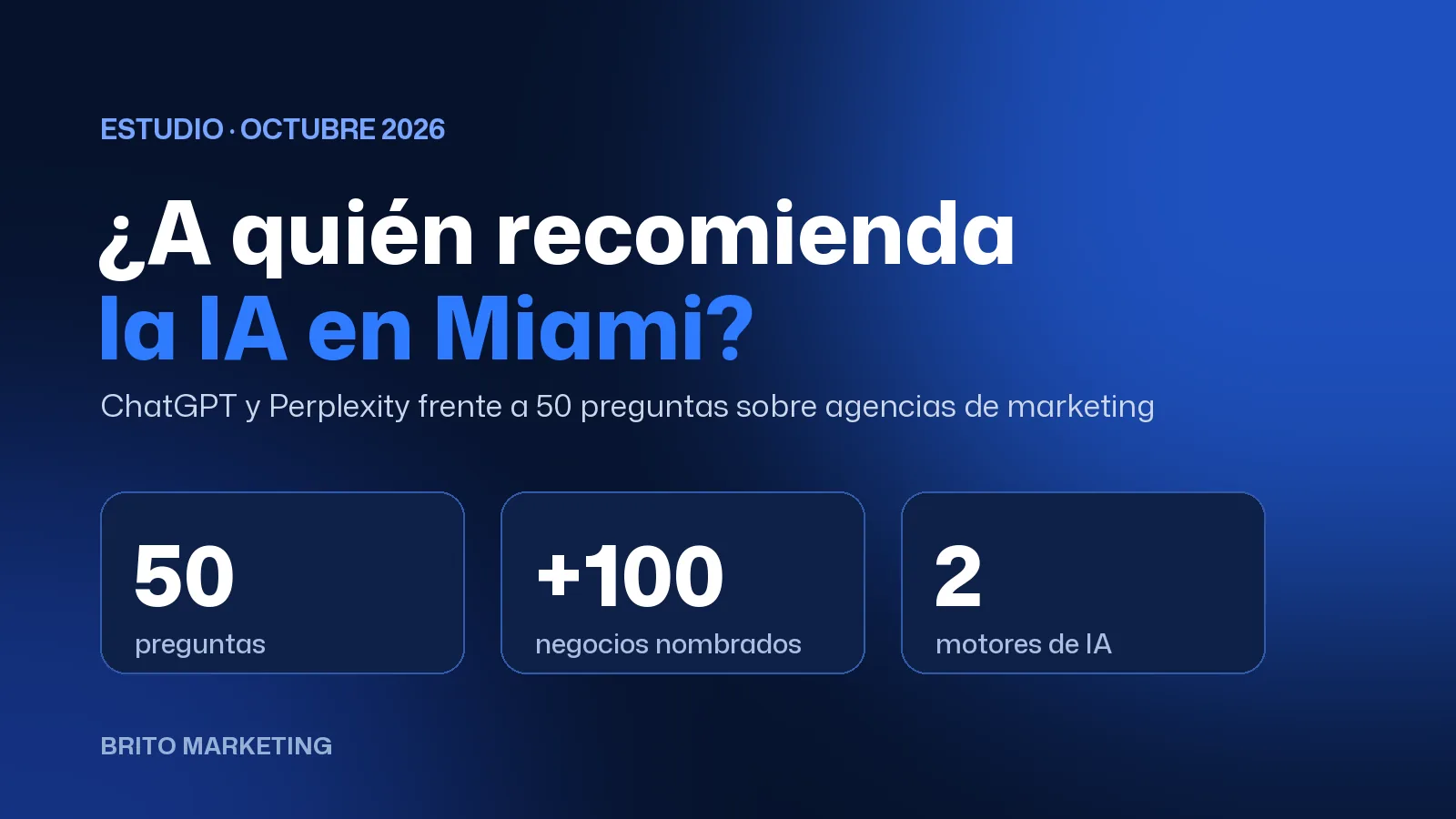
Study: Who ChatGPT and Perplexity Recommend When You Look for a Marketing Agency in Miami (October 2026)
We asked ChatGPT and Perplexity the same 50 questions, in English and Spanish. The AI named more than 100 different businesses, none in more than 4 answers, and for city searches it almost always picked someone from that city. Data, method and limits.

AI Marketing Without Losing the Human Voice
AI speeds up almost everything in marketing. But there's one thing it does badly, and your customers notice instantly.