10 Myths About Showing Up in ChatGPT, and What Actually Works
That you can pay your way in, that you need a secret file, that only the big players win. Ten things people keep repeating about ChatGPT and AI search, what the sources actually say and what to do instead.
Short answer
The most common myths are that you can pay ChatGPT to recommend you, that you need a special file or code, and that only big companies get named. What actually works is simpler: let the search crawlers in, explain clearly what you do and where, and get other people talking about you.
Lately we keep getting messages pitching “hacks” for showing up in ChatGPT: a magic file, a list of keywords, a service that promises to put you in the answer for a monthly fee. Some are half-truths. Some are just made up. Here are the ten we hear most, along with what OpenAI, Google and the data actually say, so you don’t burn time or money on things that won’t move the needle.
Myth 1: “You can pay ChatGPT to recommend you”
ChatGPT started testing ads in the U.S. in 2026, but OpenAI says ads don’t influence its answers, and they’re labeled as sponsored and kept separate from the rest of the response (TechCrunch). So yes, you can advertise. That just doesn’t get you onto the list of recommendations. If someone wants a monthly fee to “place you inside the answer,” ask them exactly how. If they can’t explain it, walk away.
Myth 2: “You need a special file so AI can read your site”
Google is blunt about this in its guide to AI Overviews and AI Mode: you don’t need new machine-readable files, AI text files or special markup to show up (Google Search Central). llms.txt is a voluntary proposal. It doesn’t hurt, and we walked through it here, but it doesn’t unlock anything. What does matter for ChatGPT is that its search crawler, OAI-SearchBot, can get into your site.
Myth 3: “There’s a secret schema for AI”
Structured data helps software understand who you are, where you are and what you offer. But Google says there’s no special schema you need to add for its AI features, and it wants whatever you put there to match what’s visible on the page. If your web vendor wants to charge extra for “ChatGPT schema,” ask them where that idea came from.

Myth 4: “Block GPTBot and you disappear from ChatGPT”
OpenAI runs several crawlers, and each one is controlled on its own. GPTBot collects content that may be used to train its models. OAI-SearchBot is the one that surfaces websites in ChatGPT search. OpenAI says the settings are independent, so you can block the first and still let the second in (OpenAI). The real risk runs the other way: a firewall that blocks every bot without anyone deciding it should.
Myth 5: “If I’m first on Google, I’m already in ChatGPT”
It helps, but it isn’t automatic. When we asked ChatGPT and Perplexity 50 fixed questions about Miami marketing agencies, ChatGPT leaned heavily on Google Maps listings (the name, the rating and the review count), while Perplexity favored businesses that showed up on third-party lists and directories. Your Google ranking counts, but AI tools look at more than that. The details are in our study.
Myth 6: “AI only recommends big companies”
In that same study, Perplexity named more than 100 different businesses across the 45 unbranded questions, and none showed up in more than 4. On “service + city” searches, it almost always picked companies based in that city. For a local business, that’s good news. You can win “bilingual dentist in Doral” without being the biggest chain in the county.
Ready to apply this to your business?
Myth 7: “Saying I’m the best on my website is enough”
When the only thing backing up a claim was the business’s own website, Perplexity flagged it with lines like “this is the company’s own claim.” AI tools cross-check sources, the same way a careful customer does. What you say about yourself counts once others confirm it: reviews, directories, your chamber of commerce, a local news outlet.

Myth 8: “The more keywords, the better”
Stuffing your copy with “plumber Miami plumber Hialeah cheap plumber” won’t get you any closer to the answer. In the academic study that gave GEO its name, forcing in keywords did worse than leaving the original text alone, while citing sources and adding figures with their origin did raise visibility. We break it down in content AI cites.
Myth 9: “I can fill my site with AI-written articles”
Google treats using generative AI to churn out lots of text without human review as a sign of low effort, and using automation to manipulate rankings breaks its spam policies (Google Search Central). Using AI to organize your thoughts is fine. Publishing a hundred articles that say nothing new is something else. AI tools look for people who know what they’re talking about, and that shows in your examples, your numbers and your real experience running the business.
Myth 10: “A few bought reviews will fix it”
Since 2024, the FTC has banned fake reviews, including AI-generated ones, along with paying for reviews on the condition that they’re positive. It can seek civil penalties from anyone who knowingly breaks the rule (FTC). Beyond the legal risk, you could lose your profile. What works is asking real customers, on the day of service, every single day.
| Myth | What’s really going on | What to do |
|---|---|---|
| Pay to get in | Ads don’t change the answer | Earn the recommendation |
| Special file | Google doesn’t require one | Let OAI-SearchBot in |
| Secret schema | There isn’t one for AI | Standard schema that matches the page |
| Blocking GPTBot erases you | The settings are separate | Decide on each bot individually |
| First on Google = in ChatGPT | AI checks more sources | Work your profile, reviews and third parties |
| Only big players win | Local searches favor locals | Pages by service and city |
| Calling yourself the best | AI is wary of self-claims | Get others to back it up |
| More keywords | It performs worse | Sourced numbers and clear answers |
| Mass AI articles | Google sees low effort | Fewer articles, with your own experience |
| Bought reviews | Banned by the FTC | Ask real customers |

What actually works
- Have whoever runs your website confirm that OAI-SearchBot, PerplexityBot and Googlebot can get in.
- One page per service that says what you do, who it’s for and which cities you cover, in English and in Spanish.
- The same details (name, address, phone, hours) on your site, your Google profile and every directory.
- Recent reviews from real customers, with a reply from you on each one.
- A presence beyond your own site: industry and city directories, associations and local press.
Where to start
- Today: if someone pitched you a ChatGPT “hack,” check it against this list before you pay for anything.
- This week: take the 15-minute test to see where you really stand.
- This month: pick two items from “what actually works” and finish them before starting anything else.
Sorting what works from what just sounds good takes time, and owners rarely have any to spare. At Brito we treat your website, your profile, your reviews and your third-party presence as one piece of work, in English and in Spanish, connected to BritoCRM and to sales. We’ve been in Miami since 2006. In Miami-Dade and Broward we come to your business; outside the area, we meet by phone or video call. If you’d like someone to look at your situation with no gimmicks, you can request a free assessment.
Frequently asked questions
Someone offered to get me into ChatGPT for a monthly fee. Is that real?
Nobody can guarantee you a spot in ChatGPT’s regular answers, and OpenAI says its ads don’t influence what it says. Ask them to walk you through the method step by step. If it’s a secret, don’t pay for it.
Should I block AI bots to protect my content?
You can block the ones that train models, like GPTBot, without losing ChatGPT search, because OpenAI controls them separately. What you don’t want to block is OAI-SearchBot if you want ChatGPT to be able to name you.
Is traditional SEO useless now?
No. Google says the same SEO best practices apply to its AI features, with no extra requirements. A clear, fast, well-written website is still the foundation for everything else.
Can I use ChatGPT to write my website copy?
Yes, as a helper, as long as you review everything and add your own experience: your examples, your service areas, the questions you actually get. Google sees mass-produced text with no human review as low effort, and customers notice too.
Twenty years building brands in New York, Las Vegas and Miami, where he's based today. He leads a Miami team that shoots commercials on cinema cameras and runs proprietary AI infrastructure. He believes great marketing starts with truly understanding the customer — and that honesty, often frowned upon in this industry, is what separates partners from vendors.
View profile→Questions about your business?
The first conversation is an assessment, not a sales pitch. Let's talk.
Or explore our Search + AI (SEO & AEO) service
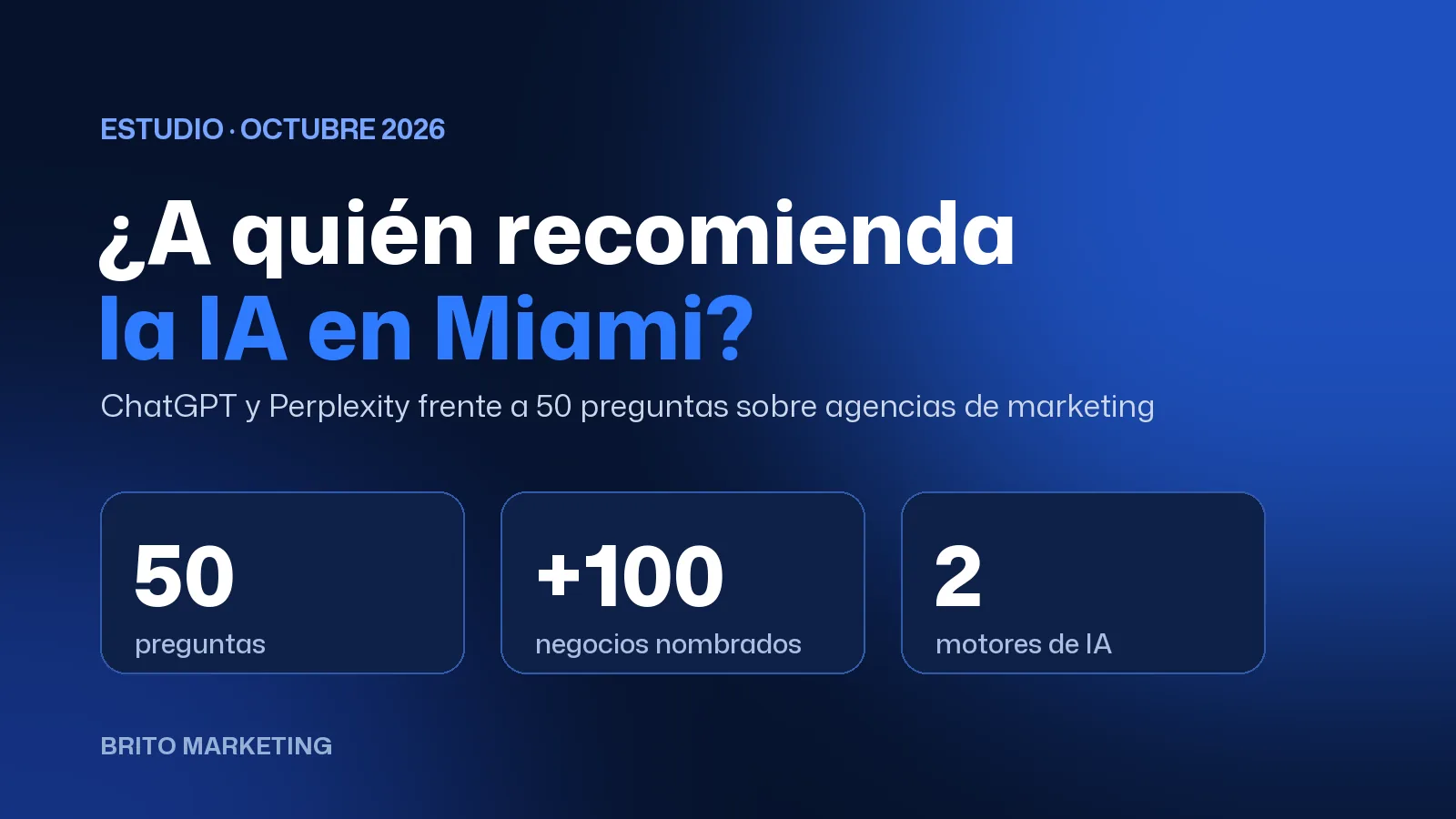
Study: Who ChatGPT and Perplexity Recommend When You Look for a Marketing Agency in Miami (October 2026)
We asked ChatGPT and Perplexity the same 50 questions, in English and Spanish. The AI named more than 100 different businesses, none in more than 4 answers, and for city searches it almost always picked someone from that city. Data, method and limits.

AI Marketing Without Losing the Human Voice
AI speeds up almost everything in marketing. But there's one thing it does badly, and your customers notice instantly.