
How to Rank in AI Search: A Step-by-Step Guide to Getting Named by ChatGPT, Gemini and Perplexity
AI search has no fixed page one, but it does reward a method. Seven steps in order, from picking your questions to measuring every month, based on what OpenAI, Google, Perplexity and the paper that coined GEO actually say.
Short answer
To get named by AI: pick your customers’ exact questions, measure where you stand today, let ChatGPT’s, Perplexity’s and Google’s crawlers in, answer each question on a page, write with facts and sources, get other people talking about you, and re-run your measurement every month. It takes consistency more than tricks.
Ranking in AI doesn’t work like ranking on Google. There’s no fixed list from one to ten. The answer changes with how the person asks, which language they use and what sources the AI finds that day. What does exist is a method that improves your odds, and most of it is documented by the companies themselves and by actual research. If you’d like to understand first why you’re not showing up today, read why ChatGPT won’t recommend your business. Here’s the order to work in.
Step 1: Pick the questions you want to be named for
You don’t rank “in AI” in general. You rank for specific questions. Sit down with your front desk or your sales team and pull together 15 to 20 real questions, in your customers’ own words. Mix three kinds: recommendation questions (“Which car accident lawyer would you recommend in Hialeah?”), pre-purchase questions (“How long does a pool permit take in Miami-Dade?”) and comparison questions (“Is an implant better than a bridge?”).
- Pair each service with each city or neighborhood you actually serve.
- Write every question in English and in Spanish, the way each customer would say it, not a word-for-word translation.
- Flag the five that bring in the most revenue. Start there.
Step 2: Measure where you stand today
Before you change anything, take a snapshot of your starting point. Run your questions through ChatGPT, Gemini and Perplexity while logged out or in a temporary chat so your history doesn’t skew things, and log who comes up, whether you do and which sources the answer cites. Those sources are gold. They tell you which directories, lists and articles AI is reading in your industry.

Step 3: Open the door to all three
Each engine has its own crawler, and if your site blocks it, no amount of content will help. OpenAI recommends allowing OAI-SearchBot to show up in ChatGPT’s search results (OpenAI). Perplexity asks the same for PerplexityBot and notes that this crawler isn’t used to train AI models (Perplexity). On Google, AI Overviews and AI Mode rely on regular Search crawling, so Googlebot just needs to be able to reach and index your page.
Watch out for firewalls and security plugins. They sometimes block these crawlers even when robots.txt allows them. Ask whoever runs your website to test all three.
Step 4: One page that answers each question
For every important question, make sure there’s a spot on your site that answers it head-on. Service questions belong on that service’s page. Pre-purchase questions can go in an FAQ section or an article. Lead with the answer in two or three sentences, then add the detail. Google is blunt about it: there are no extra requirements or special files needed to appear in its AI features. What matters is that your content is available as text, well linked and backed by a good page experience (Google Search Central).
That doesn’t mean tools like llms.txt are pointless for other engines. It just means they don’t replace the basics. If you’re curious, here’s what llms.txt is and what it does.
Ready to apply this to your business?
Step 5: Write the way a source writes
This is where the research gets specific. The paper that coined the term GEO, accepted at the KDD 2024 conference, tested different ways of rewriting content. The ones that lifted visibility in AI answers the most were citing sources, adding quotations and adding statistics. Keyword stuffing, on the other hand, didn’t help, and on Perplexity it actually made results worse (Aggarwal et al., KDD 2024).
In practice, for a clinic or a law office: instead of “we offer the best service in town,” write “treatment takes two one-hour visits, and most patients are back at work the next day.” If you mention a law or a study, link to it. What you know from experience counts too: real timelines, the mistakes you see people make, the questions nobody else bothers to answer.

Step 6: Get other people to name you
AI tools are skeptical of claims only you are making. They want to see your name elsewhere: recent reviews on Google and on your industry’s platforms, local directories, best-of lists published in your city, your chamber of commerce, an interview with a local outlet. Use the source list from Step 2. If Perplexity keeps citing the same two directories for your service, that’s where you need to be, with details identical to your Google profile. For more on how Perplexity picks its sources, see Perplexity for business.
Step 7: Re-run your measurement every month
Same questions, same day each month, on all three engines and in both languages. Note whether you come up, where you land in the answer and which sources appear. By month three or four you’ll see a pattern: which questions you’ve won, which ones aren’t budging and which new source just showed up. That tells you what to work on next.
| Step | How often | It’s done when… |
|---|---|---|
| 1. Pick your questions | Once, revisited each quarter | You have 15–20 questions in English and Spanish |
| 2. Measure your baseline | Once | You have a sheet showing who comes up and which sources AI cites |
| 3. Let the crawlers in | Once, and after every site change | OAI-SearchBot, PerplexityBot and Googlebot can all get in |
| 4. One page per question | Ongoing | Every key question has its answer up top, in text |
| 5. Write like a source | On every new page | There are facts, linked sources and firsthand experience |
| 6. Get named by others | Ongoing | You appear in the sources AI cites, with matching details |
| 7. Measure monthly | Monthly | You compare month over month and pick the next move |

Where to start
- Today: write down your five most valuable questions, in English and in Spanish.
- This week: run them through ChatGPT, Gemini and Perplexity and save the sheet with the results and sources.
- This month: confirm all three crawlers can reach your site, and rewrite your main service page with the answer up top and at least one fact with its source.
Doing this well takes patience, and patience is the first thing to go when business gets busy. At Brito we run it as part of one system: your website, content, reviews, video we shoot ourselves and BritoCRM, all tied to sales and in both languages. We’ve worked from Miami since 2006. In Miami-Dade and Broward we come to your business; outside the area, we meet by phone or video call. If you’d like to know where you stand before you start, you can request a free assessment and we’ll walk through it with you.
Frequently asked questions
Can I rank number one in ChatGPT like on Google?
There’s no fixed top spot. The answer changes with the question, the language and the sources available at that moment. What you can do is show up for more questions, more often, and track that month to month.
Do I need to do something different for each AI tool?
The core work is the same for all of them: clear content, sourced facts and third-party mentions. What differs is which crawler needs access to your site and which sources each one favors, which you’ll find out by measuring.
Does repeating my keyword a lot help?
No. In the paper that coined GEO, keyword stuffing barely moved the needle and performed 10% worse than the original text on Perplexity. Sources, quotations and statistics work better.
My business is small. Can I compete with the big players?
Yes, especially on specific questions about your service and your area. In that same paper, the sites that ranked lower in the results were the ones that improved the most after optimizing their content.
Twenty years building brands in New York, Las Vegas and Miami, where he's based today. He leads a Miami team that shoots commercials on cinema cameras and runs proprietary AI infrastructure. He believes great marketing starts with truly understanding the customer — and that honesty, often frowned upon in this industry, is what separates partners from vendors.
View profile→Questions about your business?
The first conversation is an assessment, not a sales pitch. Let's talk.
Or explore our Search + AI (SEO & AEO) service
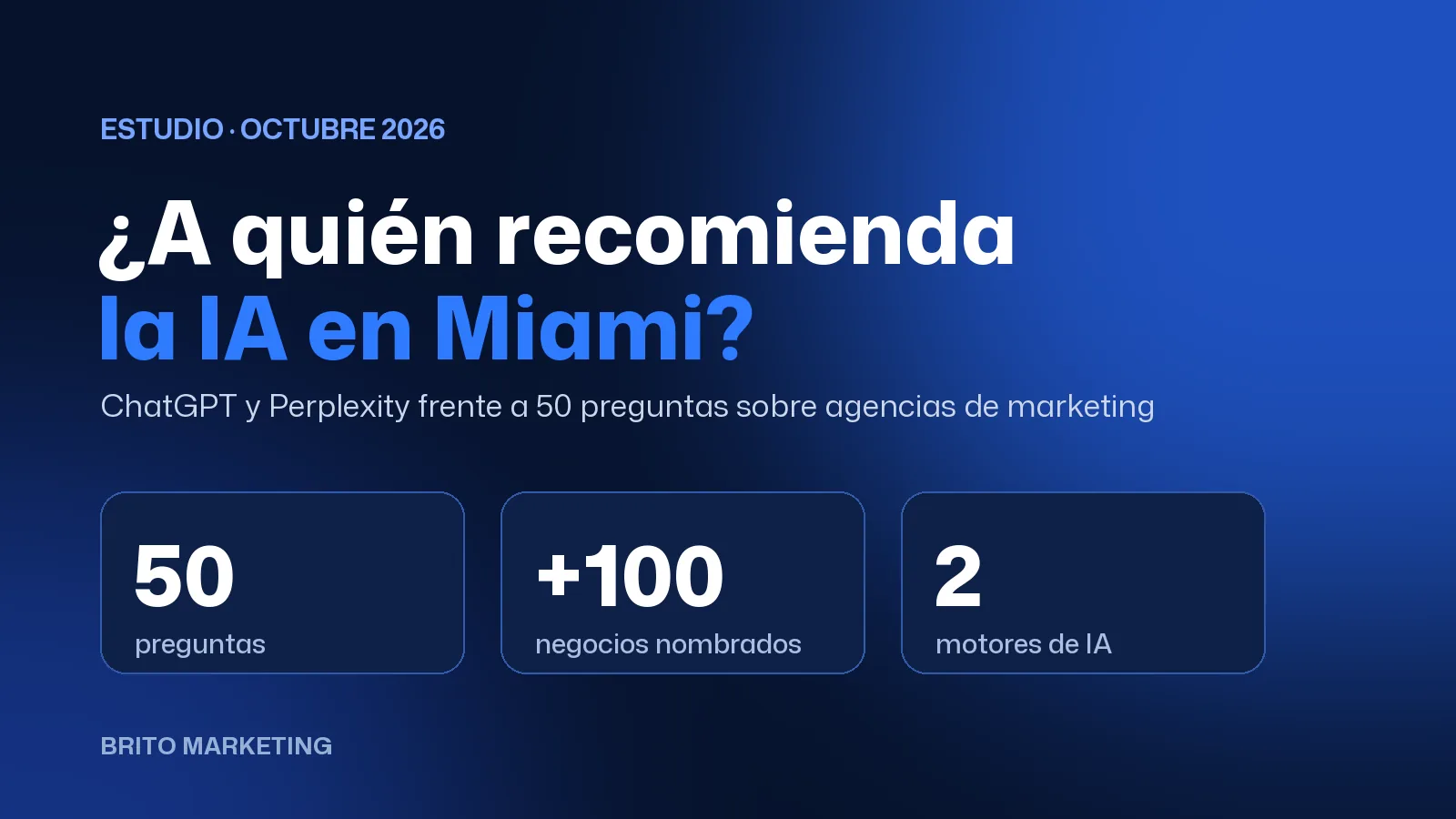
Study: Who ChatGPT and Perplexity Recommend When You Look for a Marketing Agency in Miami (October 2026)
We asked ChatGPT and Perplexity the same 50 questions, in English and Spanish. The AI named more than 100 different businesses, none in more than 4 answers, and for city searches it almost always picked someone from that city. Data, method and limits.

AI Marketing Without Losing the Human Voice
AI speeds up almost everything in marketing. But there's one thing it does badly, and your customers notice instantly.