You Just Opened Your Business in Miami: Where to Start With Marketing
With no track record and a small budget, marketing is about focus, not volume. The honest order of priorities for your new Miami business.
Short answer
Start by claiming your Google Business Profile: it's free and it's the first thing a nearby customer who's ready to buy sees. Then earn real reviews and put up a simple site that says what you do, where you are, and how to reach you. AI advertising gives you a push, but only once that foundation is in place; social media comes last.
You opened three weeks ago. The space in Hialeah or Doral is finally ready, the sign is up, you invited family for the grand opening, and now you're standing behind the counter waiting for people you don't know yet to walk in. That's the part nobody warns you about when you sign the lease: opening is an achievement, but opening isn't the same as having customers. And then comes that moment, usually about a week in, when you pull out your phone, start googling "how to do marketing for my business," and drown in a thousand tips that all contradict each other.
We often hear from new owners who want to do everything at once: Instagram, TikTok, ads, a new logo, a professional video, influencers. And the honest answer is almost never "let's do all of that." At the start, with little track record and no big budget, marketing isn't about volume. It's about focus. It's doing the three or four things that actually get a neighbor to find you and trust you, before you spend a dollar on the ones that just sound nicer.
First: claim and complete your Google Business Profile
If you do one thing this week, make it this. Your Google Business Profile (the panel that shows up on the right when someone searches for you, with the map, photos, and reviews) is free, and it's literally the first thing that shows up when someone nearby types "Cuban restaurant near me" or "dental clinic in Kendall." It isn't a social account or a fancy website. It's the listing Google shows people who already plan to buy and are just deciding who to buy from.
A lot of new businesses don't even realize the profile already exists (Google sometimes generates it on its own) and that it's incomplete, with the wrong address or no hours. Claiming it and filling it out well is the best return you'll get for zero dollars. Make sure these are clear:
- The exact name, address, and phone number, identical everywhere (always use the same number, not a different one on each platform).
- The right business category and any relevant secondary ones.
- Real hours, including holidays, so nobody shows up to a locked door.
- Real photos: your space, your food, your team, your finished work. Not stock images.
- A link to your website or WhatsApp so people can take the next step.
This is the foundation of local SEO, and in Miami, where competition is brutal block by block, a well-built profile puts you on the map ahead of people who've been open for years but never took care of theirs.
Second: earn your first real reviews
A profile with no reviews is like an empty restaurant on a Friday night: people walk right past. The first reviews are the hardest and the most important, because they're what tell a stranger "these folks take care of you." We're not talking about buying reviews or making them up; that goes without saying: it breaks Google's rules, and it burns you in the long run. We're talking about asking for them, face to face, from the real customers who already left happy.
The best time to ask for a review is right when a customer tells you "this came out great" or "thanks, I'll be back." That in-person moment is where honest reviews come from. Make it easy: have the link ready, a QR code at the register, a short message you can send over WhatsApp. In Miami, plenty of your customers will write to you in Spanish, and that's perfect; a natural mix of Spanish and English reviews reflects who you are and who you serve. You don't need a hundred at once. You need a steady, genuine trickle.
Third: a simple but clear website
This is where a lot of people get stuck, because they think they need a huge site with animations and ten pages. You don't. At the start you need a site that loads fast on a phone and, within three seconds, tells whoever lands on it three things: what you do, where you are, and how to reach you. Nothing more, nothing less.
Web design matters, but not in the "make it look spectacular" sense. It matters in the sense that it shouldn't confuse anyone. Most of your visits will come from a phone, often on mobile data, sometimes from an older person just looking up your hours. If your page is slow to open or the buttons don't show, you've lost them. A single well-made page, with your address, a tappable phone number, your services, and some real photos, does more than a pretty site nobody understands. And yes, it should be in Spanish and English if you serve both audiences, because in Miami that isn't a luxury, it's how your market actually speaks.

Ready to apply this to your business?
Fourth: AI advertising for the immediate push
Local SEO and reviews build something that lasts, but they take time. They won't fill your place the month you open. That's what AI advertising is for: it's the immediate push while the organic side matures. Even on small budgets, today's platforms use artificial intelligence to find the people in your area who likely want what you sell, and show them your ad at the right moment. It doesn't work miracles, but it puts your new business in front of real eyes from day one.
The classic mistake here is thinking advertising replaces everything else. It doesn't. If you send ads to an empty profile or a confusing website, you're paying to bring people to a door that doesn't convince them. Advertising works when the basics are already in place. Start with a budget you wouldn't mind losing, measure what happens, and only scale up what genuinely brings calls or visits. And once those calls and messages start coming in, you can't afford to drop any; that's where a system like BritoCRM helps make sure every contact gets answered and followed up, instead of getting lost in a phone full of messages.
Fifth: social media in your real voice
Social comes last on this list on purpose. Not because it doesn't help, but because at the start it eats the most time and brings the fewest direct customers. Having a presence is fine, as long as it's in your real voice: you behind the counter, the plate you just finished, the before and after of a job. People in Miami follow businesses that feel real, not accounts that look like an agency runs them. You don't need to post every day or dance on TikTok if that isn't you. You need to be consistent and genuine, and let social support everything else rather than replace it.
What NOT to do at the start
Knowing what to avoid when money and time are tight is as important as knowing where to begin. These are the stumbles we see over and over in brand-new businesses:
- Spending it all on one channel. If you put every dollar into ads but your Google profile is empty, you're building on sand.
- Trying to be everywhere at once. Five half-done social accounts do less than one thing done well. Focus wins.
- Copying the big competitor. That restaurant with ten years in business and an agency budget is playing a different game; imitating it just makes you spend on things you don't need yet.
- Chasing the pretty stuff before the basics. The professional video and the perfect logo can wait; people finding and reaching you can't.
- Measuring nothing. If you don't know where your customers come from, you're guessing, and guessing is expensive.
Where you, specifically, should start
No article can tell you exactly what your business needs, because a barbershop in Little Havana isn't the same as a clinic in Brickell or a food truck in Wynwood. Each one starts with a different mix of these pieces. But the underlying order is almost always the same: first get found and trusted, then push it with advertising, and leave the rest for once you have a base.
If you want to know where to start in your specific case, without guessing, we can run a free diagnostic for you: we look at your Google profile, your current presence, and your neighborhood competition, and we tell you honestly what to move first. No inflated promises, no packages you don't need yet. At the start, the best marketing isn't the one that spends the most. It's the one that gets the first thing right.
Frequently asked questions
If I already have Instagram and my Google profile, do I really need a website?
Yes, and not for vanity. Your Google profile and your Instagram are rented land: if the rules change tomorrow or your account gets suspended, you're left with nothing. A website is the one thing on that list that's actually yours. And a lot of people who find you on social will look up your site before calling, to confirm you're a business they can trust. It doesn't have to be big, but it has to exist and it has to be yours.
How long until I start seeing results?
It depends on the channel. Ads can bring calls almost from day one, but the organic side (building reviews and starting to show up on the map) usually takes several months of consistency. Be skeptical of anyone promising "first page in 30 days" here in Miami, that depends heavily on your local competition. The key is not to quit after a few weeks, which is exactly when most people give up.
Can I do all this myself, or do I need an agency?
You can handle a lot of the basics yourself: claiming your Google profile, asking happy customers for reviews, and putting up a simple, clear website. An agency starts to earn its keep when you run out of time, when the ads get technical, or when every missed call is costing you real money. There's no shame in starting on your own and bringing in help once the business actually needs it.
Twenty years building brands in New York, Las Vegas and Miami, where he's based today. He leads a Miami team that shoots commercials on cinema cameras and runs proprietary AI infrastructure. He believes great marketing starts with truly understanding the customer — and that honesty, often frowned upon in this industry, is what separates partners from vendors.
View profile→Questions about your business?
The first conversation is an assessment, not a sales pitch. Let's talk.
Or explore our AI Advertising service
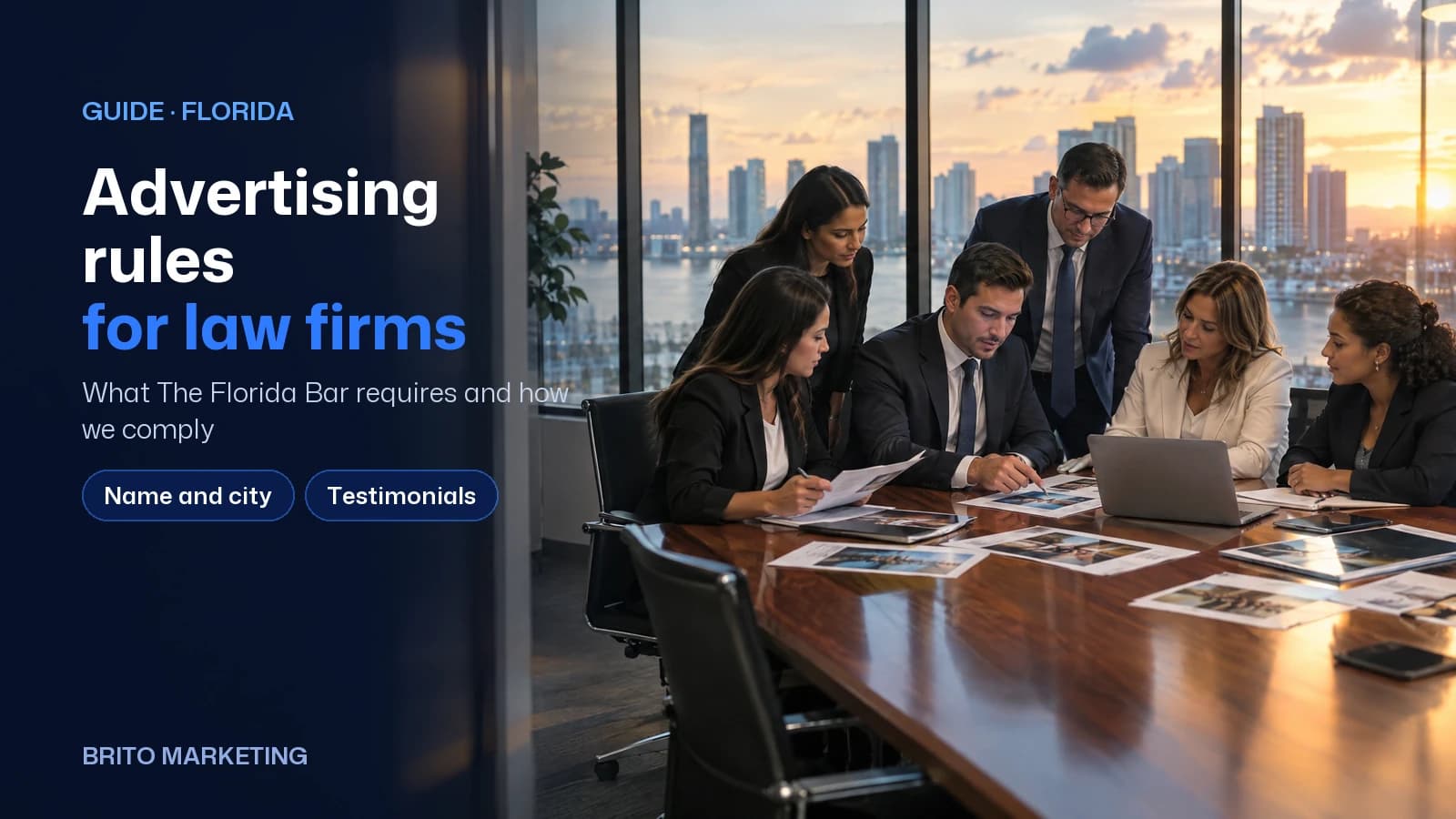
Florida Lawyer Advertising Rules: What The Florida Bar Requires and How to Comply
What The Florida Bar's Rule 4-7 requires in a law firm's ads: name and city, language, testimonials, "expert" claims, actors, and filing with the Bar 20 days ahead. Every rule, with its number and source.
Florida Dental Advertising Rules: What the Law Requires and How to Comply
What Florida law requires in a dental practice's ads: identifying the dentist, no praise or comparisons, "specialist" only with the credential, the 72-hour notice on offers, and how to advertise prices. Every rule, with its citation and source.