
2027 Marketing Goals: How to Set Them and Track Them by Quarter
Start from the number of customers you need, work backward to leads and split the year into four quarters, each with one goal, one number to track it and one person in charge. With a worked example and a table to copy.

Short answer
A useful marketing goal starts with how many new customers you need and works backward: how many appointments, how many leads and from which channel. Set it by quarter, with a number, a deadline, where the data comes from and who owns it. Check it once a month and adjust at the end of each quarter.
“I want to grow this year” sounds good, but you can't measure it. And “I want more followers” is a goal, just rarely the one that pays the rent. In the Federal Reserve Banks' 2025 survey of small employer firms, the most common operational challenge was reaching customers and growing sales (Federal Reserve Banks, 2026). That's exactly why marketing goals should be about customers, not posts. If you haven't settled on a budget yet, start with how much to invest based on your business stage.
Start with the business number
Before you talk ads or social, answer one question: how many new customers a month do you need in 2027? Work backward from there using your own numbers. Here's an example with round numbers, not from a real business: if you want 10 new customers a month and you close 1 out of every 3 appointments, you need 30 appointments. If 1 out of every 2 leads books, you need 60 leads a month.
If you don't know how many appointments you close or how many leads book, that's your first goal of the year: find out. Without those two percentages, any lead target is a number you made up.
These BrightLocal numbers show why a “website visits” goal falls short. Two out of three people keep comparing after they read your reviews, and more and more of them do it outside Google, in other map apps or in an AI assistant. What you want to measure is what happens at the end: the call, the form, the appointment.
A good goal has four parts
- A number: “60 leads a month,” not “more leads.”
- A deadline: the end of the quarter, not “this year.”
- A data source: your CRM, your Google Business Profile, Google Analytics or the sheet where you log calls. If you can't say where the number comes from, you can't track it.
- An owner: someone on your team who checks that number every month and speaks up when it falls behind.

One year, four quarters
Twelve scattered goals don't get hit. Four quarters, each with one main focus, do. The order below works for most service businesses because it fixes what's leaking customers first, then puts money into bringing in more.
| Quarter | Focus | Example goal | How to track it |
|---|---|---|---|
| Q1 (Jan–Mar) | Measure, and stop losing what already comes in | Reply to every lead in under 5 minutes and know which channel each one came from | First-response time and lead source in your CRM |
| Q2 (Apr–Jun) | More appointments from the same leads | Raise the share of leads who book | Appointments booked ÷ leads that month |
| Q3 (Jul–Sep) | Reputation and visibility | New reviews every month and showing up when you ask AI about your service | New reviews on your Google profile and a monthly check in ChatGPT and Gemini |
| Q4 (Oct–Dec) | Scale what worked and take care of existing customers | More budget for the channel with the most customers per dollar, plus a repeat-customer goal | New customers by channel and repeat customers |
January to March: know your numbers first
Quarter one is about measuring right. Every lead goes into one system with its source, someone replies fast, and by the end of March you know your two percentages: how many leads book and how many appointments close. Once you have those, the rest of the year's goals stop being guesswork.
April to June: more appointments, not more leads
Before you pay for more leads, get more out of the ones you have: better replies, follow-up for the people who went quiet, a booking link so nobody has to call. Raising your booking rate usually costs less than buying new leads.

July to September: get seen and get picked
With operations in order, quarter three goes to reputation: ask for a review after every job, reply to every one and check whether AI mentions you. For that check, repeat the 15-minute test to see if you show up in AI every month and write down your score.
October to December: scale up and close out the year
By year-end you've got nine months of data. Put more budget behind the channel that brought in the most customers per dollar, cut the one that brought in none and set a goal for repeat customers, who are almost always your most profitable. Keep in mind that some channels take months to pay off; before you cut one, read how long digital marketing takes to show results.
How to track them without losing your mind
- One sheet or one dashboard with the quarter's goals. No more than five numbers.
- A standing 30-minute meeting each month with whoever owns each number.
- When you can, compare each month with the same month last year, not just the month before. December and August are nothing alike.
- At the end of each quarter, make one of three calls on every goal: keep it, raise it or change it. Write down why.
The most common mistakes
- Tracking followers, likes or site visits and calling it growth.
- Setting goals without knowing where the data will come from.
- Changing strategy every month because a number dipped for a week.
- Setting a lead target without checking whether the team can handle that many.

Where to start
- This week: write down how many new customers a month you want in 2027 and work backward to appointments and leads.
- By January 15: decide where each number comes from and who watches it.
- On March 31: review the first quarter and reset April's goals with real numbers. If a January to-do list would help, use the checklist to start 2027.
Setting goals is the easy part. The hard part is having the data to track them and the time to review them every month. That's how we work with our clients at Brito: marketing, video, CRM and AI connected to sales, in English and Spanish, from Miami since 2006. We're closed through January 4, so there's no need to call. If you'd like to turn your goals into a plan, you can build your marketing plan in 2 minutes and we'll go over it together when we're back.
Frequently asked questions
How many marketing goals should I have?
Not many: one main goal per quarter and, at most, four or five numbers to track it. If you have fifteen goals, in practice you have none.
What if I don't have last year's data?
Then your first-quarter goal is to get it: log where every lead comes from, how many book and how many buy. By April you can set goals with real numbers.
Do social media followers count as a goal?
As a supporting number, sure. As your main goal, no. Followers don't pay. Track the messages, calls and appointments that come in from social.
What if I'm way behind halfway through the quarter?
Don't change everything at once. Find where the number is breaking down (too few leads, too few appointments or too few sales), fix that step and wait until the quarter closes to decide whether to adjust the goal.
Twenty years building brands in New York, Las Vegas and Miami, where he's based today. He leads a Miami team that shoots commercials on cinema cameras and runs proprietary AI infrastructure. He believes great marketing starts with truly understanding the customer — and that honesty, often frowned upon in this industry, is what separates partners from vendors.
View profile→Questions about your business?
The first conversation is an assessment, not a sales pitch. Let's talk.
Or explore our AI Advertising service
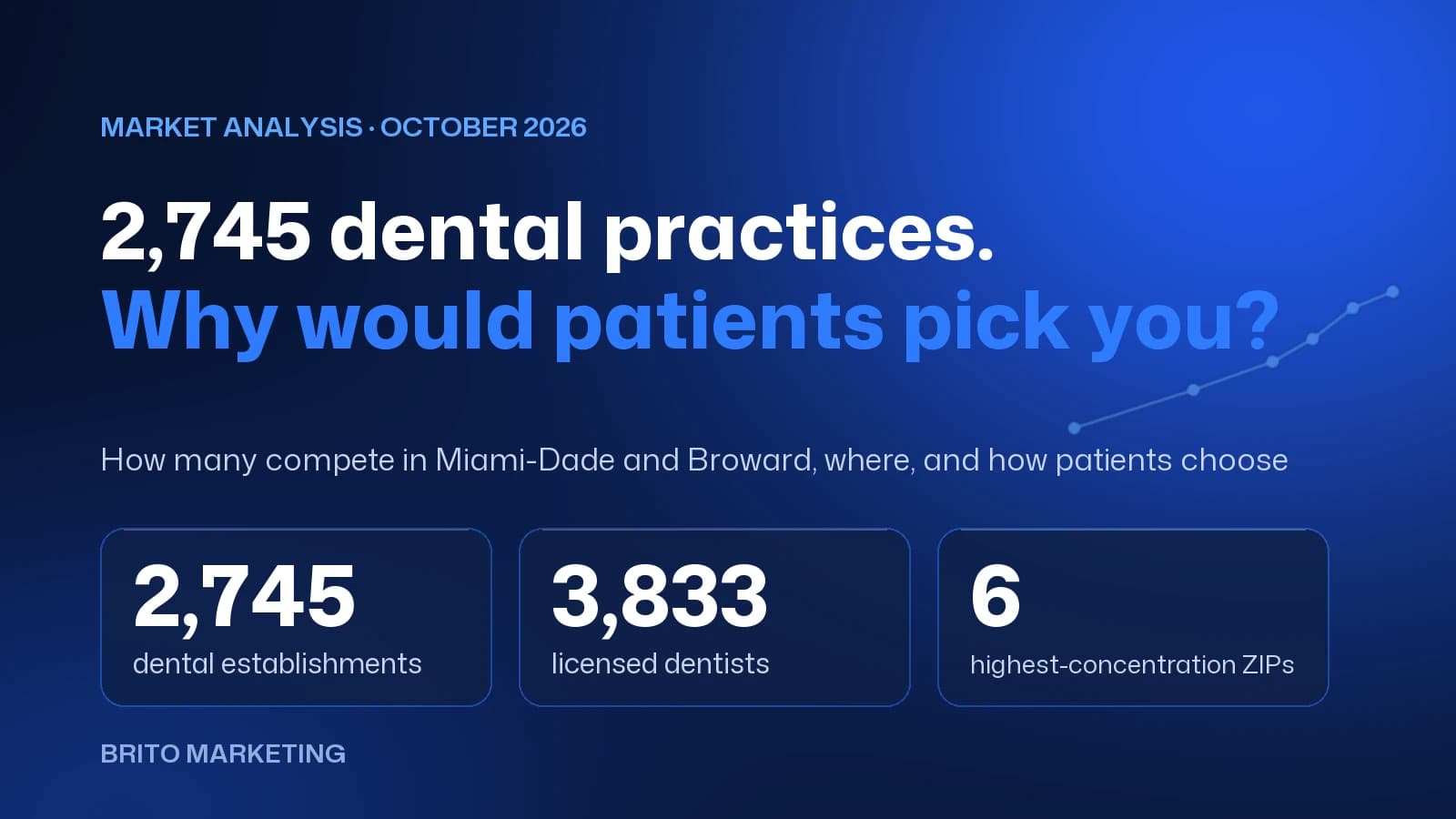
2,745 Dental Practices Compete in Miami-Dade and Broward: Why Would a Patient Choose Yours?
We measured the dental market in Miami-Dade and Broward with federal and state data: how many practices compete, which ZIP codes they cluster in and how patients choose today. There's no shortage of options, only of clear reasons to pick one.

Florida Lawyer Advertising Rules: What The Florida Bar Requires and How to Comply
What The Florida Bar's Rule 4-7 requires in a law firm's ads: name and city, language, testimonials, "expert" claims, actors, and filing with the Bar 20 days ahead. Every rule, with its number and source.