Medical Clinics in 2027: What to Work On to Grow Your Practice
Google and AI search, video, reviews, booking, no-shows, your CRM, and HIPAA-safe AI: what a South Florida medical clinic should be working on in 2027.
Short answer
In 2027, a medical clinic grows when patients can find it on Google and in AI answers, every call turns into a booked appointment, and patients actually show up. That takes bilingual service pages, recent reviews, automated reminders, a CRM kept separate from the medical record, and AI only from vendors that sign a HIPAA agreement.
In Miami-Dade and Broward, a new patient shops for a clinic on their phone, often in Spanish and often after office hours. They want to know who takes their insurance, who can see them this week, and who has reviews from people like them. More and more, they ask an AI tool, too: BrightLocal found that the share of consumers using ChatGPT and other AI tools for local business recommendations went from 6% to 45% between 2025 and 2026. Meanwhile, no-shows are creeping back up at a lot of practices. So the work for 2027 is as much about keeping patients from slipping away between the first call and the waiting room as it is about attracting them.
Marketing and visibility: Google and AI search
Your Google Business Profile is the first thing almost every new patient sees. Make sure there's one for each location, with real hours (Saturday too, if you're open), your accepted insurance list on the website, photos of your actual team and exam rooms, and a booking button that works on a phone. If you offer telehealth, say so plainly.
Google and AI tools favor pages that answer one clear question. "Primary Care" doesn't say much. A page on diabetes management in Doral, written in Spanish for the patient and in English for the daughter who helps with her appointments, covering hours, insurance, and what to bring to the first visit, says a lot more. Here's how a clinic shows up in AI answers.
- Build one page per service or condition you treat, in English and in Spanish, each written for its own reader.
- Keep your accepted insurance list current and easy to find.
- Add structured data (MedicalClinic, Physician, FAQPage) so Google knows who practices where.
- Keep your name, address, and phone number identical on Google, your site, insurer directories, and social media.
- Check every ad against the Florida medical advertising rules: no unjustified expectations, and the 72-hour notice on free or discounted offers.

Social media and video
Patients pick a doctor they feel comfortable with, and video lets them get to know that doctor before they walk in. Short clips work well: one of your physicians answering a common question ("How often should I get checked if I have high blood pressure?"), a quick walkthrough so new patients know where to park and who'll greet them, and your team introducing themselves in their own language.
Privacy runs the show here. No patient appears on camera, not their name, face, or story, without a signed authorization. Check the background of every shot, too. An open chart on a monitor or a schedule sitting on the front counter is all it takes to create a problem.
- Record eight to ten short answers in one morning, and shoot the English and Spanish versions separately.
- Always add captions; a lot of people watch with the sound off in the waiting room.
- Educate, don't promise: "here's what we do," not "here's what you'll get."
- Two videos a week for the whole year beats ten in one month and then silence.
Reviews and reputation
Reviews have a shelf life. In BrightLocal's 2026 survey, 74% of consumers look for reviews from the last three months, and 47% won't use a business with fewer than 20 reviews. A clinic sitting on 15 reviews from four years ago is losing patients it will never know were looking.
Ask for the review at the end of a good visit, with a short text and the direct link, in the patient's language. When you reply, be careful: don't confirm the person is a patient or mention anything about their care, even if they brought it up first. A safe reply thanks them, invites them to call the office, and leaves out the details.
Sales and follow-up: from call to appointment
For a clinic, "sales" means turning an inquiry into a booked visit. Every call that rings out over lunch is a patient who probably dialed another practice. And someone who filled out your web form and didn't hear back that day has already moved on.
- Have someone answer in English and Spanish, or make sure every missed call gets a text back within minutes.
- Offer online booking for new patients, tied to your real schedule.
- Verify insurance before the visit so the patient doesn't find out at the front desk.
- Follow up with people who asked but didn't book: a text the next day and another a week later.
- Send reminders for annual physicals and follow-ups, since those are visits patients already want.
Ready to apply this to your business?
Operations: fewer no-shows, shorter waits
According to MGMA, 32% of medical groups saw more no-shows in 2026 than in 2025. Practices that reported fewer no-shows pointed to automated and text reminders, among other steps. An empty slot can't be sold twice, so it's usually smarter to go after no-shows before you buy more ads.
- Text a reminder two or three days out and again the day before, with a one-tap option to confirm or reschedule.
- Make a confirmation call to new patients, who don't know your office yet.
- Use digital pre-registration so forms and insurance are done before patients arrive.
- Keep a waitlist to fill same-day cancellations.
- Track your no-show rate every month by day, by provider, and by visit type.
Systems and CRM
Your EHR holds the patient's medical history. Your CRM handles the path before and around the visit: where they came from, whether they confirmed, whether they're due for a physical. The two should talk to each other without being mixed together. Clinical notes and diagnoses don't belong in a marketing CRM.
One rule isn't up for debate: any vendor that handles your patients' health information on your behalf, whether it's the CRM, the texting platform, or an AI answering service, has to sign a Business Associate Agreement under HIPAA. If a vendor won't sign one, it isn't a fit for a clinic. Take a hard look at ad tracking pixels on any page where patients enter health details or request an appointment, too.
- It should record the source of every new patient: Google, an ad, a referral, a video.
- It should send reminders and texts in the patient's language.
- It should sync with your scheduling system so nobody re-keys data.
- It should set permissions by user and log who viewed what.
Artificial intelligence: what to do and what to avoid
AI is already in the exam room. The American Medical Association's 2026 survey found that 81% of physicians use it in their practice, and 70% see it as a way to automate tasks that contribute to burnout. In the same survey, 86% said data privacy is critical to broader AI adoption. That's the balance worth aiming for: use it, and keep the data locked down.
Do
- Use an assistant that handles after-hours logistics questions (hours, insurance, directions) and books appointments.
- Use documentation tools that draft the visit note, from a vendor that signs a HIPAA agreement, with a physician reviewing everything.
- Automate reminders and confirmations in English and Spanish.
- Draft patient education content that a physician edits before it goes live.
Don't
- Let a chatbot diagnose or recommend treatment without a clinician involved.
- Paste patient data into a consumer AI tool that hasn't signed a HIPAA agreement.
- Publish AI-written health content nobody reviewed.
- Use AI to promise outcomes. The advertising rules apply no matter who or what wrote the copy.

A 2027 plan, quarter by quarter
| Quarter | Focus | What to do |
|---|---|---|
| Q1 | Foundation | A Google profile for each location, your insurance list on the site, signed HIPAA agreements with every vendor, and a dashboard for new appointments and no-shows. |
| Q2 | No-shows and access | Text reminders, confirmation calls for new patients, online booking, and a waitlist for cancellations. |
| Q3 | Content and reviews | Service pages in both languages, one filming day for short videos, and a review request after every visit. |
| Q4 | AI and review | An after-hours booking assistant, an internal AI use policy, and a look at which sources brought patients who came back. |
Where to start
- Call your clinic at 12:30 p.m., in Spanish, as if you were a new patient. Note how long it took and what you were told.
- Pull your no-show rate for the last 90 days and see which days and visit types miss the most.
- Text the last ten patients who left happy today and ask for a review, with the direct link.
If you've read this far, you've seen it's seven fronts at once, while your clinic keeps seeing patients all day. That's exactly how we work: marketing, in-house video, CRM, and AI connected to your appointments, in English and Spanish, out of Miami since 2006, with your patients' privacy as the starting point. If you'd like to sort your thinking first, you can build your plan in 2 minutes and see what makes sense for your clinic.
Frequently asked questions
Is AI going to replace my front desk staff?
That's not what we'd recommend. AI is useful for answering after hours, confirming appointments, and taking repetitive tasks off the front desk so your team can focus on the patients in the building. The human touch is still what patients remember.
Can I use ChatGPT with patient information?
Only if you're on a version whose vendor signs a Business Associate Agreement under HIPAA. Consumer versions aren't built for health data. Without that agreement in place, don't paste in anything that identifies a patient.
Can I post patient testimonials?
Yes, with the patient's written authorization and without creating unjustified expectations. The details are in our guide to Florida medical advertising rules.
Does my clinic need to be on TikTok?
Not necessarily. Posting short, useful videos consistently where your patients already are matters more, and for many clinics that's Instagram, Facebook, and YouTube. If you serve a younger crowd, TikTok can help.
Twenty years building brands in New York, Las Vegas and Miami, where he's based today. He leads a Miami team that shoots commercials on cinema cameras and runs proprietary AI infrastructure. He believes great marketing starts with truly understanding the customer — and that honesty, often frowned upon in this industry, is what separates partners from vendors.
View profile→Questions about your business?
The first conversation is an assessment, not a sales pitch. Let's talk.
Or explore our AI Advertising service
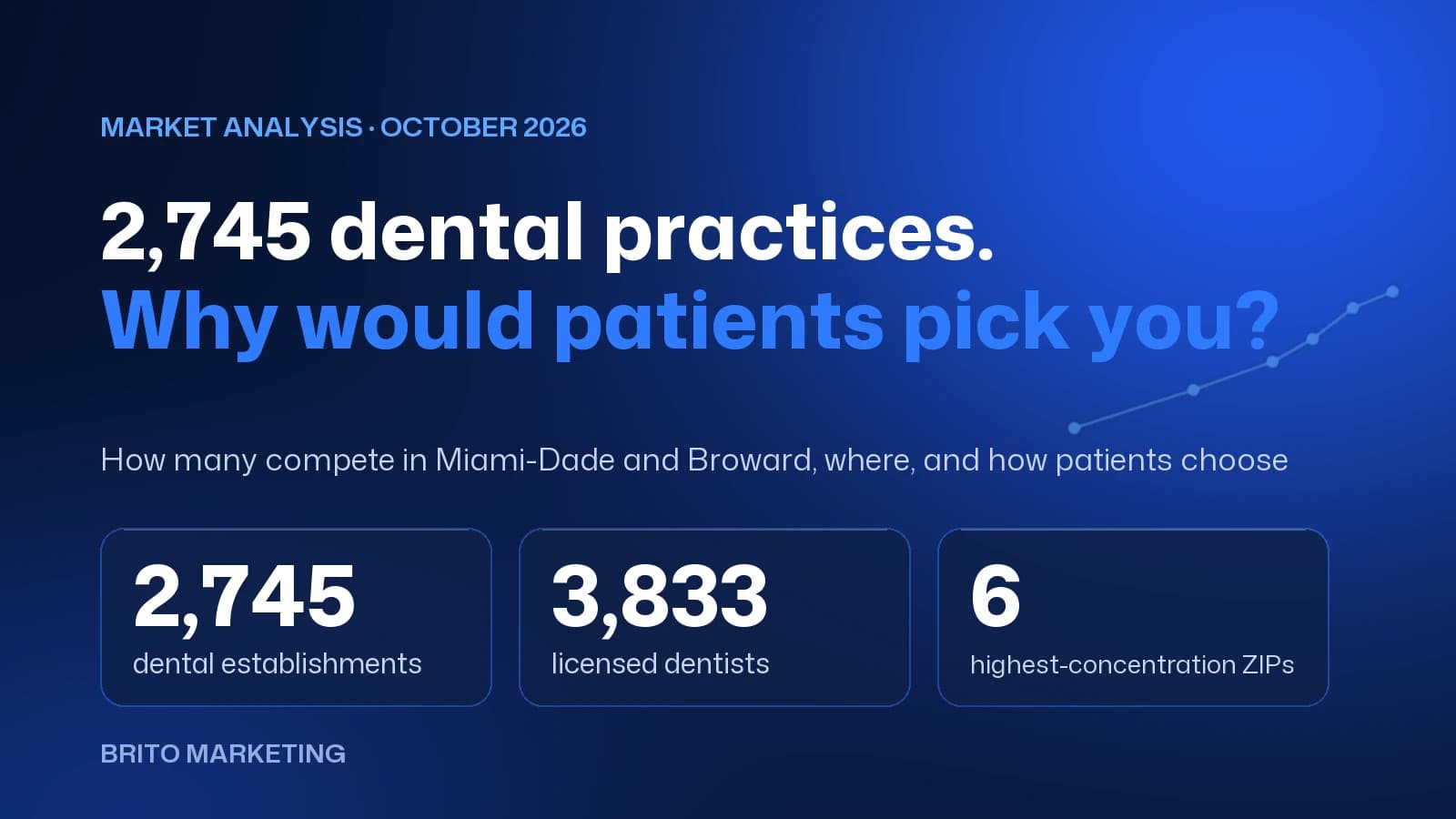
2,745 Dental Practices Compete in Miami-Dade and Broward: Why Would a Patient Choose Yours?
We measured the dental market in Miami-Dade and Broward with federal and state data: how many practices compete, which ZIP codes they cluster in and how patients choose today. There's no shortage of options, only of clear reasons to pick one.
Florida Lawyer Advertising Rules: What The Florida Bar Requires and How to Comply
What The Florida Bar's Rule 4-7 requires in a law firm's ads: name and city, language, testimonials, "expert" claims, actors, and filing with the Bar 20 days ahead. Every rule, with its number and source.