Content AI Cites: How to Write So AI Uses You as a Source
A study presented at KDD 2024 tested nine ways to rewrite content so AI search engines use it. Quotes, sourced statistics and citations won. Keyword stuffing didn't help.
Short answer
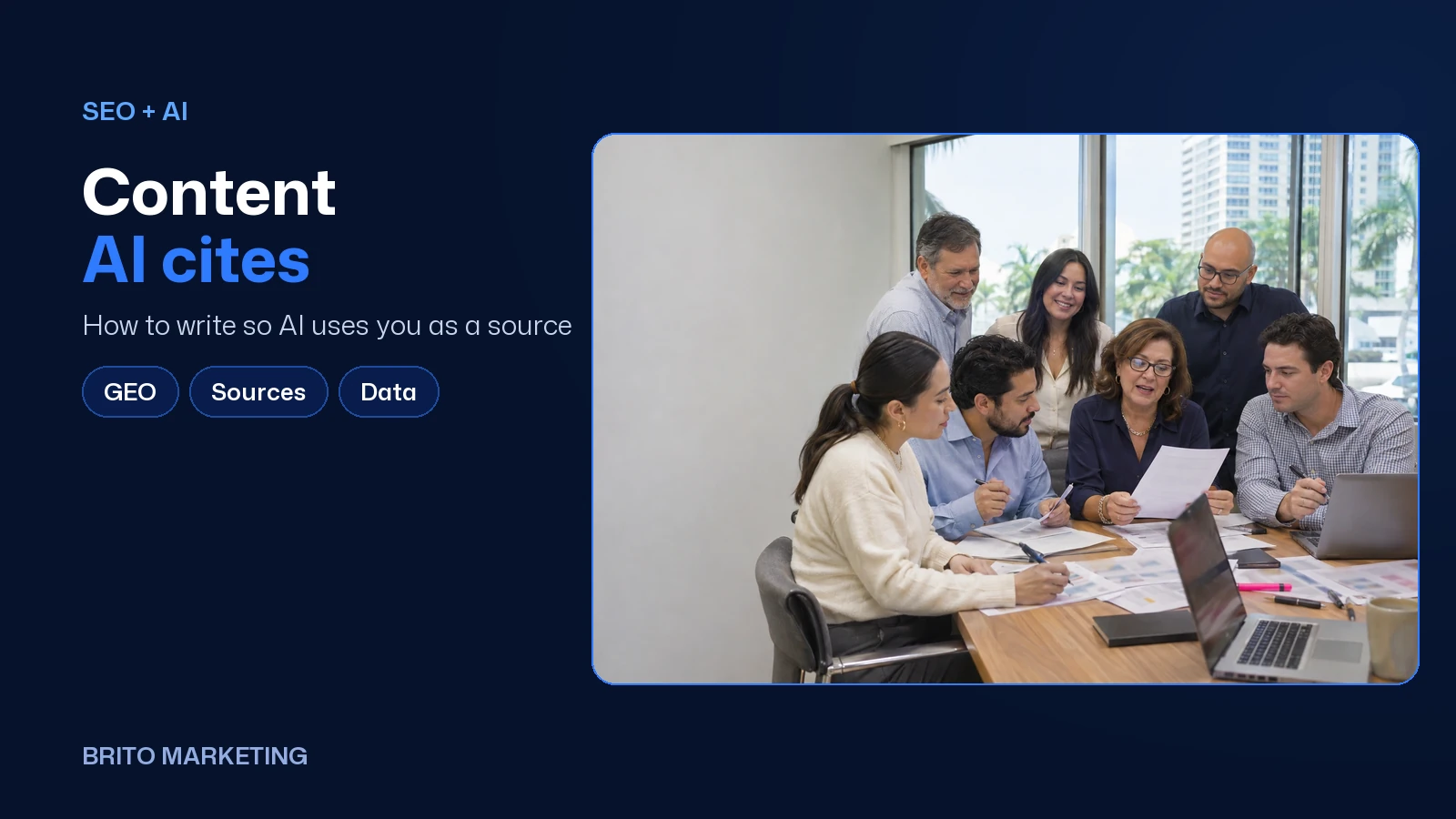
To get AI to use you as a source, write clear answers people can verify: statistics with their source, quotes from someone who knows the subject and links to where you got your facts. In the GEO study presented at KDD 2024, those three techniques did the most for visibility in AI answers, and stuffing in keywords didn't help.
We've already covered what SEO, AEO and GEO each do and the step-by-step for getting named by AI. This post zooms in on one piece of that puzzle: the writing itself. What makes a paragraph something ChatGPT, Perplexity or Google's AI summary will pick up and use? Fortunately, someone measured it, and the findings apply to any business that publishes content on its website.
What the GEO study measured
Researchers from Princeton University and IIT Delhi, along with two independent researchers, published “GEO: Generative Engine Optimization,” accepted at the KDD 2024 conference (Aggarwal et al., arXiv). They built a benchmark of 10,000 queries, rewrote the source pages nine different ways and measured how much of each page made it into the AI-generated answer, and how prominently. Among the things they tried: sounding more authoritative, adding statistics, citing sources, adding quotations, simplifying the language, using technical terms and repeating keywords.
The authors point to three techniques as the top performers: adding quotations, adding statistics and citing sources. The most useful finding for a small business is who gained the most: pages that weren't at the top of Google. Citing sources lifted visibility 115% for pages ranked fifth, as we covered in the step-by-step for getting named by AI, while the same move pulled the top-ranked page down. Put another way, in AI answers, well-supported writing can count for more than where you rank in classic search.

What the study shows, and what it doesn't
It's worth reading carefully. The main experiment used a search engine the authors built themselves, pulling the top five Google results and an OpenAI model from that period. They also reran part of the test on Perplexity, with results pointing the same way. So it's a serious measurement, but a lab one, from 2023 and 2024. It doesn't guarantee ChatGPT will cite you tomorrow. What it does make clear is the kind of writing these tools prefer when they decide where to pull an answer from.
1. Use numbers, and say where they come from
“Lots of patients look for a dentist online” helps nobody. “45% of consumers used an AI tool to get a local business recommendation, according to BrightLocal's 2026 survey” does, because anyone can check it. Use numbers from recognized sources or your own data, as long as it's real and you can explain it: “In 2026 we handled this many cases like yours.” What you never do is make up a number or round it up so it sounds better.
2. Quote someone who knows
A direct quote gives your content a named voice. For a local business, that voice is usually in-house: your dentist explaining when an implant makes sense, your attorney listing what to bring to a first consultation, your project manager describing which permit the city requires. Include their name, title and license where it applies. And if you're citing a law or regulation, quote the part that matters and link to the official text.
3. Link your sources
Citing sources was the technique that gave the biggest lift to pages that weren't already near the top. In practice it's simple: whenever you share a fact that isn't yours, link to the original page, not a blog that copied it. To an AI tool, that signals the content stands on something. To your customer, it's a way to check you're not blowing smoke.

4. Write so people understand you
The study also tested simpler language and smoother writing, and both did better than the original text. For a business, the rule hasn't changed: short sentences, one idea per paragraph and the words your customers use, not industry jargon. If your customers say “my tooth hurts,” don't just write “odontalgia.”
5. What doesn't work: keyword stuffing
Repeating “Miami dentist” ten times in a paragraph did nothing good. In the experiment, it actually scored below the untouched original. It's an old SEO habit that doesn't help customers today, and it won't help an AI tool pick you either.
Structure matters too
Beyond what you say, how you lay it out matters. In its 2025 guidance on AI search, Google notes that people now ask longer, more specific questions, calls for helpful, original content and warns against pages where the main information is hard to find (Google Search Central, 2025). In practice: open with a two- or three-sentence answer, use subheadings that are real questions and make every section stand on its own, because AI tools rarely take the whole page. And if you mark that information up properly, AI can read your site more easily.
| Technique | What it is | Local business example |
|---|---|---|
| Add statistics | Specific data with its source | “According to the ADA…” or “In 2026 we did X installs,” if it's true |
| Add quotations | A named person's own words | Your dentist or attorney walking through a typical case |
| Cite sources | Link to where the fact came from | A link to the statute, the study or the official agency |
| Clear, fluent language | Simple, well-connected sentences | “My tooth hurts” before the technical term |
| Keyword stuffing | Repeating the search phrase over and over | Skip it: it didn't help in the study |

Where to start
- Pick your most important service page and open it with a two- or three-sentence answer to the question you hear most.
- Add one real statistic with its link and one quote from a named team member, with their title.
- Cut any keyword repetition that sounds forced when you read it out loud.
Writing this way takes longer than writing filler, because you have to find the number, check it and talk to the person who knows. At Brito we treat it as part of a system: your website content, the video we shoot with your team and search on Google and in AI tools, in English and in Spanish, all connected to BritoCRM so you can see what brings in customers. We've worked out of Miami since 2006. In Miami-Dade and Broward we come to your business; farther out, we meet by video call. If you'd like to know which pages on your site have the best shot at getting cited by AI, request a free assessment, no strings attached.
Frequently asked questions
Do I need to write really long articles for AI to cite me?
No. What AI tools pull is usually a short section that answers one specific question. A clear page with solid answers beats a long piece full of filler.
My business is small. Where do I get statistics?
From public sources in your industry (trade associations, the Census Bureau, state agencies) or from your own numbers, as long as they're real and you can explain them. Always link the source, and never make one up.
Can I just have ChatGPT write my content?
It can help with a draft, but the numbers, quotes and sources have to be real and checked by someone on your team. What the study rewards, original and verifiable content, is exactly what an AI tool can't make up for you.
Does this replace traditional SEO?
No, it builds on it. AI tools usually start from pages they can already find through search, so a well-built, fast website is still the foundation. Writing this way gives them a reason to use you once they find you.
Twenty years building brands in New York, Las Vegas and Miami, where he's based today. He leads a Miami team that shoots commercials on cinema cameras and runs proprietary AI infrastructure. He believes great marketing starts with truly understanding the customer — and that honesty, often frowned upon in this industry, is what separates partners from vendors.
View profile→Questions about your business?
The first conversation is an assessment, not a sales pitch. Let's talk.
Or explore our Search + AI (SEO & AEO) service
Study: Who ChatGPT and Perplexity Recommend When You Look for a Marketing Agency in Miami (October 2026)
We asked ChatGPT and Perplexity the same 50 questions, in English and Spanish. The AI named more than 100 different businesses, none in more than 4 answers, and for city searches it almost always picked someone from that city. Data, method and limits.

AI Marketing Without Losing the Human Voice
AI speeds up almost everything in marketing. But there's one thing it does badly, and your customers notice instantly.