SEO vs. AEO vs. GEO: What Each One Does and Which Your Business Needs
Three acronyms that sound alike but do different jobs. What each one does, where it gets you seen, how you measure it and which one to start with for your kind of business, all side by side in one table.
Short answer
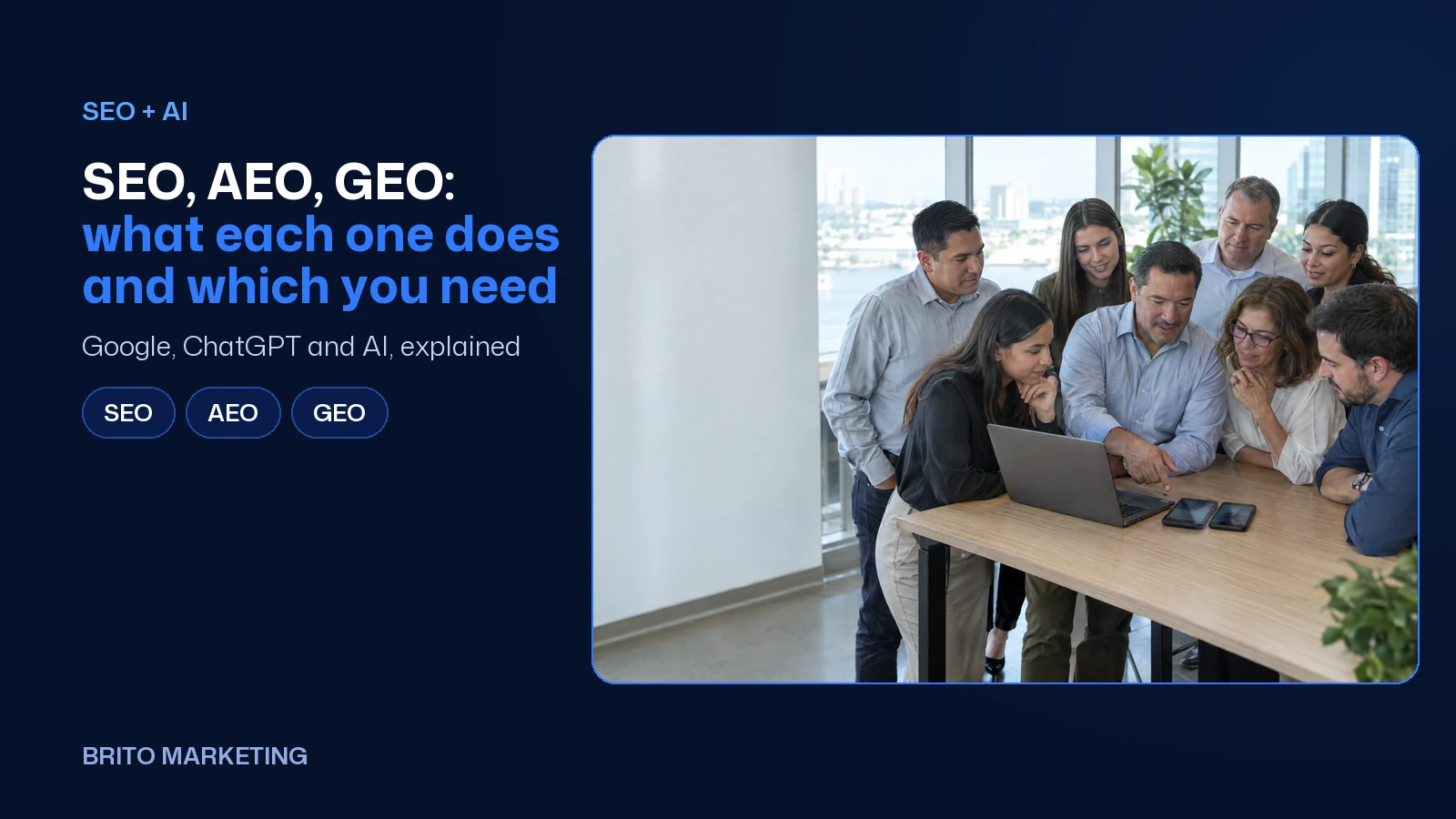
SEO gets you into Google’s search results and the map. AEO aims to make your content the direct answer Google or a voice assistant gives to a question. GEO aims to get ChatGPT, Gemini or Perplexity to name you when they put together a recommendation. Most businesses need all three, and all three sit on the same foundation.
If someone has pitched you AEO or GEO this past year, you probably walked away wondering whether it’s one more thing to pay for or just SEO wearing a new name tag. The honest answer: they share most of the same groundwork, but each one targets a different place where your customer makes up their mind. Below, we line them up side by side, using a South Florida service business as the example, so you can see which one you’re missing.
One question, three different places
Picture a mom in Kendall looking for a pediatric-friendly dentist who takes her insurance. She can type that into Google and scan the map with three practices and the list of websites underneath. That’s SEO. Google might answer her at the top with an AI-generated summary, or she might ask her phone out loud. That’s AEO. Or she might open ChatGPT and type, “Recommend a kids’ dentist in Kendall who takes my insurance.” That’s GEO.
Same question. What changes is who answers it, and how. Google hands her options to choose from. The summary and the voice assistant hand her an answer. ChatGPT hands her two or three names with a reason for each. If your practice only shows up in one of those places, the decision gets made without you in the other two.
SEO: getting found in the results and on the map
SEO, or search engine optimization, has been doing its job for more than twenty years: getting your website and your Google Business Profile near the top when someone searches for what you sell in your area. For a local business, half the work happens on the map: a complete profile, reviews, the right categories, and your name, address and phone number written exactly the same everywhere. The other half is your website: a page for each service, fast on a phone, written in the words your customers actually use.
- You measure it with Google rankings, website visits, and the calls and direction requests that come from your profile.
- It takes months to build and holds up as long as you keep it maintained.
- For the full local playbook, here’s our guide to local SEO in Miami.

AEO: making the answer come from you
AEO, or answer engine optimization, is about making sure that when someone asks a specific question, the answer comes from your content. It plays out in the AI summaries Google shows at the top, in featured snippets and in voice assistants. These are the questions people ask before they buy: “How long does a dental crown last?” “What does renters insurance cover in Florida?” “Do I need a permit to replace my roof?”
It matters because people click less when a summary shows up. Pew Research Center tracked real searches by 900 U.S. adults in March 2025. About 18% of those searches produced an AI summary, and when one appeared, people clicked a traditional result on 8% of visits, compared with 15% when there was no summary (Pew Research Center, 2025). If the answer is yours, at least the person read your name, even if they never landed on your site.
GEO: getting named when AI makes a recommendation
GEO, or generative engine optimization, is the newest of the three. The term comes from an academic paper accepted at the KDD 2024 conference. The researchers tested ways of rewriting content so it shows up more often in AI search answers and found visibility could rise by up to 40% (Aggarwal et al., KDD 2024). Here you’re not fighting for a spot on a list anymore. You’re fighting to be one of the two or three names the AI actually writes into its answer.
To decide, AI tools cross-check what your website says against what everyone else says about you: reviews, directories, best-of lists, third-party articles. We measured this in our own industry in October 2026 and found that claims that live only on your own site carry little weight unless someone else backs them up. The details are in our study of who AI recommends in Miami.

Ready to apply this to your business?
All three, side by side
| SEO | AEO | GEO | |
|---|---|---|---|
| Where you show up | Google’s results and the map | Google’s AI summary, featured snippets, voice assistants | Answers from ChatGPT, Gemini, Perplexity and other AI tools |
| What the person wants | Options to compare | A quick answer to a question | A recommendation with names |
| What it asks of you | A complete profile, a fast site, one page per service | Clear, short answers to real questions | Matching info everywhere and third-party mentions |
| How you measure it | Rankings, visits, calls from your profile | Search Console impressions and appearances in the summary | Ask several AI tools every month and note whether you’re named |
| Most common mistake | A nice-looking site with no service pages | Answers buried in long paragraphs | Relying only on what your own site says |
What they share, and why you don’t have to pick one
Here’s the part most pitches leave out. Google’s own guidance for site owners says there are no extra requirements or special optimizations needed to appear in its AI features. Your page has to be indexed and eligible to show with a snippet, the same as regular SEO (Google Search Central). In other words, AEO is built on top of solid SEO.
GEO works much the same way. AI tools need to be able to read your website, find details that match your Google profile and see that other people talk about you. If your profile is half-finished and your site doesn’t explain what you do, no acronym is going to rescue you. So think of the three as floors of the same building. For the long version of the second and third floors, read the complete AEO and GEO guide, and for the finer line between the first two, see AEO vs SEO.
Which one does your business need first?
- If your Google profile isn’t verified or your site doesn’t have a page for each service, start with local SEO. Without it, nothing else has anything to hold on to.
- If your customers ask a lot of questions before they buy (clinics, law firms, insurance, construction), add AEO and write out answers to the ten questions you hear most on the phone.
- If you compete in a city where customers already ask ChatGPT for recommendations, work on GEO: reviews that mention your service and your neighborhood, plus listings in your industry’s directories and best-of lists.
- If you serve customers in English and Spanish, do it in both. AI tools pull from different sources in each language, so you can be visible in one and invisible in the other.

Where to start
- Ask your customer’s question in Google, Gemini and ChatGPT, something like “[your service] in [your city].” Note which of the three you show up in.
- List the ten questions people ask before they hire you, then check whether your website answers each one in two or three sentences.
- Compare your name, address, phone number and hours on your Google profile, your website, Facebook and Yelp. Fix any mismatch this week.
Running all three at once is a lot for someone who’s also serving customers and making payroll. At Brito we treat it as one system: your website, SEO, answers built for AI, video we shoot ourselves and BritoCRM, all connected to sales, in English and in Spanish. We’ve been doing it from Miami since 2006. In Miami-Dade and Broward we come to your business; if you’re farther away, we meet by phone or video call. If you’d like to know which of the three you’re missing, you can request a free assessment and we’ll go through it with you, no strings attached.
Frequently asked questions
Do AEO and GEO replace SEO?
No. Google says its AI features don’t require special optimizations; the same SEO fundamentals apply. AEO and GEO are built on top of a solid profile and website.
Do I have to pay for three separate services?
It doesn’t have to work that way. Much of the work counts for all three at once: your Google profile, service pages, answers to real questions and reviews. What helps is one strategy tying them together.
How do I know if AI already recommends me?
Ask ChatGPT, Gemini and Perplexity the same thing your customer would ask, in English and in Spanish, and note whether you come up. Repeat it every month with the same questions to see what changes.
My business is small. Where should I start?
With local SEO: a complete, verified Google profile and a website with a page for each service. That’s the base Google and AI tools later read from when they answer and recommend.
Twenty years building brands in New York, Las Vegas and Miami, where he's based today. He leads a Miami team that shoots commercials on cinema cameras and runs proprietary AI infrastructure. He believes great marketing starts with truly understanding the customer — and that honesty, often frowned upon in this industry, is what separates partners from vendors.
View profile→Questions about your business?
The first conversation is an assessment, not a sales pitch. Let's talk.
Or explore our Search + AI (SEO & AEO) service
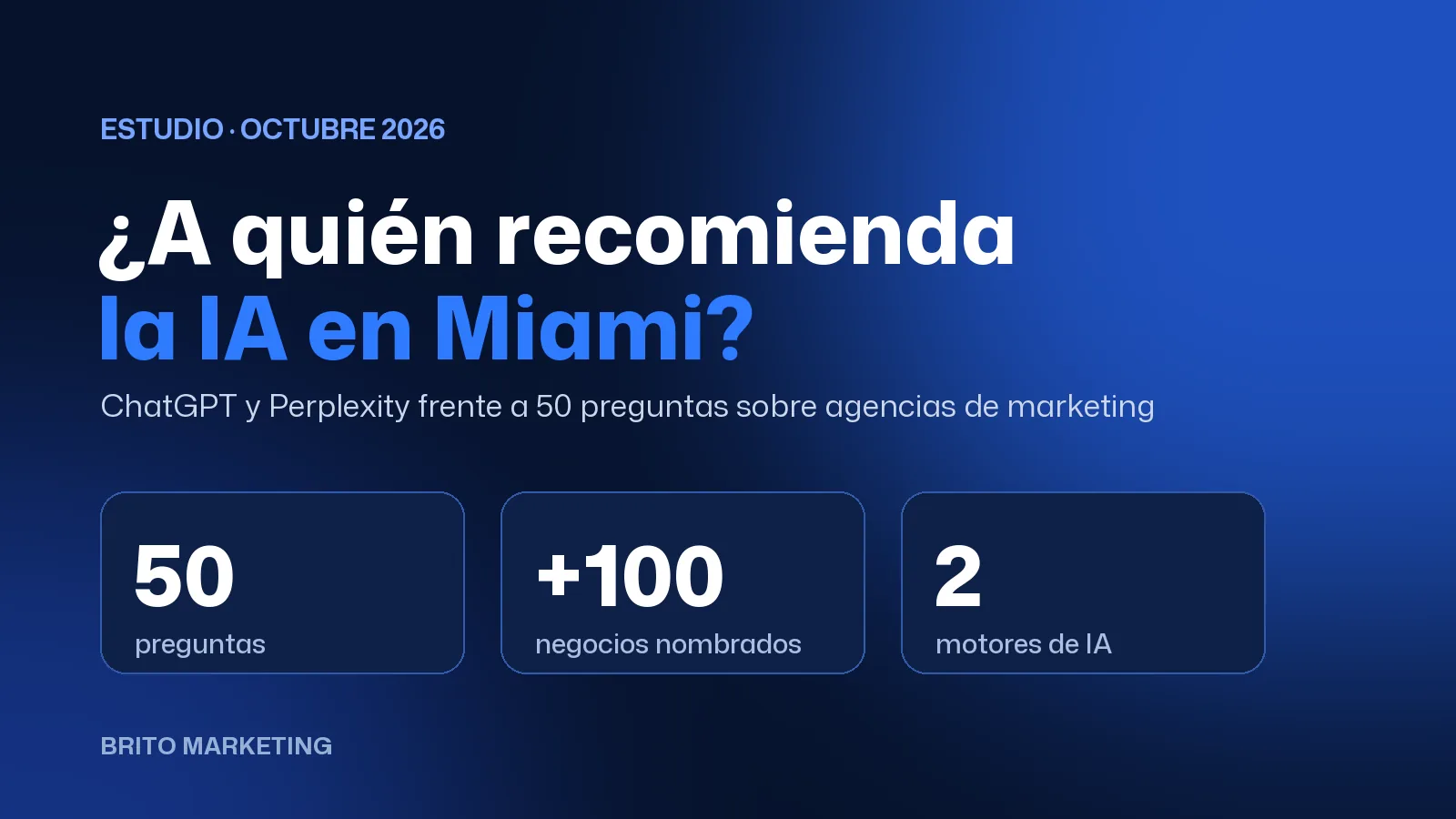
Study: Who ChatGPT and Perplexity Recommend When You Look for a Marketing Agency in Miami (October 2026)
We asked ChatGPT and Perplexity the same 50 questions, in English and Spanish. The AI named more than 100 different businesses, none in more than 4 answers, and for city searches it almost always picked someone from that city. Data, method and limits.

AI Marketing Without Losing the Human Voice
AI speeds up almost everything in marketing. But there's one thing it does badly, and your customers notice instantly.