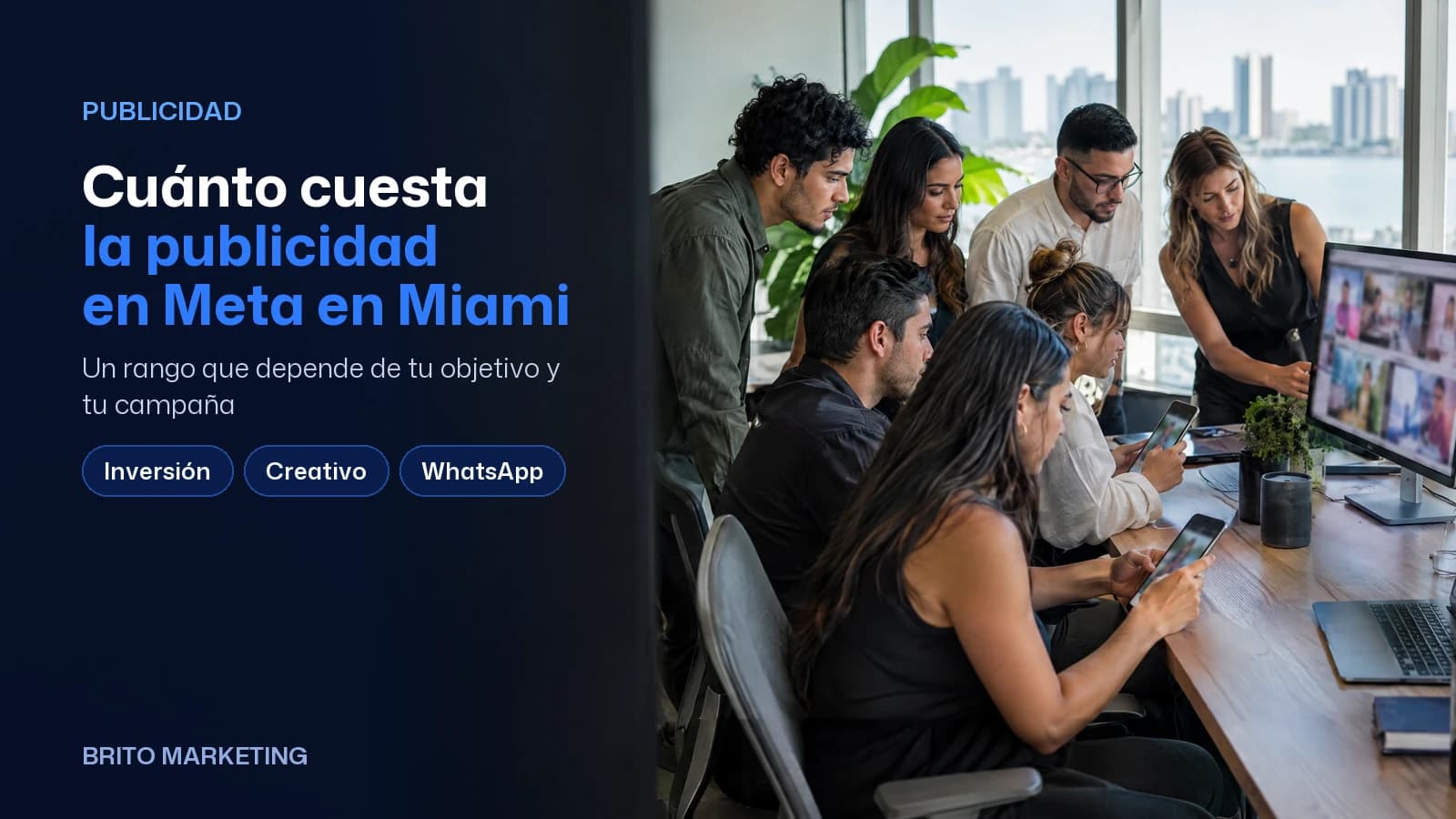
What Meta Advertising Costs for a Business in Miami
The first question every owner asks. The honest answer isn't a fixed number: it's a range that depends on your goal, your market and the campaign.
Short answer
There's no fixed price: it's two separate costs — what you spend on Meta (can start at a few hundred dollars a month) and the campaign management, on top. What moves the real cost is your goal, your local competition, the creative quality and the targeting. First data lands in days; optimizing takes four to six weeks.
“How much does advertising on Facebook and Instagram cost?” is the first question we get. And the honest answer makes some people uncomfortable: it depends. Not because we want to dodge it, but because a number with no context would lead you to a bad decision.
The two costs you need to keep separate
There are two different costs: what you pay Meta (the ad spend, which goes straight to the platforms) and what you pay whoever runs the campaign (the management). Mixing them is the first mistake. Your media budget can start at a few hundred dollars a month; professional management is separate, and it's what makes those dollars perform instead of burn.
What actually moves the cost
- Your goal: chasing brand awareness doesn't cost the same as generating leads that close sales.
- Your local competition: in Brickell or Doral more businesses are bidding for the same audience, which raises the cost per result.
- Ad quality: a strong creative and message drop your cost per lead dramatically. This is where you win or lose the most.
- Targeting: reaching the right audience — in English, in Spanish, or in both — is the difference between empty clicks and customers.
The mistake that costs the most
The costliest isn't investing too little — it's investing with no strategy. Putting money in, getting clicks, and at the end of the month not knowing if it was worth it. Every wasted dollar hurts more in a tightening market. That's why we measure everything and translate it into something you understand: did this bring you customers or not?
What to expect from a well-built campaign
First data lands in days. Serious optimization takes four to six weeks to start performing well, because the system learns and we adjust. What's not normal is paying for months without a clear report of what came in, what went out and what's next.
If you want a realistic range for your specific case, the first conversation is a diagnosis, not a sale. We'll tell you if ads are for you — and how we'd make them perform.

The creative decides more than any setting
In Doral I watched two restaurants run ads the same month, same budget, same audience. One filled up; the other barely got a bite. The difference wasn't the targeting or the bidding — it was the ad itself. The first shot a vertical video of the owner showing the dish coming out of the kitchen, talking the way he'd talk to a neighbor; the other posted a generic stock photo with text slapped on top. Meta rewards whatever makes people stop scrolling: the first three seconds, a real face, the actual product, a message that sounds like a person and not a brochure. You can have flawless targeting, but if the creative doesn't grab attention, you're paying to be ignored.
Your Miami audience isn't one single block
This is the mistake that stings the most. A lot of people target "all of Miami" or a single demographic as if their audience were one person. It isn't. The homeowner in Kendall, the executive in Brickell, the young family in Doral, and the tourist landing in South Beach don't search the same, don't buy the same, and don't trust the same things. Good targeting isn't guessing who someone is and stapling a cliché to it. It's understanding the behavior, the need, and the actual language that person searches in. You define a customer by what they need today, not by the label you assume they wear.
- Target by behavior and intent — what they're looking for, what problem they have — before you make assumptions.
- Respect the real language: the same business needs ads in both Spanish and English, because the same customer searches in both.
- Use the neighborhood (Hialeah, Doral, Homestead) as a context clue, not a stereotype.
- Let the numbers, not your biases, tell you who the ad is actually working on.
Ready to apply this to your business?
How we build a Meta audience when your customers live in two languages
Now for the hands-on part: what we touch in Ads Manager and what we leave alone, because several settings don't do what their names suggest.
Language, interests, and location: what each setting really does
- Language: Meta mostly goes by the language someone uses Facebook or Instagram in, not the one they speak at home. Plenty of bilingual people here keep their phone in English and watch videos in Spanish; target Spanish only and you shut them out. Most of the time, let the language of the ad do the filtering.
- Interests: pick them by the need (redoing the kitchen, taking care of their teeth, planning a party), not by who you think the person is. And Meta often treats them as a hint, not a fence: if it finds people more likely to respond, it goes past them.
- Location: draw the map from the addresses of the customers you already have, not “all of South Florida,” and exclude the areas you don't serve.
- Background: Meta already pulled the ethnic-affinity targeting that some old guides still recommend. If someone offers it to you, they're working off an expired map.
- Special categories: if you advertise housing, jobs, credit, or financial services, Meta makes you declare it and takes away options like age, ZIP code, and lookalike audiences. Know that before you plan.
What actually sharpens it: your own data and one creative per language
The sharpest audiences come from people who've already been in touch with you: your customer list, people who visited your site, people who messaged you on Instagram or your Facebook page, people who watched a good chunk of one of your videos. That's where language sorts itself out: build one audience from the people who watched your Spanish video and another from the ones who watched the English version, and keep talking to each group in the language they responded to. Build your lookalike audiences from customers who actually paid, not everyone who asked; we have a separate guide on the blog about that.
- Write each version from scratch, thinking in that language. If it reads like a translation, people catch it in the first line.
- Keep the audio, captions, and copy in the same language. A video spoken in English with Spanish captions doesn't really land with anyone.
- Change more than the words: the example, the reference, who's on camera.
- One version per ad: a paragraph in English and another in Spanish in the same copy doesn't speak well to anyone. If your customer switches languages mid-sentence, that mix can be its own version.

WhatsApp: the button that changes everything in Miami
Here's something out-of-town agencies don't get about Miami: a lot of customers here don't fill out forms or sit around waiting for an email. They message you on WhatsApp. Click-to-WhatsApp ads take a person straight from the ad into a chat with you, with no middle steps to lose them in. For a shop in Westchester, a clinic in Kendall, or anyone who sells over chat, that can outperform sending traffic to a website. But it only works if you answer fast — a message left sitting for two days is money thrown away. Not every business needs it, but for a lot of businesses here it's the difference between a click and a real conversation.
How to know if it's working: count customers, not likes
Likes and reach look great on your phone, but they don't pay the rent. The only question that matters at the end of the month is: how much did each customer who actually walked in cost me? To answer it you have to follow the whole trail — from the ad to the message or lead, and from the lead to the closed sale. That's where a CRM like BritoCRM earns its keep: not to look modern, but so you know exactly what it cost to bring each customer and how much they spent with you. If what a customer spends with you comfortably beats what it cost to bring them in, it doesn't matter how many likes the ad got. And if nobody can tell you that number, you're measuring vanity, not results.

The expensive mistakes we see all the time
Beyond investing with no strategy, there are concrete slip-ups that cost owners money week after week. These are the ones we flag most with new clients:
- Killing the campaign after three days because "nothing happened." The system is barely learning; shutting it down early throws away what you spent.
- Changing everything every two days. If you never let a campaign breathe, you'll never know what worked.
- Hitting "boost post" and thinking that's a campaign. It's the most expensive, least profitable button on Meta.
- Sending traffic to a slow website, a dead profile, or a number nobody answers.
- Talking only in English to a customer who found you in Spanish — or the other way around.
Sometimes the honest answer is: not yet
I'll say this even though it's how I make a living: some businesses aren't ready to pay for ads, and throwing money at it only makes the problem grow faster. If your website takes forever to load, if your Instagram has been dead for months, or if there's nobody to answer the messages that are about to come in, ads won't save you — they'll expose the gap faster and hand you the bill. It's like opening the tap with a broken pipe: the more pressure, the more water you lose. In those cases the best investment isn't the ad, it's fixing where people land first. Sometimes the honest answer is "not yet" — and we'll tell you that too.
Frequently asked questions
Do I need a website to run Meta ads, or can I send everything to WhatsApp or Instagram?
Not always. For a lot of businesses here, sending the ad straight to WhatsApp or your profile works fine, as long as you answer fast. But if you sell something people research or compare before deciding, a fast page that explains it well helps you close. In the first call we'll tell you which one makes sense for your case.
Is hitting "Boost post" the same as running a real campaign?
No. The "Boost" button is the toy version: you put in money and Meta decides almost everything for you. A campaign built in Ads Manager gives you real control over the objective, the audience, placements, and measurement. Boosting is fine for a quick visibility bump; to bring in customers seriously, you need the second one.
Do I have to run my ads in both English and Spanish?
It depends on who you're selling to, not on some fixed rule. If your customer lives their day in Spanish, talk to them in real Spanish, not English run through a translator. Plenty of Miami businesses run both versions and let the numbers say which one performs. What matters is that each ad sounds like a person, not a Google translation.
Can I make my Meta ads reach only Hispanic customers?
Not the way you used to, and you don't need to. Meta removed the options to target by ethnic affinity, so nobody can sell you that filter today. What does work is combining the language of the ad, interests tied to what you sell, the area you serve, and audiences built from your own customers. In the end, the people who respond to a good Spanish-language ad are exactly the ones you wanted to find, without slapping a label on anyone first.
Twenty years building brands in New York, Las Vegas and Miami, where he's based today. He leads a Miami team that shoots commercials on cinema cameras and runs proprietary AI infrastructure. He believes great marketing starts with truly understanding the customer — and that honesty, often frowned upon in this industry, is what separates partners from vendors.
View profile→Questions about your business?
The first conversation is an assessment, not a sales pitch. Let's talk.
Or explore our AI Advertising service

Florida Lawyer Advertising Rules: What The Florida Bar Requires and How to Comply
What The Florida Bar's Rule 4-7 requires in a law firm's ads: name and city, language, testimonials, "expert" claims, actors, and filing with the Bar 20 days ahead. Every rule, with its number and source.
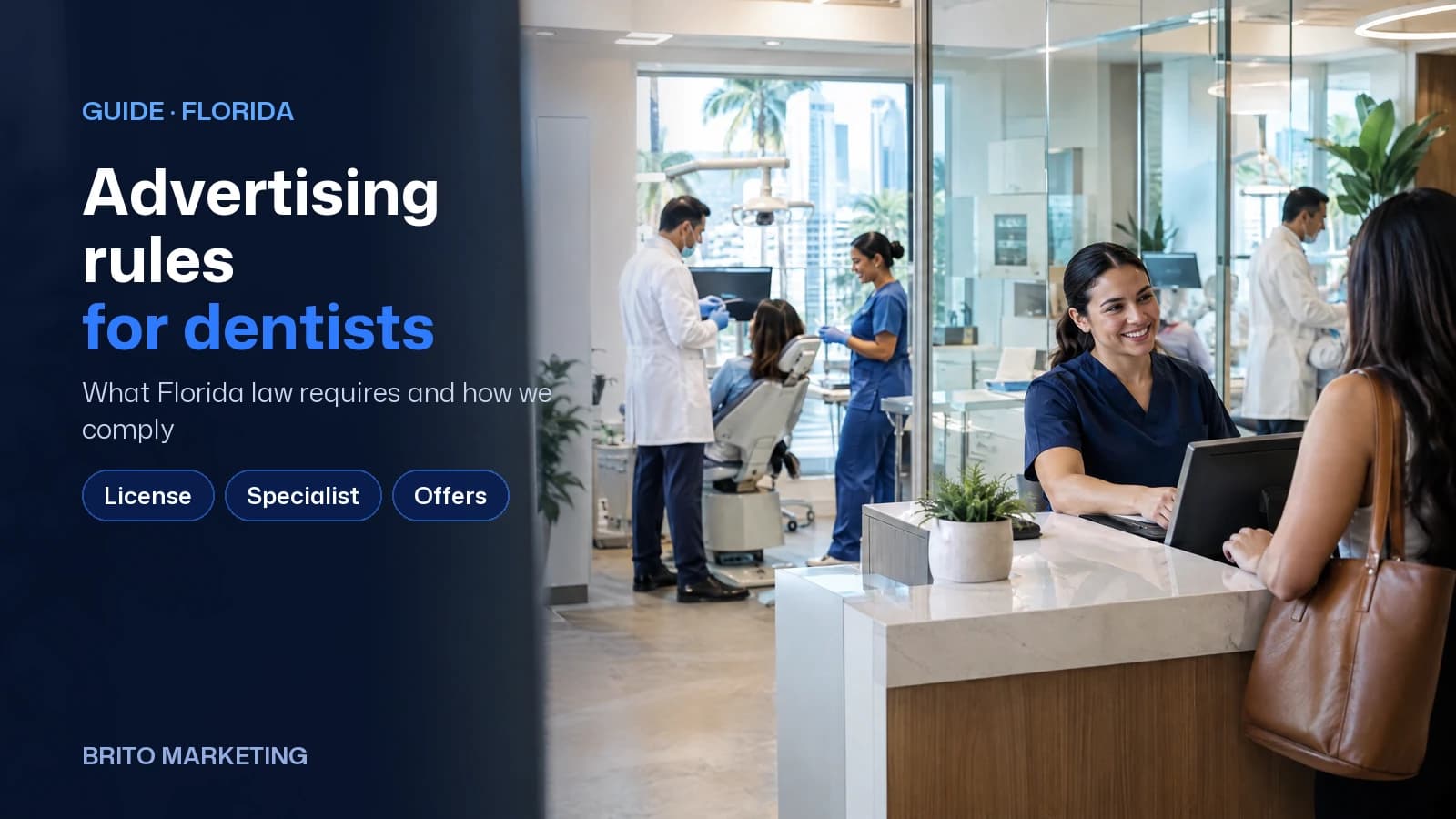
Florida Dental Advertising Rules: What the Law Requires and How to Comply
What Florida law requires in a dental practice's ads: identifying the dentist, no praise or comparisons, "specialist" only with the credential, the 72-hour notice on offers, and how to advertise prices. Every rule, with its citation and source.