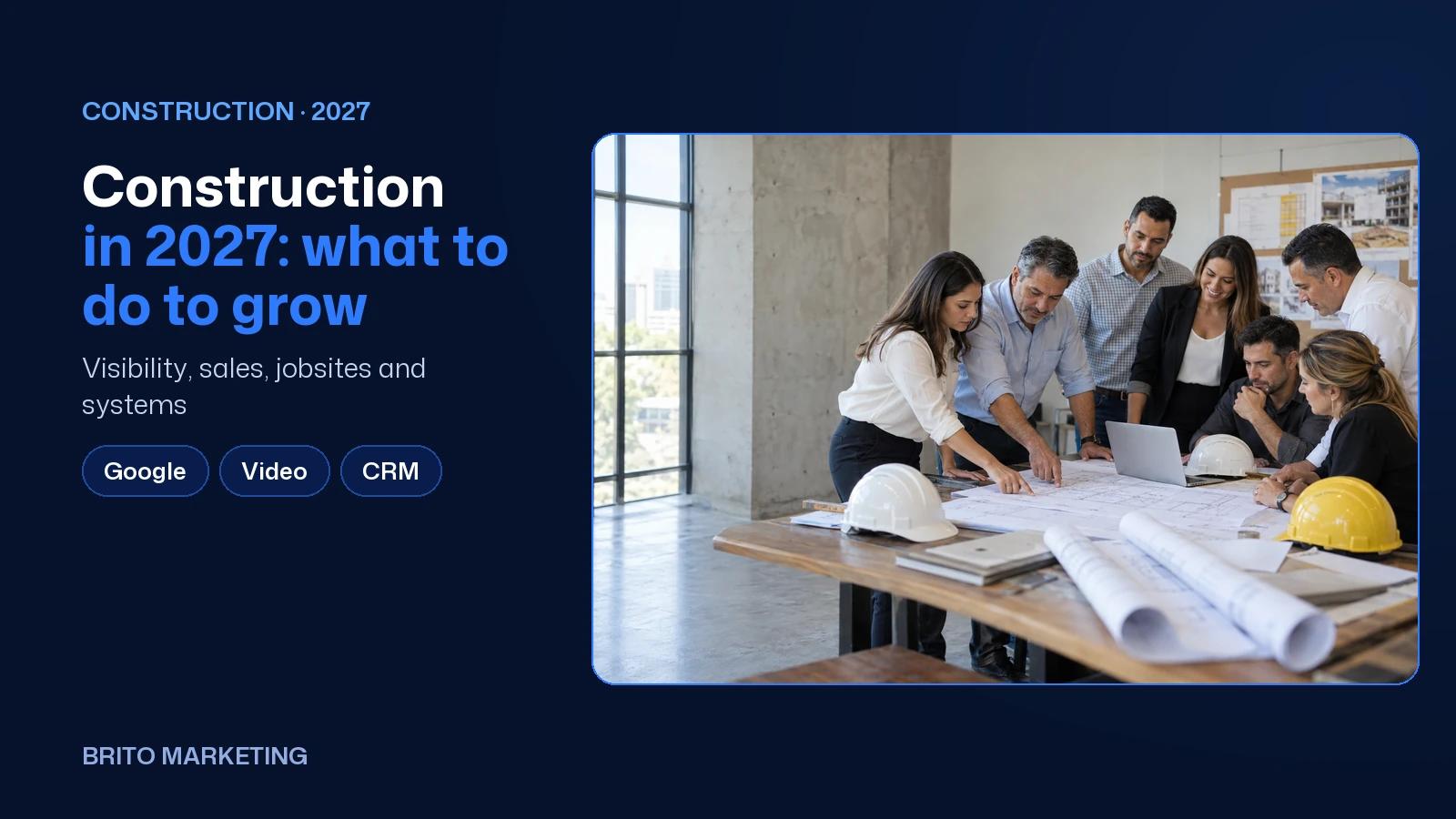
Construction in 2027: What Companies Should Do to Grow
What a South Florida construction company should change in 2027: Google and AI search, jobsite video, reviews, estimate follow-up, operations, CRM, and a quarter-by-quarter plan.
Short answer
In 2027, a construction company grows when customers can find it where they already look (Google, AI answers, reviews and video), when it responds to every request fast, when it runs sales and jobs through a CRM, and when it uses AI for office work without handing it jobsite decisions. Even better in English and Spanish.
If you build in South Florida, you're juggling two problems at once: landing good projects and finding people to do them. In the 2025 AGC and NCCER workforce survey, 92% of construction firms said they were having a hard time filling open positions, and 45% said labor shortages were causing project delays (AGC, August 2025). That changes how you should market. The smart goal for 2027 is to attract the projects your crews can deliver well and on schedule, and stop chasing the ones that blow up your calendar.
Marketing and visibility: Google and AI search
When a family in Kendall finds a roof leak or a property manager in Doral needs an office build-out, the first move is a search: Google, Maps, and more and more often an AI assistant. BrightLocal found that the share of consumers using ChatGPT and other AI tools for local business recommendations jumped from 6% to 45% in a single year (BrightLocal, 2026). Those tools recommend the companies whose information online is clear, complete and consistent.
- Fill out your Google Business Profile with every service you actually do (roofing, kitchens, baths, flooring, commercial work), the cities you serve, and photos of finished jobs.
- Build a page on your site for each service and each key area, answering the questions you hear every day in two or three sentences: how long a permit takes, what happens if it rains, what the estimate covers.
- Put your license number on your website, your ads and your lettered trucks. Florida requires it, and we walk through it in our guide to Florida construction advertising rules.
- Make sure your name, address and phone number match exactly on Google, Yelp, Nextdoor, Houzz, the BBB and your website. Small mismatches confuse both Google and AI tools.
One thing a lot of companies miss: publish in both languages. A homeowner in Hialeah types “remodelación de baño cerca de mí” while the neighbor in Weston types “bathroom remodel near me.” If your site only answers in one of them, Google and AI tools have half the information they need to recommend you.

Social media and video
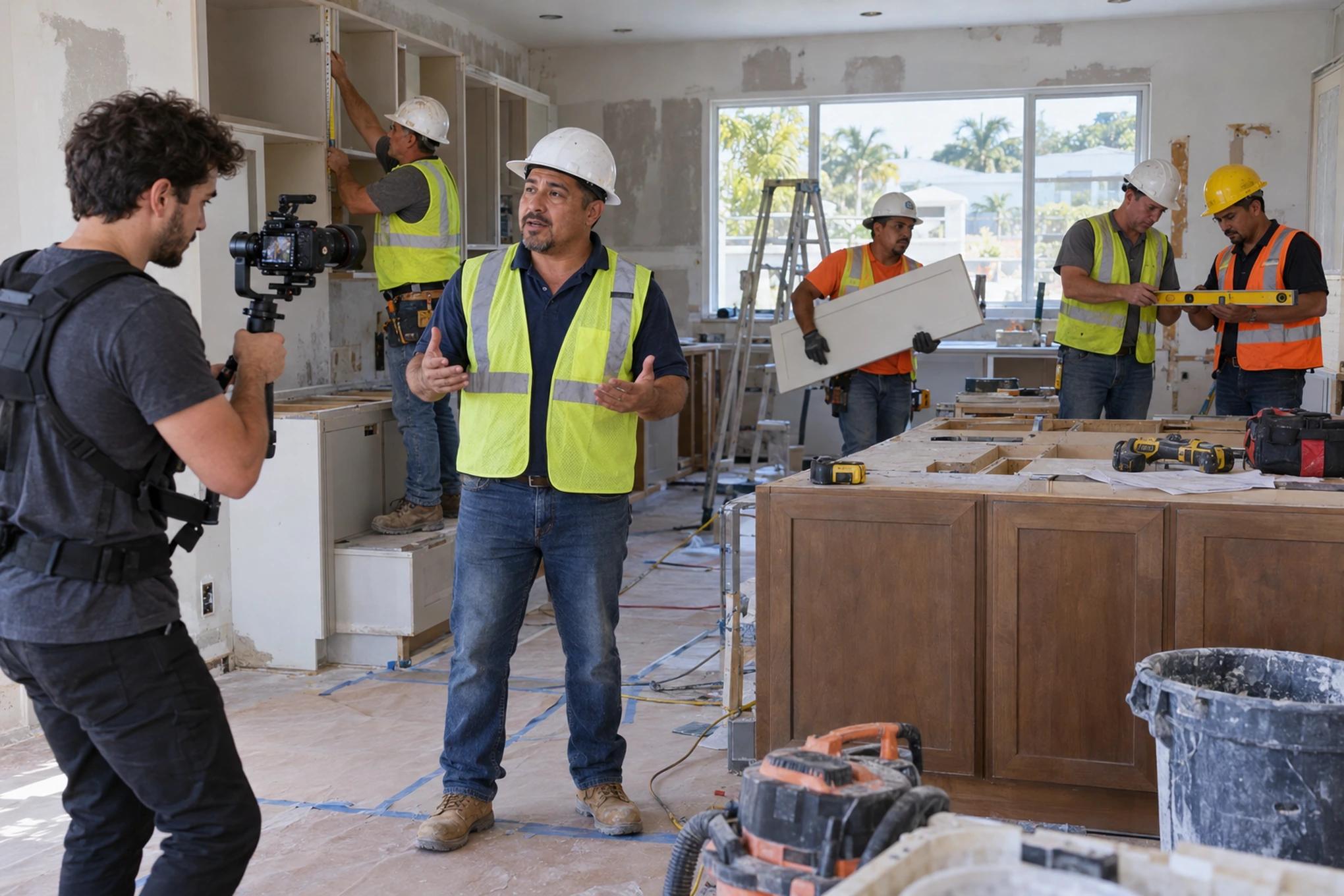
In construction, video does a lot of the selling because customers want to see how you work. A real before-and-after shot from the same angle says more than any tagline. And a 30-second walkthrough where your foreman explains what was done, and why, builds the kind of trust a single photo can't.
- Film every job at three points: the problem, the work in progress and the handoff. A phone and decent light are enough to start.
- Get written permission before showing a customer's home or business, and never show the exact address.
- Post on Instagram, Facebook and YouTube Shorts. For residential work, Nextdoor is a strong fit because it's organized by neighborhood.
- Feature your crew by name and trade. In an industry where hiring is this hard, that video doubles as a recruiting tool.
What about TikTok? It's worth it if you sell to homeowners and can post often. If you mostly do commercial work, LinkedIn and YouTube usually pay off more, since that's where property managers, architects and business owners spend their time.
Reviews and reputation
A remodel is one of the biggest checks a family writes, so people read before they call. In BrightLocal's 2026 survey, 74% of consumers look for reviews from the last three months, and 31% will only use a business rated 4.5 stars or higher (BrightLocal, 2026). A company with 200 reviews from years ago and nothing recent looks like it's slowed down.
- Ask for the review on handoff day, while the customer is standing in the finished space, and text or WhatsApp them the direct link.
- Reply to every review, bad ones included, calmly and with facts: what happened and how you fixed it.
- Ask customers to mention the type of job and the city, like “kitchen remodel in Coral Gables.” That helps Google and AI tools understand what you do and where.
- Never pay for reviews or offer anything in exchange. Google and the FTC both prohibit it.
Sales and lead follow-up
In construction, leads go cold fast. A homeowner collecting three estimates often goes with whoever called back first and showed up to measure, even if they weren't the cheapest. The working rule for 2027: respond within minutes, book the visit in that same conversation, and follow up until you get a yes or a no.
- Respond to every request as fast as you can during business hours, even if it's only to book the visit.
- Qualify with four questions: what's the job, what city, when do they want to start, and do they already have plans or permits.
- Send estimates with photos, a clear scope and what's NOT included. That way there are no surprises at the end, which is where a lot of customer relationships fall apart.
- Schedule your follow-ups up front: two days, one week and one month out.
- Track why you lose each job: price, timing, or nobody called back. That data is gold when you adjust your ad spend.
And don't forget the people who already hired you. A quick text six months later asking how the job is holding up opens the door to the next project and to referrals, which still carry a lot of weight in this business.
Ready to apply this to your business?
Operations
When nearly half of firms are already seeing labor-related delays, operations become part of your marketing. Every job that runs late without warning turns into a lukewarm review or a customer who never refers you. Whatever sales promises, the field has to be able to deliver.
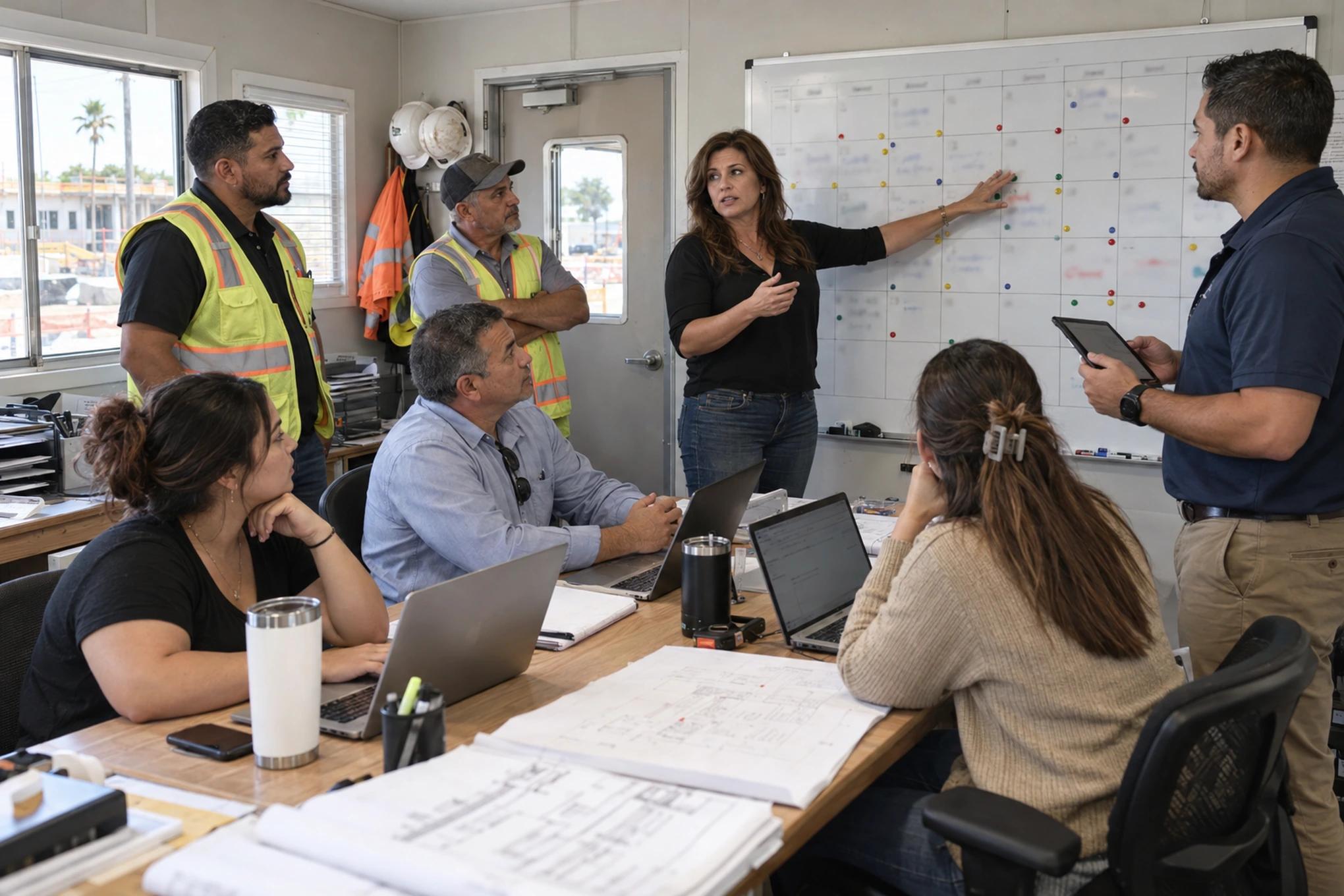
- Keep a real capacity calendar: how many crews you have and how many jobs fit each month. When it's full, pull back on ads before you sell work you can't deliver.
- Send each customer a weekly update with photos. One short message saves you ten phone calls.
- Have a hurricane season plan: what happens to open jobs, how materials get secured, and how you communicate schedule changes.
- Write down the processes that only live in the owner's head today: how you measure, how you price and how you hand off a job.
Systems and CRM
Plenty of construction companies still keep their customers spread across the owner's cell phone, a notebook and the office WhatsApp. That works until someone gets sick or a phone goes missing. A CRM puts every request, call, estimate and follow-up in one place, and shows you where the jobs you actually close are coming from.
- Connect your website forms, ads, phone calls and WhatsApp to the CRM.
- Keep the stages simple: new, visit booked, estimate sent, won and lost.
- Check three numbers every month: requests, visits and closed jobs, broken out by source.
- Set up automatic appointment and follow-up reminders in each customer's language.
Sometimes it pays to go a step past the CRM. For D&J The Pool Resurfacers in Orlando, we launched a 3D pool designer right on their website, so customers can design their pool before they ask for a quote. That way, people come into the conversation already knowing what they want.
Artificial intelligence: what to use it for and what to avoid
AI is already saving construction offices hours every week, as long as someone experienced reviews what it produces. The safe ground is admin work. Technical calls stay with you.
Use it for
- Answering after-hours inquiries right away and booking the measuring visit.
- Summarizing calls, jobsite notes and customer meetings.
- Drafting first versions of proposals, emails and project descriptions.
- Turning messages into Spanish or English, with a person checking them before they go out.
Don't use it for
- Giving final prices or promising completion dates.
- Posting AI-generated images as if they were your own jobs.
- Making calls on safety, building code or permits.
- Publishing copy without checking that your license, contact details and scope of work are right.
| Quarter | Focus | Actions |
|---|---|---|
| Q1 · January to March | The foundation | Complete Google profile, license number on every ad and truck, matching details across directories, and a CRM connected to your site and WhatsApp. |
| Q2 · April to June | Before hurricane season | A plan for the season that starts June 1, roofing and window campaigns with the legally required notices, and video of jobs in progress. |
| Q3 · July to September | Reputation and video | A review request at every handoff, two videos per job, and service-and-city pages in English and Spanish. |
| Q4 · October to December | Measure and plan | See which sources brought in closed jobs, set your 2028 budget, and reach out to customers from past years. |
Where to start
- Today: search for your company on Google, then ask ChatGPT which remodeling company it recommends in your city. Write down what shows up and what's missing.
- This week: ask your last ten happy customers for a review, with the direct link.
- This month: log every request in a spreadsheet, where it came from and whether it closed. That's your first step toward a CRM.
Doing all of this at once, while you're running jobs, crews, inspections and suppliers, is a lot for any owner. At Brito Marketing, this is exactly how we've worked since 2006 in Miami: marketing, in-house video, CRM and AI tied to sales, in English and Spanish. In Miami-Dade and Broward we come to your office; anywhere else, we meet by phone or video call. If it helps to see the order of things on paper, you can build your plan in 2 minutes and look it over on your own time.
Frequently asked questions
Does my construction company need to be on TikTok?
It's not a must. If you work with homeowners and can post regularly, TikTok and Instagram give your jobsite videos real reach. If you mostly do commercial work, LinkedIn and YouTube usually pay off more.
Can AI write my estimates?
It can help you organize the draft, the scope description and the email that goes with it. Measurements, prices and dates should be set and checked by someone on your team, because a mistake there costs money and reputation.
Is it worth advertising in both English and Spanish?
In South Florida, yes. Plenty of customers search in one language or the other depending on the moment, and having your site, ads and replies in both gives you more chances to show up and close the job.
How do I ask for reviews without being pushy?
Ask once, at handoff, and send the direct link so it takes the customer a minute. If they don't leave one, a friendly reminder a few days later is plenty.
Twenty years building brands in New York, Las Vegas and Miami, where he's based today. He leads a Miami team that shoots commercials on cinema cameras and runs proprietary AI infrastructure. He believes great marketing starts with truly understanding the customer — and that honesty, often frowned upon in this industry, is what separates partners from vendors.
View profile→Questions about your business?
The first conversation is an assessment, not a sales pitch. Let's talk.
Or explore our AI Advertising service
2,745 Dental Practices Compete in Miami-Dade and Broward: Why Would a Patient Choose Yours?
We measured the dental market in Miami-Dade and Broward with federal and state data: how many practices compete, which ZIP codes they cluster in and how patients choose today. There's no shortage of options, only of clear reasons to pick one.

Florida Lawyer Advertising Rules: What The Florida Bar Requires and How to Comply
What The Florida Bar's Rule 4-7 requires in a law firm's ads: name and city, language, testimonials, "expert" claims, actors, and filing with the Bar 20 days ahead. Every rule, with its number and source.