How AI Reads Your Website: Structured Data Explained for Business Owners
Your website has two readers: the person looking at it and the machine reading it. What each one sees, what structured data is in plain English, how to check yours in 15 minutes and what to ask your web person for.
Short answer
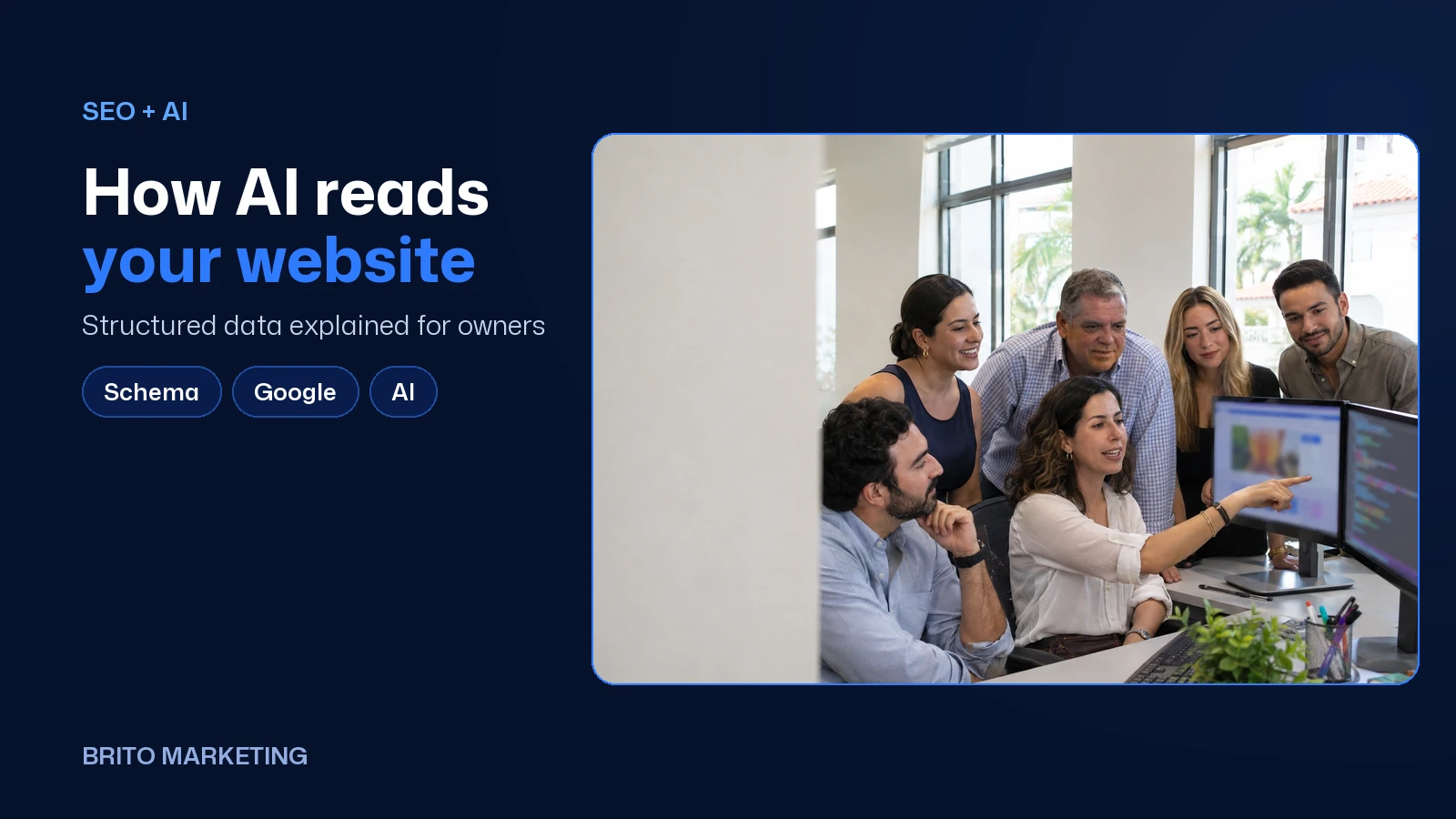
Google and AI tools read your website’s text and code, not its design. Structured data is a hidden fact sheet in that code that tells them who you are, what you do, where you are and when you’re open. It won’t work miracles, but it keeps the machine from guessing, and it has to match what’s on the page.
When you open your website, you see photos, colors and a “Call Us” button. When a crawler from Google or an AI tool lands on the same page, it sees something else: text, links and code. If your address lives inside an image, the crawler can’t read it well. If your hours are in a PDF, it may never find them. This piece isn’t for developers. It’s so you, as the owner, understand what the machine sees and know what to ask for. If you already have someone working on your site, the technical side is in our schema guide.
Your website has two readers
Think about a box of cold medicine. The bright design on the front is so you can spot it on the shelf. The Drug Facts label on the back, laid out the same way on every box, is so nobody has to guess the dose. Your website works the same way: the design is for people, and the organized information is for machines.
A person gets that “Mon–Fri 9–6” means your hours. A machine may or may not, depending on how it’s written. Structured data spells it out in the machine’s language: this is the business name, this is the address, this is the phone number, these are Monday’s hours. Google describes it as a standardized format for providing information about a page and classifying its content (Google Search Central).

What the machine reads, and what it misses
| Detail | How it often appears on a site | What happens to the machine | How it should appear |
|---|---|---|---|
| Address | Inside an image or an embedded map | It may not read it as text | As visible text and in the structured data |
| Hours | In a PDF or a photo of the door sign | It has trouble finding them | As text on the contact page and in the data |
| Services | All in one long paragraph on the homepage | It can’t tell them apart | One page per service, with its name in the title |
| Areas you serve | “Serving all of South Florida” | It can’t tie you to a specific city | Cities and neighborhoods listed one by one |
| FAQs | In a video or an accordion that doesn’t load | The answer may get lost | Question and answer in text, on the page |
| Phone number | Different in the footer and on the contact page | It can’t tell which one is right | The same everywhere on the site and on your Google profile |
Notice that almost nothing in that table is technical. Before anyone touches code, the key information has to be written as text, in one clear place, with no contradictions. Structured data goes on top of that. It doesn’t replace it.
Structured data in plain English
It’s a block of code that doesn’t show up on screen and follows a shared vocabulary called schema.org. Google recommends writing it in a format called JSON-LD. For a service business, you’d normally want at least these pieces:
- Who you are: your business type (a dental practice, a law firm, an insurance agency), your exact name, your logo and your social profiles.
- Where you are and when you’re open: address, phone, hours for each day and the areas you serve.
- What you offer: each service by name, on its own page.
- How your site is organized: breadcrumbs showing that “Implants” sits under “Services.”
- Who wrote it: on articles, the author and the real publish date.
What it does, and what it doesn’t
Google publishes real case studies from sites that use it. These are results in Google Search, not in ChatGPT, but they give you a sense of how much it matters when a machine understands a page correctly.
Now the honest part. Google says structured data can enable richer search results, but it doesn’t guarantee them. And in its guidance on AI features in Search, Google says there’s no special schema you need to add to appear in AI Overviews. What it asks is that your structured data match the visible text on the page (Google Search Central). If someone pitches you “AI schema” that promises ChatGPT will start recommending you, be skeptical.
So what’s it for? It keeps the machine from having to guess. When your website, your structured data and your Google profile all say exactly the same thing, any system that cross-checks sources has one less reason to doubt you. It’s one piece of a bigger job, the one we lay out in how to rank in AI search.

Ready to apply this to your business?
Check it yourself in 15 minutes
- Open Google’s Rich Results Test (search.google.com/test/rich-results), paste in your homepage address and see what data it detects. If it finds none, you know where to start.
- Do the same in the Schema.org validator (validator.schema.org). It shows your data even when Google doesn’t use it for a rich result.
- Compare what comes up with your Google profile. Name, address, phone and hours need to match exactly, character for character.
- Try highlighting all the text on your contact page with your mouse. If your address or hours won’t highlight, they’re stuck inside an image.
- If you have Search Console, check the enhancements section. That’s where Google flags errors in your site’s data.
What to ask your web person for
You don’t need to learn code, but you do need to ask the right questions. Ask for structured data that uses the most specific business type available for your industry, a page for every service, data that updates automatically when you change your hours, and nothing in the code that contradicts what visitors see. Then ask who checks it whenever the site changes, because that’s exactly when it breaks. If you’re thinking about rebuilding your site, the 10 things that separate a site that sells make a good checklist.

Where to start
- Today: run your homepage through Google’s Rich Results Test and save the result.
- This week: pull your address, hours and phone number out of images and PDFs and write them out as text.
- This month: ask for structured data covering your business and each service, matching your Google profile. To see where this fits with everything else, revisit SEO vs. AEO vs. GEO.
For most owners, this is the part of the website nobody ever explained. At Brito we build sites with both readers in mind, the person who needs to call and the machine that needs to understand you, in English and in Spanish, and connected to BritoCRM so every inquiry lands in one place. We’ve done it from Miami since 2006. In Miami-Dade and Broward we come to your business; outside the area, we meet by phone or video call. If you’d like us to look at how machines read your site today, you can request a free assessment, no strings attached.
Frequently asked questions
Will structured data get ChatGPT to recommend me?
Not on their own. They help machines understand who you are and what you do, but a recommendation also depends on your reviews, your content and what other people say about you.
Does my website template already include them?
Some platforms add something basic, but often with missing details or a generic business type. Run it through Google’s Rich Results Test and you’ll know in a minute.
Can I add star reviews to my structured data?
Only if they follow Google’s rules and reflect real reviews that are visible on the page. Making them up or marking them up misleadingly can earn you a manual action from Google. When in doubt, check with your web person before adding them.
How often should I check them?
Any time something about the business changes (hours, address, phone, services) and any time the site is redesigned. Beyond that, a quarterly check is usually enough.
Twenty years building brands in New York, Las Vegas and Miami, where he's based today. He leads a Miami team that shoots commercials on cinema cameras and runs proprietary AI infrastructure. He believes great marketing starts with truly understanding the customer — and that honesty, often frowned upon in this industry, is what separates partners from vendors.
View profile→Questions about your business?
The first conversation is an assessment, not a sales pitch. Let's talk.
Or explore our Search + AI (SEO & AEO) service
Study: Who ChatGPT and Perplexity Recommend When You Look for a Marketing Agency in Miami (October 2026)
We asked ChatGPT and Perplexity the same 50 questions, in English and Spanish. The AI named more than 100 different businesses, none in more than 4 answers, and for city searches it almost always picked someone from that city. Data, method and limits.

AI Marketing Without Losing the Human Voice
AI speeds up almost everything in marketing. But there's one thing it does badly, and your customers notice instantly.