Insurance Agencies in 2027: How to Grow in Florida
What a Florida insurance agency should work on for 2027: Google and AI search, video that explains coverage, reviews, fast quote follow-up, renewals, CRM and AI, with a quarter-by-quarter plan.

Short answer
In 2027, the insurance agencies that grow will show up on Google and in AI answers with a clear page for every line they write, explain coverage on video in English and Spanish, answer every quote request within minutes, manage renewals in a CRM, and use AI for repetitive work, all without promising anyone savings.
If you run an agency in South Florida, you know today's client shows up with more questions and less patience. Their homeowners renewal just went up, they saw an ad promising a lower rate, and they already ran quotes on two apps before calling you. The agency owners who grow in 2027 will be the ones who understand that path: where people search, what they compare, and what makes them trust a person instead of just a price.
Nearly half of new policies being bought online doesn't make agents obsolete. It means the first impression is now digital and the client arrives already comparing. Your edge is the one an app doesn't have: explaining, in their language, what their policy really covers, and picking up the phone when they have a claim. Let's go area by area.
Marketing and visibility: Google and AI search
When someone types “home insurance in Hialeah” or asks ChatGPT for a Spanish-speaking agency in Kendall, the answer comes from your Google Business Profile, your website, directories and your reviews. If your site has one page that says “we offer all types of insurance,” an AI tool has nothing to grab onto when deciding whether to recommend you.
- Build one page for every line you actually write: auto, home, flood, commercial, life, health, Medicare. Give each one an FAQ in English and Spanish.
- Fill out the Google profile for every office, with hours, team photos, services and the languages your staff speaks.
- Answer on your site the questions you get on the phone: what a hurricane deductible is, when you need flood coverage, what happens if a carrier non-renews you.
- Make sure your name, address, phone and license number match on Google, your site and every directory.
- Before any ad goes live, check it against the Florida insurance advertising rules: nothing misleading about the policy, nothing that looks like the government and, for health, the insurer's name.

Social media and video
In insurance, the video that works is the one that explains. An agent from your office taking one minute to walk through what renters insurance covers, or why it pays to review your coverage before June, builds more trust than any slick graphic. People are looking for a person, so showing the real faces on your team goes a long way.
- Film a series of short videos answering the 10 questions you hear most, in English and Spanish.
- Put your agents on camera, with their names and the languages they speak.
- Never promise savings or percentages in a video. Talk about how you review a policy, not how much they'll pay.
- Post practical content before hurricane season: how to photograph a home inventory, where to keep the policy, who to call.
- Handle comments and DMs carefully, and never ask for personal information in a public comment thread.
Reviews and reputation
Insurance is bought on trust, and these days people check that trust in your reviews before they ever pick up the phone.
- Ask for reviews when the client feels your help the most: after a claim you handled well, after placing a policy that was hard to find, at renewal.
- Reply to every review without revealing policy or claim details in the public response.
- Only use real testimonials, and if anything was given in exchange, disclose it, as the advertising rules guide explains.
- When a negative review has a point, fix the problem and reply with what you changed.
Sales and lead follow-up
If shoppers collect three or four quotes on average, you're up against two or three other agencies on the same day. Often the winner is whoever calls back first and explains things best, not whoever is cheapest. At GoldenTrust Insurance, 2,343 insurance requests came in over 8 months. At that volume, follow-up stops being a detail and becomes the business.
- Respond to every quote request in minutes, not hours: a call or text saying who you are and what you need to quote.
- Set up a multi-day follow-up sequence across calls, texts and email, with the client's consent on file.
- When you quote auto, ask about their home, business or life coverage. Plenty of clients don't know you write those too.
- In health insurance, Florida's rules require you to disclose on the first contact that a prospect's name came from a lead generator. It's good practice on every line.
- Track how many requests came in, how many you quoted and how many you closed, by source.

Ready to apply this to your business?
Operations
In Florida, a renewal increase with no heads-up is the fastest way to lose a client you've had for years. The agencies that hold on to their book don't wait for an angry call. They reach out first, explain the change and lay out the options.
- Build a renewal calendar and contact every client early, before the notice shows up in their mailbox.
- Keep a document checklist for each policy type so you're not asking for the same paperwork three times.
- Decide who handles claims and how fast, especially after a storm.
- Have a hurricane plan for the office: how you keep serving clients if the power goes out, which number to publish and how you'll notify everyone.
- Document your processes so a new agent can get up to speed in weeks, not months.
Systems and CRM
A lot of agencies have their management system on one side and prospects scattered across email, WhatsApp and notepads on the other. For 2027, it makes sense to keep everything sales-related in one connected CRM: every request, every call, every quote and every renewal date.
- Send every web form, phone call and social message into the same CRM, tagged with its source.
- Segment by line of business, language and stage: new, quoted, closed, up for renewal.
- Automate renewal and follow-up reminders, but have a real person sign the message.
- Store call and text consent right on the client record.
- Limit who can see what. Your clients' personal and financial information deserves the same care as their money.
AI: what to use it for and what to avoid
Good uses: an after-hours assistant that collects the basic quote details and books a call with an agent; call summaries that go straight into the CRM; draft emails and review replies that an agent checks first; and help preparing videos and FAQs in both languages.
What to avoid: letting AI recommend coverage, promise rates or tell someone they “qualify.” That's a licensed agent's job. Don't paste client data into tools when you don't know where that data ends up, and remember that health and Medicare come with their own privacy and advertising rules. AI takes work off your plate; the advice is still yours.

Your 2027 plan, quarter by quarter
| Quarter | What to focus on | How you know it's working |
|---|---|---|
| Q1 (Jan–Mar) | One page per line of business, a Google profile for every office and a review of every ad against Florida's rules. | Pages live in English and Spanish, and ads reviewed. |
| Q2 (Apr–Jun) | FAQ videos and pre-hurricane-season content, plus a renewal calendar. | Videos posted and clients contacted ahead of renewal. |
| Q3 (Jul–Sep) | Minutes-not-hours response on every quote, a follow-up sequence and an after-hours AI assistant. | Faster response times and more quotes closed. |
| Q4 (Oct–Dec) | Health and Medicare enrollment seasons with current rules, a review routine and a year-end review. | New reviews every month and a clear plan for 2028. |
Where to start
- This week: call your own agency after hours and fill out your own quote form. Time how long it takes to hear back.
- This month: reply to every review and write down the 10 questions you get most, with answers in both languages.
- Before the quarter ends: build a page for every line you write and check your ads against Florida's rules.
Doing all of this at once, while you're also handling clients, claims and renewals, is a lot for any agency owner. That's exactly how we work at Brito: marketing, in-house video, BritoCRM and AI all connected to sales, in English and Spanish, out of Miami since 2006, with Florida's insurance advertising rules checked on every piece. If your agency is in Miami-Dade or Broward, we'll come to you; anywhere else, we'll do it by phone or video call. If you'd like to see where to begin in your case, build your plan in 2 minutes and look it over at your own pace.
Frequently asked questions
Is AI going to replace my agents?
Not where it counts. AI can answer after hours and collect information, but recommending coverage and guiding a client through a claim is a licensed agent's job, and it's exactly what keeps clients around.
Can my ads say clients will save money?
It's better not to. A savings promise that doesn't hold for everyone can be misleading under Florida's rules. Talk about what you do, like comparing options and reviewing the policy, and check the advertising rules guide before you publish.
Do I have to be on TikTok?
No. What you do need is short videos that answer your clients' questions. The same clip can go on Instagram, Facebook, YouTube and, if your audience is there, TikTok.
Is it worth buying leads?
It can work, but only if you respond within minutes and follow up for several days. And in health insurance, if a lead came from a lead generator, Florida's rules require you to say so on the first contact. Many agencies get more out of the leads already coming in from Google and referrals.
Twenty years building brands in New York, Las Vegas and Miami, where he's based today. He leads a Miami team that shoots commercials on cinema cameras and runs proprietary AI infrastructure. He believes great marketing starts with truly understanding the customer — and that honesty, often frowned upon in this industry, is what separates partners from vendors.
View profile→Questions about your business?
The first conversation is an assessment, not a sales pitch. Let's talk.
Or explore our AI Advertising service
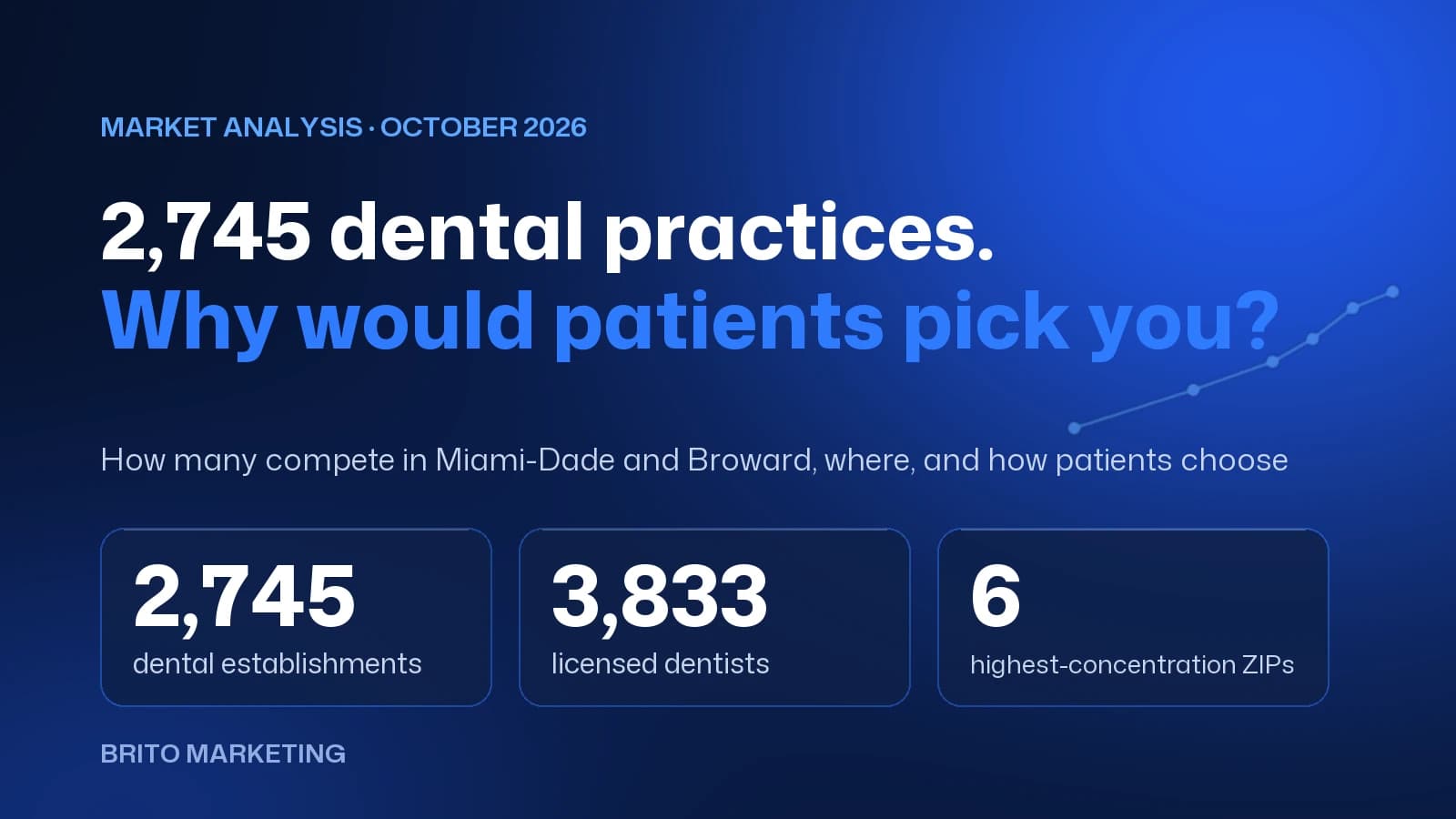
2,745 Dental Practices Compete in Miami-Dade and Broward: Why Would a Patient Choose Yours?
We measured the dental market in Miami-Dade and Broward with federal and state data: how many practices compete, which ZIP codes they cluster in and how patients choose today. There's no shortage of options, only of clear reasons to pick one.
Florida Lawyer Advertising Rules: What The Florida Bar Requires and How to Comply
What The Florida Bar's Rule 4-7 requires in a law firm's ads: name and city, language, testimonials, "expert" claims, actors, and filing with the Bar 20 days ahead. Every rule, with its number and source.