Law Firms in 2027: What to Work On Now to Keep Growing
Google, AI search, video, reviews, lead follow-up, your CRM, and AI in the office: what a South Florida law firm should be working on in 2027, all within The Florida Bar's advertising rules.
Short answer
In 2027, a law firm grows by showing up in Google and in AI answers, picking up every inquiry fast, and following each potential case until it signs or says no. That takes bilingual content built around real client questions, fresh reviews, a CRM that doesn't let leads slip, and AI used carefully, all within The Florida Bar's Rule 4-7.
Someone who gets rear-ended on I-95 or opens a letter from immigration doesn't always start by typing "lawyer near me" anymore. A lot of them ask ChatGPT or Google what to do first, skim a couple of answers, and then call whichever firm sounded clearest. BrightLocal's 2026 survey found that the share of consumers using ChatGPT and other AI tools for local business recommendations jumped from 6% to 45% in a single year. For a South Florida firm that works in English and Spanish, that moves the moment you win a case: it now happens before the first phone call.
Marketing and visibility: Google and AI search
Your Google Business Profile is still the front door. Make sure the primary category matches what you actually practice (personal injury, immigration, family), that there's one profile for each office where you really meet clients, and that the photos show your team and your space, not stock images. The Bar already requires every ad to name the city of a bona fide office (Rule 4-7.12(a)), so a profile for an address where nobody sees clients is a problem twice over.
AI tools, meanwhile, quote pages that answer specific questions. A generic "Legal Services" page gives them nothing to work with. A workplace injury page for Hialeah, written in Spanish for the worker and in English for the family, covering the questions your front desk hears every week, gives them plenty. If you want to dig into this, here's how a law firm earns a spot in AI answers.
- Keep your name, address, and phone number identical on Google, your site, The Florida Bar directory, Avvo, Justia, and social media.
- Build one page per practice area in English and one in Spanish, each written for its own audience instead of translated line by line.
- Add an FAQ section with the questions clients actually ask, answered the way you'd explain it across the desk.
- Use structured data on your site (LegalService, FAQPage) so Google and AI tools understand what you do and where.
- Once a quarter, search your practice area and city on Google and in ChatGPT, and write down who shows up.

Social media and video
People hire a lawyer they trust, and video is the fastest way for someone to feel like they know you before they ever call. You don't need to dance on TikTok. What works better is one of your attorneys answering a real question in 40 seconds ("What do I say if the insurance adjuster calls me after the crash?"), shot well, captioned, and posted on Instagram, YouTube Shorts, and Facebook, where your clients already spend time.
A commercial can build that trust without promising anything, too. The 30-second spot we shot for Hector Hernandez & Associates tells the story of the moments after a crash calmly, with no numbers and no guarantees. Just keep in mind that the Bar's rules cover social media and video as well (Rule 4-7.11(a)), and testimonials, dramatizations, and actors each come with their own conditions. Before you film, read our guide to Florida lawyer advertising rules.
- Block one morning and record eight to ten short answers to the questions you get all the time.
- Shoot the English and Spanish versions separately so each one sounds natural in its own language.
- Always add captions, since plenty of people watch with the sound off.
- Pick a pace you can keep: two videos a week all year beats ten in one month and then nothing.
Reviews and reputation
Old reviews don't carry much weight. In BrightLocal's 2026 survey, 74% of consumers look for reviews written in the last three months, and 89% expect the business to respond. Five stars from 2021 don't tell today's prospect much of anything.
Ask for the review when the client is grateful, which is usually the day their case wraps up: a short text in their language with the direct link. Don't offer anything in exchange, and never write it for them. Reply to every review, the rough ones included, without revealing anything about the matter. Your duty of confidentiality doesn't go away just because the client told their side in public.
Sales and lead follow-up
The case a firm loses most often is the one nobody picked up. Someone who was just in an accident calls several firms the same afternoon, and they don't wait around: if no one answers, they dial the next number. Plenty of people also don't decide on the first call. They want to talk it over with family, and the firm that stays in touch without pushing is usually the one they come back to.
- Respond in the client's language from the very first hello, including on WhatsApp and your website forms.
- After hours, make sure someone or something answers, takes the details, and books the consultation for the next day.
- Use an intake script so everyone asks the same questions and you know quickly whether the case is viable.
- Follow up over several days by phone, text, and email, and log every attempt in your CRM.
- Track where each signed case came from, not just each call, so you know which spending actually works.
One distinction matters here: follow-up is for people who called or wrote to you. Reaching out to people who didn't ask is governed by separate rules in Florida, so keep those two things out of the same campaign.

Ready to apply this to your business?
Operations
A client who doesn't know where their case stands picks up the phone, and every "any news?" call costs someone on your team half an hour. The fix is rarely more staff. It's putting the repetitive work on rails. When intake, conflict checks, signing the engagement agreement, and status updates all follow a set path, your attorneys spend their time on the work only they can do.
- E-sign the engagement agreement the same day as the consultation.
- Schedule status updates every two or three weeks, even if the message is just "we're still waiting on the insurer."
- Keep bilingual templates for the emails and texts your team writes over and over.
- Run a simple dashboard with three numbers: new inquiries, signed cases, and time to first response.
Systems and CRM
Case management software and a CRM do different jobs. The first one runs the file after the client signs. The CRM handles everything before that: who called, where they came from, what they were told, and when someone needs to call back. A lot of firms have the first one dialed in and the second one living in a notebook or on the receptionist's phone.
- It should record the source of every lead: Google, an ad, a referral, a video.
- It should send reminders and automated texts in the client's language.
- It should flag any lead that's gone 24 hours without a response.
- It should connect to your case management software so nobody types the same details twice.
- It should set permissions by person, because not everyone on the team needs to see everything.
Artificial intelligence: what to do and what to avoid
AI is already inside most firms: Clio's 2025 Legal Trends Report found that 79% of legal professionals use it. The Florida Bar made clear in Ethics Opinion 24-1 that lawyers can use it, as long as they protect client confidentiality, verify the work, bill properly, and follow the advertising rules. Clients want to be in the loop, too: 78% want their lawyer to tell them when AI is involved.
Do
- Summarize long documents, transcribe calls, and prepare first drafts that an attorney then reviews.
- Run a website assistant that answers after hours, collects details, and books consultations, while making clear it's an AI program and not a lawyer, as Opinion 24-1 requires.
- Sort and prioritize the day's leads so your team calls the most urgent ones first.
- Draft articles and video scripts that an attorney sharpens with real experience.
Don't
- Let a chatbot give legal advice without an attorney involved.
- Upload confidential information to a tool before you've checked how it stores and uses data.
- File anything with citations nobody verified.
- Publish AI-written copy that predicts results. Rule 4-7.13(b)(1) applies no matter who or what wrote it.

A 2027 plan, quarter by quarter
| Quarter | Focus | What to do |
|---|---|---|
| Q1 | Foundation | A Google profile for each office, matching details across every directory, a CRM that tracks lead source, and a three-number dashboard. |
| Q2 | Content and video | Practice area pages in both languages, real FAQs, and one filming day for short answer videos. |
| Q3 | Reviews and follow-up | A review request when each case closes, replies to every review, and automated lead follow-up by text and email. |
| Q4 | AI and review | An intake assistant with an AI disclaimer, an internal AI use policy, and a look at which sources produced signed cases. |
Where to start
- Call your own firm on a Tuesday at 7 p.m., in Spanish. Whatever you hear is what a new client hears.
- Search your practice area and city on Google, then ask ChatGPT the same thing. Write down who comes up and why.
- Text the last ten clients who left happy today and ask for a review, with the direct link.
If you've read this far, you've noticed it's seven fronts at once, and each one takes hours that a firm with an active caseload rarely has. That's exactly how we work: marketing, in-house video, CRM, and AI connected to sales, in English and Spanish, out of Miami since 2006, with every piece checked against The Florida Bar's rules before it goes out. If it would help to see where your firm stands today, you can request a free diagnostic and decide on your own time what to do with it.
Frequently asked questions
Does my firm need to be on TikTok?
Not necessarily. What matters is showing up where your clients already are, with short videos that answer real questions, and for many firms that means Instagram, YouTube Shorts, and Facebook. If your practice serves a younger crowd, TikTok can help, under the same Florida Bar rules.
Can an AI chatbot handle my firm's prospective clients?
It can answer after hours, collect details, and book consultations. Under Florida Bar Ethics Opinion 24-1, it has to disclose that it's an AI program and not a lawyer, and it must follow the advertising rules. Legal advice still comes from an attorney.
Do I need my website in both English and Spanish?
If you serve clients in both languages, yes, and each version should be written for its audience rather than run through a translation tool. Keep in mind that if an ad is in Spanish, the required information has to be in Spanish too (Rule 4-7.12(c)).
Can I ask my clients for reviews?
Yes, and it pays to do it consistently, right when each case closes. Don't offer anything in return or write the review for them, and when you reply, never reveal anything about the matter.
Twenty years building brands in New York, Las Vegas and Miami, where he's based today. He leads a Miami team that shoots commercials on cinema cameras and runs proprietary AI infrastructure. He believes great marketing starts with truly understanding the customer — and that honesty, often frowned upon in this industry, is what separates partners from vendors.
View profile→Questions about your business?
The first conversation is an assessment, not a sales pitch. Let's talk.
Or explore our AI Advertising service
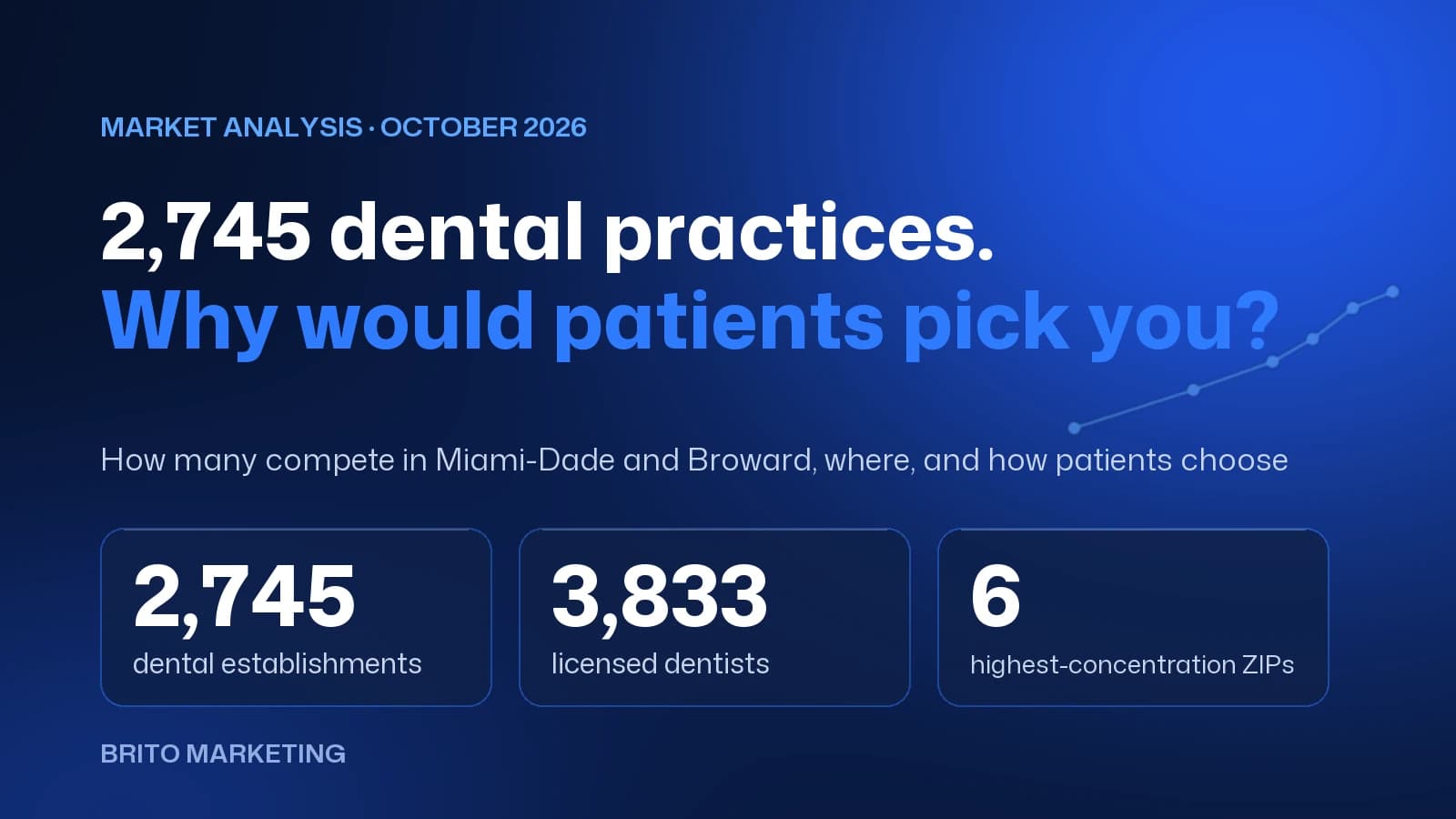
2,745 Dental Practices Compete in Miami-Dade and Broward: Why Would a Patient Choose Yours?
We measured the dental market in Miami-Dade and Broward with federal and state data: how many practices compete, which ZIP codes they cluster in and how patients choose today. There's no shortage of options, only of clear reasons to pick one.
Florida Lawyer Advertising Rules: What The Florida Bar Requires and How to Comply
What The Florida Bar's Rule 4-7 requires in a law firm's ads: name and city, language, testimonials, "expert" claims, actors, and filing with the Bar 20 days ahead. Every rule, with its number and source.