How to Respond to Negative Reviews, and What AI Learns From Your Replies
What to write when someone leaves you one star: the four parts of a good reply, what never to say, what to do about fake reviews, and the rules for healthcare and law firms.
Short answer
Reply quickly, calmly and briefly: thank them, acknowledge the specific problem without arguing, say what you did or will change, and take the rest offline. Never share customer details. Your reply sits publicly under the review, where the next customer reads it, along with the AI tools that summarize what people say about you.
It shows up on a Saturday night: one star and a long paragraph. Your first instinct is to fire back and explain why the customer has it wrong. Before you type, think about who’s actually going to read your reply. It’s rarely just the person who complained. It’s the hundreds of people who’ll land on your profile over the next few months looking for a reason to pick you or to keep scrolling. We covered why reviews carry so much weight in what AI recommends in this piece. This one is practical: what to write when the review is bad.
What happens to your reply once it’s posted
On Google, your reply shows up under the review, signed as the business rather than with your name. The customer gets notified when you respond, and they can still edit what they wrote. Google checks every reply before posting it. That usually takes up to 10 minutes, but it can sometimes take up to 30 days (Google Business Profile Help). In other words, whatever you write angry at 11 p.m. is going to stick around.
And it’s not just people reading anymore. Since late 2024, Google Maps has used Gemini to summarize a place’s reviews and to answer questions about it based on what customers say (Google, 2024). Google doesn’t say whether those summaries factor in the owner’s replies. What is clear is that patterns get noticed: if ten reviews mention long waits, that’s what gets repeated. A reply won’t erase the complaint, but it shows the next reader, human or machine, that somebody listened and what changed.
Three questions before you write anything
- Is this a real customer? Look them up in your calendar or CRM by name, date or service. If they’re not there, your reply changes (more on that below).
- Do they have a point? There’s usually some truth in it: the wait, the call nobody returned, the price nobody explained. Start there.
- What can’t you say? Nothing about the customer’s details, their case, their account or their treatment. If you’re not sure whether something is private, leave it out.
How to write a good reply
A good reply fits in four or five lines and has four parts. It doesn’t need to sound like a lawyer or a complaints department. It needs to sound like the person in charge.
- Thank them, using the name on the review.
- Acknowledge the specific problem. “Waiting 40 minutes without anyone telling you what’s going on isn’t OK” says far more than “We apologize for any inconvenience.”
- Say what you did or will change, but only if it’s true.
- Take the rest offline, with a name and the business phone or email.
Here’s an example. Review: “Waited 40 minutes and nobody told me anything.” Reply: “Thanks for letting us know, Mike. Waiting that long without a heads-up isn’t OK. We talked it over with the team this week, and we now send a text when the schedule runs behind. If you want to share more, call the office and ask for Diana, our office manager.” Reply in the language the review was written in, and change the wording every time. The same template pasted fifty times is obvious, and it cheapens every reply you’ve written.

What not to write
- A point-by-point rebuttal. Even if you’re right, readers see an owner fighting in public.
- Anything about the customer: what they bought, what they owe, what was done for them or who they came in with.
- Legal threats. The FTC’s rule on reviews bans using groundless legal threats, intimidation or false public accusations to prevent or remove a negative review (FTC, 2024).
- A discount in exchange for changing or deleting the review. Fixing the problem is fine. Tying the fix to the review breaks Google’s rules on incentives.
Ready to apply this to your business?
If you’re in healthcare or you’re a lawyer
In healthcare, the costliest mistake is confirming the person is a patient at all. In 2019, a Dallas dental practice agreed to pay $10,000 to the federal Office for Civil Rights after disclosing patient information while replying to Yelp reviews, and it agreed to two years of monitoring (California Dental Association). A safe reply talks about your policies in general terms (“we make a point of…”) and offers a phone number, without a word about the case. We go deeper in our guide to advertising rules for medical clinics.
For lawyers, the Florida Bar answered this in Ethics Opinion 20-1, issued in 2020: you can’t reveal confidential information to defend yourself without the client’s informed consent. You can post something general, such as saying the rules don’t allow you to respond in detail and that the review doesn’t give a fair picture of what happened (The Florida Bar). The rest of what the Bar expects is in our guide to attorney advertising in Florida.
When the review is fake
Not every bad review comes from a customer. Google’s policies require contributions to reflect a genuine experience, and they list conflicts of interest, including current or former employees, among the problems. They also ban harassment and posting personal information (Google content policies). If you think a review breaks those rules, report it from your profile. While Google looks into it, reply briefly and without accusing anyone: “We can’t find your name in our records. If you were a customer, please contact the office so we can look into it.” Anyone reading will see you took it seriously.

| Situation | What to say | What to avoid |
|---|---|---|
| A real mistake | Own it and say what changed | Excuses or blaming the customer |
| A misunderstanding | Clear it up calmly, no private details | Correcting them with an edge |
| “Too expensive” | Explain what the service includes | Arguing price in public |
| One star, no text | Thank them and invite them to share more | Ignoring it |
| Possibly fake | Report it and say you can’t find them | Accusing the author |
| Healthcare or legal | A general reply and a phone number | Confirming they’re your patient or client |
Don’t leave any of them hanging
A perfect reply doesn’t help if it shows up three weeks late. Decide who responds (the owner or manager, not the employee being named), how fast, and what happens with the issue afterward. Log every negative review with its reason. Once a month, look at the whole list. If five of them are about calls nobody returned, that gets fixed in the office, and no reply will cover it up.

Where to start
- Today: find the negative reviews with no reply and answer the two most recent ones using the four parts above.
- This week: decide who replies and how fast, and write your general reply for healthcare, legal or reviews you don’t recognize.
- This month: group complaints by reason, fix the one that keeps coming up and keep asking for reviews every day. If asking feels awkward, here’s how to do it without the awkwardness.
Replying with a clear head, on time, while still running the business is a lot easier with a system behind it. At Brito we build it alongside everything else: BritoCRM asks for a review after every service and keeps it in the same place as your leads and appointments, and we connect it to your marketing, the video we shoot ourselves and AI, in English and Spanish. We’ve been doing this from Miami since 2006. If you want to get this sorted for 2027, you can build your plan in 2 minutes, on your own time, no strings attached.
Frequently asked questions
Can I get Google to remove a bad review?
Only if it breaks Google’s policies, for example if it’s fake, comes from an employee, or includes harassment or personal information. Being unfair or harsh isn’t enough. In that case, a good reply is your best tool.
How fast do I need to reply?
The sooner the better. According to BrightLocal, 19% of consumers expect a reply the same day and 32% by the next day, while 81% expect one within a week. Aim for one or two business days.
What if the customer comes back even angrier?
Don’t keep the argument going in public. One clear, polite reply, and the rest by phone or email. If it gets resolved, the customer can update the review on their own.
Is it worth replying to good reviews too?
Yes. A profile where the owner answers everything looks cared for, and BrightLocal found 80% of consumers are likely to use a business that responds to all its reviews. One or two sentences that mention what the customer described is plenty.
Twenty years building brands in New York, Las Vegas and Miami, where he's based today. He leads a Miami team that shoots commercials on cinema cameras and runs proprietary AI infrastructure. He believes great marketing starts with truly understanding the customer — and that honesty, often frowned upon in this industry, is what separates partners from vendors.
View profile→Questions about your business?
The first conversation is an assessment, not a sales pitch. Let's talk.
Or explore our Search + AI (SEO & AEO) service
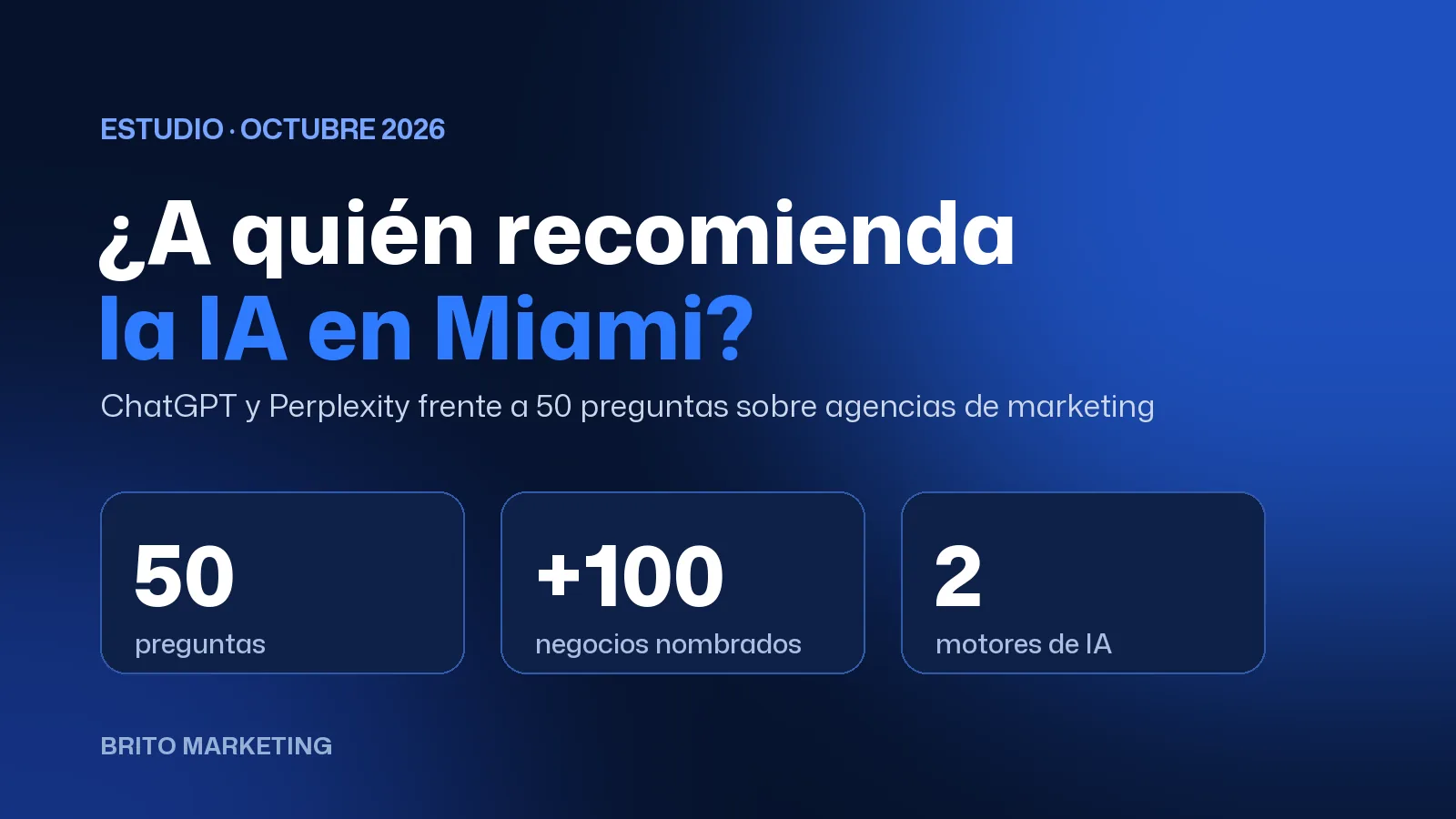
Study: Who ChatGPT and Perplexity Recommend When You Look for a Marketing Agency in Miami (October 2026)
We asked ChatGPT and Perplexity the same 50 questions, in English and Spanish. The AI named more than 100 different businesses, none in more than 4 answers, and for city searches it almost always picked someone from that city. Data, method and limits.

AI Marketing Without Losing the Human Voice
AI speeds up almost everything in marketing. But there's one thing it does badly, and your customers notice instantly.