10 Interview Questions for a Trust-Building Corporate Video
Ten questions for interviewing your team on camera, plus how to prep the speaker, film without fuss and get more out of every answer.
Short answer
An interview video builds trust when the questions draw out concrete stories instead of brochure answers. Start by introducing the person, move to your customer's problem and your process, and close with the human side. Prepare the interviewee with topics, not a script, get the sound right first and reuse each answer as its own clip.
An interview video works when the person on screen talks the way they really talk and covers what your customers want to know before they pick up the phone. That depends less on the camera than on the questions: generic questions get brochure answers, and specific ones get stories that build trust.
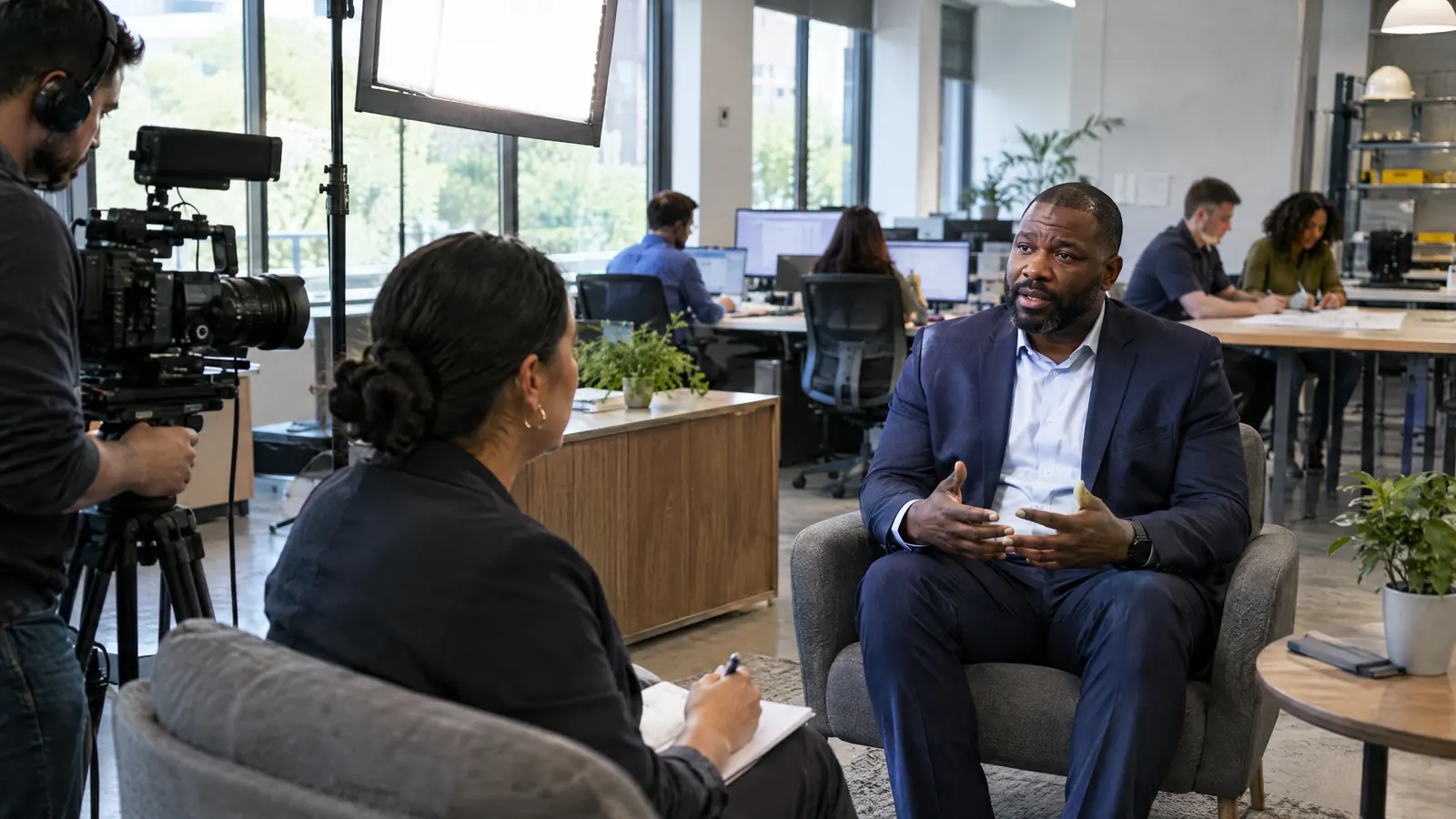
Below are ten questions for interviewing the owner or someone on your team, in the order a good conversation flows: warm up, go deeper and close with the human side. For each one, you'll see why it works and what a good answer sounds like. Then, how to prepare the speaker, film and make the most of the footage.
Warming up: let them introduce themselves
How would you explain what you do here to a neighbor?
This is the useful version of “introduce yourself.” Ask for a name and a title and you get a résumé line; ask them to explain it to an outsider and they drop the jargon and talk like your customer. Their name and title go in a caption.
A good answer: fits in a few sentences, skips the acronyms and makes it clear who they work for. If they get tangled up, have them try it as if talking to a relative.
What made you choose this line of work?
People trust someone who has a reason. This question brings out the origin story: the experience or the moment that led someone into their field. It's what turns a generic professional into someone with a name and a face.
A good answer: has a specific moment in it, not a vague “I've always liked it.” If the answer stays general, ask “Do you remember when you decided?” and let them describe the scene.
What does a normal workday look like for you?
It shows what customers never see, like the care that goes into the details, and makes the business feel real and approachable.
A good answer: describes things you can actually see, like what they check before handing off a job. Those images also help you plan the B-roll.
The core of the interview: what your customer goes through
What problem does someone usually have when they first come to you?
Viewers recognize themselves in that description and think “that's me.” That feeling does more than any slogan.
A good answer: uses the customer's words, not industry terms, and describes how that person feels, not just what they need. Ask them to think of real cases, without naming anyone.
What happens from the moment someone contacts you until the job is done?
Plenty of people hold off because they don't know what comes next. Walking through the process removes that uncertainty and makes reaching out feel easy.
A good answer: follows a clear order, with few steps and in everyday language. If they get lost in technical detail, ask for the version they'd give on a first call.
What do you do differently?
This is the honest way to talk about what sets you apart. Instead of adjectives anyone could use, ask for a specific habit the team always keeps.
A good answer: describes a practice people can verify, like how they follow up, and doesn't knock anyone else. And all of it has to be true: the video stays online.
What do people tend to get wrong about your work?
Clearing up a misconception shows expertise without bragging. These answers also make great short clips.
A good answer: names the mistaken idea, explains the reality in a few sentences and ends with a practical tip. If it runs long, ask for a shorter version.
Closing: the human side and the invitation
What job are you proudest of, and why?
Stories stick better than a list of services. This question opens the door to a story with a beginning, a problem and an ending, told with the feeling of someone who lived it.
A good answer: focuses on what changed for the customer, not on how hard it was for the team. If they mention a specific customer, keep it anonymous or get that customer's written permission.
What would you say to someone who's still on the fence?
It's the natural close and the most believable call to action, because it doesn't sound like an ad: it sounds like advice.
Ready to apply this to your business?
A good answer: is honest, even if that means saying who the service isn't for, and invites a small next step, like asking a question, instead of applying pressure.
Is there anything I didn't ask that you'd like to share?
Always save this one for last. Once the person is relaxed, it often brings out the most spontaneous moment of the interview.
A good answer: has no set shape. Your job is to stay quiet for a few seconds after they finish; the line you were hoping for often comes right after.
How to prepare the person you're interviewing
An interview isn't something you improvise in front of the camera.
- Do a pre-interview call. A few days ahead, go over the topics without asking for exact answers. They show up calmer and you find out which stories they have.
- Share topics, not a script. Read or memorized answers are obvious right away. Two or three points per question, in their own words, is enough.
- Ask for complete answers. Your voice won't be in the video, so every answer has to stand on its own. Ask them to work the question into what they say instead of starting with a plain yes.
- Choose the language together. Let them speak in Spanish or English, whichever feels more natural. If you need both versions, record each one separately instead of translating on the fly.
- Set up a comfortable space. A quiet place they know, water within reach and no rush. Suggest solid colors, no thin stripes and no other brands' logos.
Filming basics, without the complications
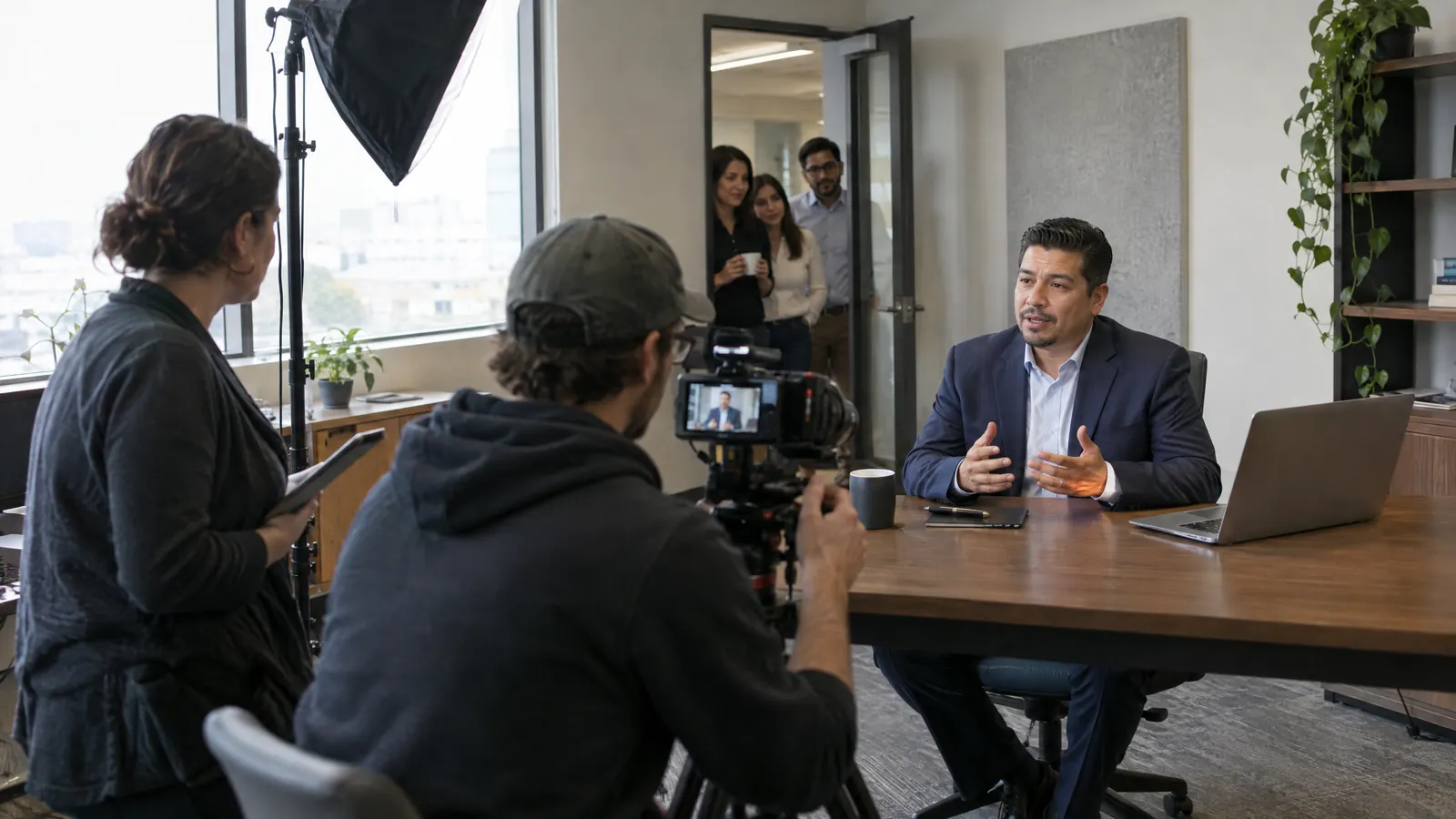
You don't need a studio, but you do need to get four things right, in this order.
- Sound comes first. Simple visuals are easy to forgive; audio nobody can understand isn't. Put a microphone close to the speaker, turn off a noisy air conditioner and listen on headphones while you record.
- Then light. Have the person face a window or a soft light, never with it behind them. Avoid harsh midday sun.
- A background that says something. The shop, the office or the storefront says a lot about your business, as long as it's tidy and free of distractions. Move the person a little away from the wall to add depth.
- Two angles, if you can. A wide shot and a tighter one let you cut out pauses without jarring jumps. Film everyday B-roll too, to cover the cuts.
If you want a team to handle the planning, filming and editing, we do exactly that in video and media production; you can see examples in the video portfolio.
How to use the answers afterward
A well-planned interview gives you material for much more than one video: each question can become a piece of its own.
- On your website: a version a few minutes long on your homepage or About page, and specific answers on each service page.
- On social media: one short clip per question, with captions, since many people watch with the sound off. It's the kind of piece we build in social media and content.
- In ads: the answer about the customer's problem can work as an opener, because it speaks straight to someone already looking for a solution.
- In customer follow-up: the process clip can go out by email or WhatsApp to someone who just asked for information.
If you're still deciding where video fits in your marketing, read this guide on video marketing for Miami businesses.
You don't need to use all ten questions in every interview. Pick the ones that fit your story and let the speaker talk in their own words. And if you want to see where your marketing stands before you invest in video: Take the free self-assessment.
Twenty years building brands in New York, Las Vegas and Miami, where he's based today. He leads a Miami team that shoots commercials on cinema cameras and runs proprietary AI infrastructure. He believes great marketing starts with truly understanding the customer — and that honesty, often frowned upon in this industry, is what separates partners from vendors.
View profile→Questions about your business?
The first conversation is an assessment, not a sales pitch. Let's talk.
Or explore our AI Advertising service
YouTube Marketing: An Educational Channel Built to Win Customers
How to build a YouTube channel that answers your customers' questions: topics, formats, language, findable titles, and a clear path to your WhatsApp.

5 Tips to Launch a Rebrand Without Losing Your Mind
A rebrand has a million moving parts. Here are 5 practical tips to plan the rollout, get your team on board, and launch without the stress.