
How AI Recommends a Restaurant in Miami (and How to Be That Name)
A growing share of diners now ask AI where to eat. Here is what it weighs before recommending a restaurant, and how to make it pick you.
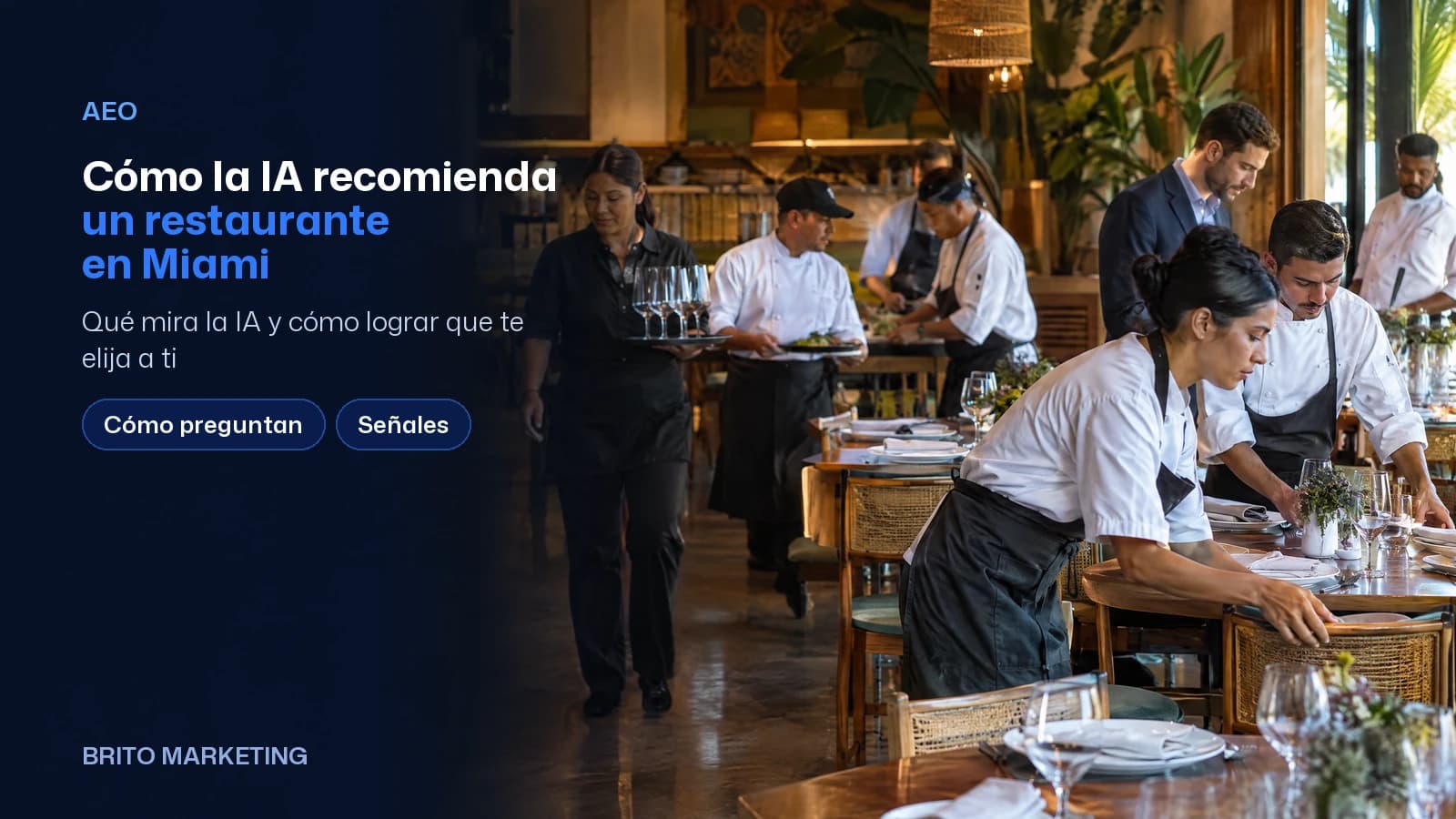
Short answer
On a Friday at 7pm, people ask AI where to eat nearby. To be recommended, your menu must be real text (not a PDF or image), your Google profile spotless with the right category, recent answered reviews, consistent hours across Google/Yelp/OpenTable and identical NAP. AI won't send anyone to a closed spot: accurate info is what it rewards.
It's 7 p.m. on a Friday. A couple just got to Brickell and doesn't know where to have dinner. A family in Doral wants real Peruvian food, not the first place that pops up. A group of friends in Wynwood is looking for somewhere with a good patio for Sunday brunch. Not long ago, all three would have opened Google or Yelp and compared. Today, many ask ChatGPT directly: “what's the best Peruvian restaurant in Doral that's open right now?” — and get two or three names back. If your restaurant isn't one of them, that table sat down somewhere else.
There's a name for getting into that answer: AEO, answer engine optimization. It's the work of getting the AI to name you when someone asks it for a place to eat like yours. This article walks through what the AI looks at before recommending a restaurant, here in Miami, and what you can start doing this week.
How people actually ask AI where to eat
Nobody asks ChatGPT for “a restaurant.” They talk to it the way they'd talk to a friend who knows the city: with a craving, an area, a time and, very often, a restriction. These are real queries people run every day in Miami:
- “Best Peruvian restaurant in Doral” — or its Spanish version, which brings an entirely different audience.
- “Where can I get ceviche near Brickell that's open right now?”
- “Restaurant for a romantic dinner in Miami with good reviews.”
- “Brunch spot in Wynwood that takes groups and reservations.”
- “Where's some good Venezuelan food near me that isn't too pricey?”
- “Restaurant with gluten-free options to take my mom to.”
Notice the pattern: almost none of them is just about a name. They carry a dish, an occasion, a time and sometimes a language. The AI doesn't answer with twenty links or a map full of pins. It answers with a short recommendation. Being in that answer is all that matters.
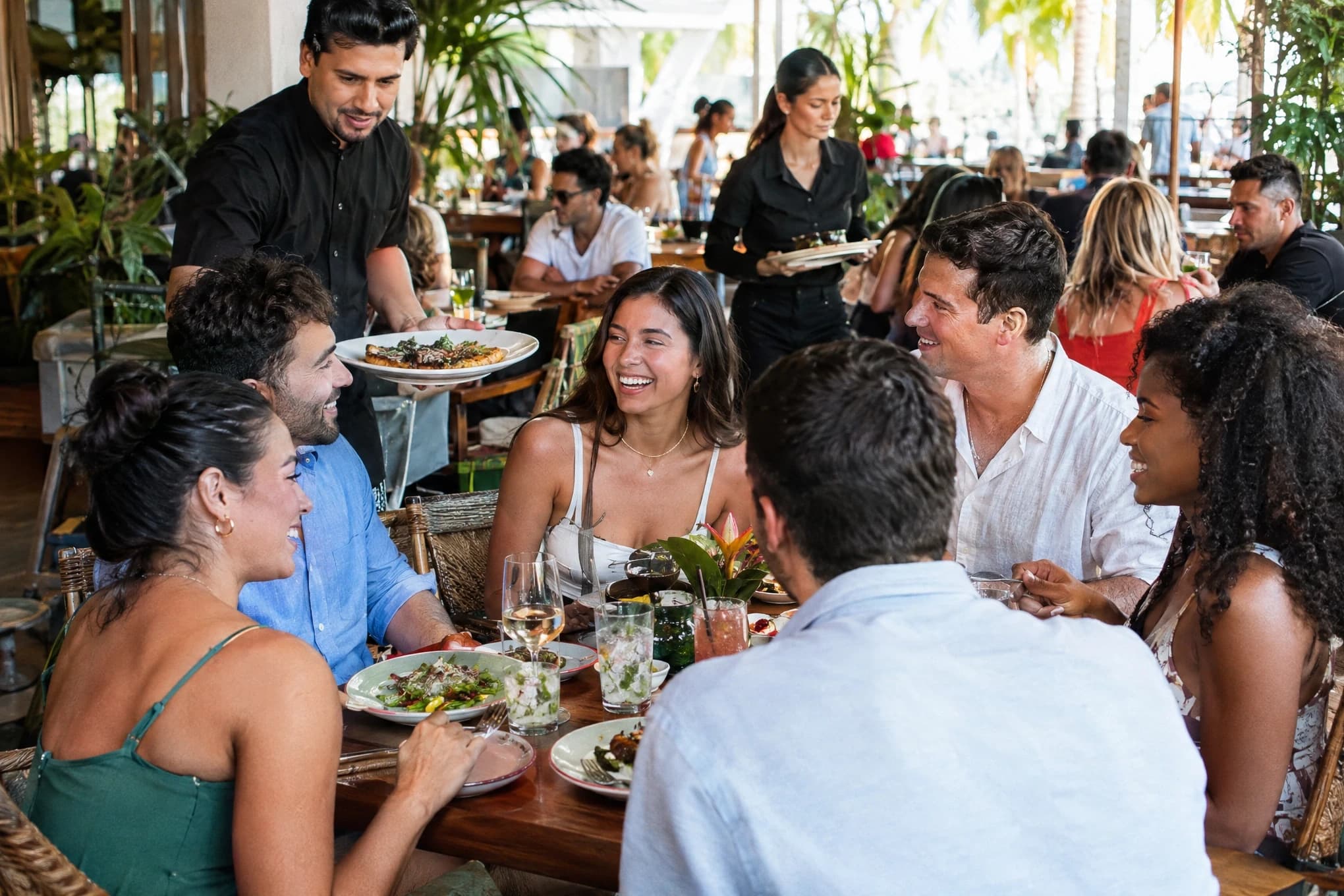
Why this matters so much for a restaurant
A restaurant lives on decisions made fast and on an empty stomach. The person asking the AI where to eat isn't researching: they're about to pick a table tonight, often just a few blocks from you. It's a high-intent, in-the-moment decision — they want it solved now. And unlike other fields, the competition here isn't in another city: it's on your own street. Showing up in that answer, or not, translates directly into tables that fill or tables the place next door fills instead.
Ready to apply this to your business?
What makes an AI recommend a restaurant
The AI doesn't recommend whoever has the biggest sign or the most ads. It recommends the restaurant it can understand, verify and describe with confidence. In food, that's built from very concrete pieces:
- A menu the AI can read: your dishes and cuisine type as real text on your site, not locked inside a PDF or a photo. If the AI can't read that you make lomo saltado or arepas, it won't connect you to whoever's looking for it.
- A spotless Google Business profile: the right category (Peruvian, not just “restaurant”), up-to-date hours, real photos of the food and the room, and a working reservation or menu link.
- Genuine, recent, answered reviews: the AI looks at how often you're reviewed and what people say. Five reviews from this month weigh more than fifty from three years ago. You don't buy them; you earn them and tend to them by responding to each one.
- Consistent hours and reservations: if Google says you close at 10 and OpenTable says something else, the AI hesitates — and when it hesitates, it doesn't name you. Keep your hours and your booking link matching everywhere.
- Identical name, address and phone everywhere: your site, Google, Yelp, OpenTable and every directory saying exactly the same thing. Mismatched info is the most common and silliest reason the AI leaves you out.
- A real bilingual presence: in Miami, “Peruvian food” and “comida peruana” are two different doors. A restaurant that describes itself well in both languages widens the ways a diner can find it through AI.
The detail almost no one pays attention to: honesty works in your favor
Here's what a lot of restaurants get wrong. They post photos of dishes they no longer serve, leave old pandemic hours up, or gather inflated reviews from friends and family. In the short term it looks like it helps. Over time, it does the exact opposite.
Answer engines are trained to prefer accurate, verifiable information and to distrust anything that doesn't add up. A restaurant with real photos of what it serves today, a menu that matches what's on the table, correct hours and authentic reviews is exactly what the AI wants to recommend — because it doesn't want to send someone to a closed spot or to order a dish that's gone. Keeping everything truthful isn't the price of appearing in the AI: it's part of the formula for appearing. For once, being honest and being effective are the same thing.
A short list to start this week
You don't need to rebuild everything. You start with what moves the needle most:
- Put your menu as real text on your site, with the dish names and your cuisine type, in Spanish and English — not just a PDF or a photo.
- Complete your Google Business profile: right category, up-to-date hours, a reservation link, and real, recent photos of your food.
- Ask customers who left happy for reviews and respond to all of them, even the lukewarm ones, calmly and with grace.
- Check that your name, address, phone and hours are identical across Google, Yelp and OpenTable — nothing contradicting itself.
- Ask ChatGPT, Perplexity and Gemini yourself for “the best [your cuisine] restaurant in [your area]” and see if you show up. That's your honest starting point.
That last step is the most revealing, and also the most uncomfortable. If you'd like, we'll do it for you at no cost: we'll show you what AI and Google say today when someone looks for a place to eat like yours in your area of Miami, and the main gaps keeping your restaurant from being one of the names that come up. It's a diagnosis, not a sale — and in a market where most restaurants haven't started working on this yet, whoever moves first takes the advantage.
Twenty years building brands in New York, Las Vegas and Miami, where he's based today. He leads a Miami team that shoots commercials on cinema cameras and runs proprietary AI infrastructure. He believes great marketing starts with truly understanding the customer — and that honesty, often frowned upon in this industry, is what separates partners from vendors.
View profile→Questions about your business?
The first conversation is an assessment, not a sales pitch. Let's talk.
Or explore our Search + AI (SEO & AEO) service

How AI Recommends a Law Firm in Miami
When someone has a legal problem, they no longer compare ten lawyers: they ask ChatGPT and get two or three names. Here's how your firm becomes one of them.

How AI Recommends a Dentist in Miami
With a toothache on a Saturday, nobody compares ten clinics: they ask ChatGPT and get two or three names. Here's how your practice becomes one of them.