What AEO Is and Why Your Business Should Appear in ChatGPT
More people ask ChatGPT, Perplexity or Gemini instead of Google. If your business isn't in those answers, it doesn't exist for that customer.
Short answer
AEO (Answer Engine Optimization) means optimizing your business so ChatGPT, Perplexity, Gemini and Claude understand and recommend it. Unlike SEO, which competes for a click in a list of ten, AI gives one answer with two or three names — so the prize is concentrated. It complements SEO; it doesn't replace it.
The way people search changed more in two years than in the previous twenty. Today, instead of typing “dentist near me” into Google and scanning ten results, many people ask an AI directly: “who's the best dentist in Doral with Saturday hours?” — and get three names. If your business isn't one of those three, you lost the customer before you knew they existed.
AEO in one sentence
AEO (Answer Engine Optimization) means optimizing your digital presence so AI answer engines — ChatGPT, Perplexity, Gemini, Claude — understand who you are, what you do and why they should recommend you. It doesn't replace SEO: it complements it. SEO positions you on Google; AEO positions you in the conversation with the AI.
Why it matters now
AIs don't show ten results: they show one answer, sometimes with two or three recommendations. That means the prize is far more concentrated. In SEO, being on page one was good; in AEO, you're either in the answer or you're not. And because almost no local business is working on it yet, there's a real first-mover advantage.

What makes an AI recommend you
- Structured, clear content the AI can understand and cite (data in text, not inside images).
- Trust signals: real reviews, robust schema, consistent business info (name, address, phone).
- Topical authority: content that proves you know your field, not just that you sell it.
- A coherent presence across the web — your site, your Google profile, your profiles, all saying the same thing.
How to start
Start with the basics done right: a fast site with semantic HTML, business schema, reviews you actively manage, and content that genuinely answers the questions your customer asks the AI. If your site already ranks on Google but is built with poor structure, AIs can't read you — and that's where the opportunity is lost. We measure it, fix it, and show you progress with data.
The future of search is already here. The question isn't whether your business will need to appear in AI answers — it's whether you'll get there before or after your competition.
How an AI answer gets built
It's a question we hear often: but where does ChatGPT even get the names from? Fair question. When someone types “best A/C repair shop in Kendall,” the AI doesn't pull up a list of ten the way Google does. It reads across what it already knows from the web — sites, listings, reviews, directories, press mentions — builds a picture of who fits that question, and hands back two or three names with a line on why. It doesn't reward whoever pays most: it rewards whoever it can understand clearly and verify in more than one place. If your business shows up well-explained and consistent across many sources, you have a real shot at appearing. If you're fragmented or silent, the AI simply skips you.
Ready to apply this to your business?
The five signals an answer engine actually weighs
You saw the basics above. Now let's talk about the concrete signals that tip the scale. It's not magic or luck — it's things you can check one by one.
- A clear entity: the AI understands you're a specific business — with a name, a location and a defined field — not a loose page that could be anything.
- Content that answers directly: pages that answer the customer's question in the first few lines, in plain language, without making the AI guess.
- Schema, the code that introduces you: the markup that tells the machine, without ambiguity, what you are, where you are and how to reach you.
- Third-party reputation: other people talking about you — reviews, directories, press, forums — not just what you say about yourself on your own site.
- Freshness: up-to-date information. A site that keeps getting updated tells the AI you're still active; one frozen in 2019 raises doubts.

The reputation that counts most lives outside your own site
This is the part almost nobody explains. Your site can say you're the best — every site says that. What actually moves the AI is what's said about you where you don't control the message: your Google reviews, your listing, your industry directories, a mention in a local outlet, an answer you left on a forum. When several independent sources agree on who you are and that you do good work, the AI feels safe naming you. When the only voice is yours, it hesitates. That's why tending your reviews and showing up well in the right places matters as much as your own page.

How to measure it without paying for expensive tools
You don't need thousand-dollar software to start. The most honest test is one you run yourself in five minutes: open ChatGPT, Perplexity and Gemini, and ask them the way your customer would.
- Ask in Spanish and in English — “best [your service] in [your neighborhood]” and its version in the other language — because they're two different searches.
- Write down which names come up and in what order. If you're not there, that's your real starting point.
- Ask the follow-up: “why that one?” The AI will tell you which signals convinced it, and that's where you see what you're missing.
- Notice which sources it cites when it can (Perplexity shows them). Those are the places you need to show up.
- Run the test again every month. AEO isn't a snapshot — it's watching whether you're moving toward the answer or staying out of it.
Why moving first in Miami is worth double
In a bilingual market, whoever moves first takes two advantages, not one. The first you already know: in most local fields the AI's answer is still taking shape, and there's room for whoever fills it well. The second almost nobody uses: “immigration lawyer” and “abogado de inmigración,” “best roofer in Homestead” and “mejor techero en Homestead” are separate doors, and most businesses only cover one. A business that genuinely answers in both languages doubles the ways a customer can find it through AI. In Miami that's not a detail — it's the half of the market your competition is ignoring.
And in all honesty: if your site today is broken, slow or silent, that gets fixed first — there's no point polishing AEO on top of a foundation the AI can't even read. Sometimes the right answer is to start with the basics this month and work the AI answer next. We'll tell you that too, because it does you no good to be sold step three when you're missing step one.
Frequently asked questions
How long does it take for my business to show up in ChatGPT's answers?
It depends on where your presence stands today and how competitive your field is. If your site, your listing, and your reviews are already healthy, it's faster; if the foundation needs fixing first, it takes longer. In general you're looking at months, not days — and be wary of anyone who promises a specific date, because no one controls what an AI decides to say.
What do I do if ChatGPT says something wrong or outdated about my business?
AI doesn't make things up from nothing — it repeats what it finds in your public sources: your Google listing, directories, your website, your reviews. So you don't fix it by arguing with ChatGPT; you fix it at the source: update your listing, clean up the old data, and make everything say the same thing. Over time, the AI picks up the corrected version.
Do I have to optimize separately for ChatGPT, Gemini, and Perplexity?
The good news is that almost all the work carries over to all three. They read the same public sources — your listing, your website, your reviews, directories — so when you make that clear and consistent, you improve across the board at once. There's no separate trick for each one; there's one solid foundation they all reward. That said, it's worth checking now and then what each one says, because they don't always agree.
Twenty years building brands in New York, Las Vegas and Miami, where he's based today. He leads a Miami team that shoots commercials on cinema cameras and runs proprietary AI infrastructure. He believes great marketing starts with truly understanding the customer — and that honesty, often frowned upon in this industry, is what separates partners from vendors.
View profile→Questions about your business?
The first conversation is an assessment, not a sales pitch. Let's talk.
Or explore our Search + AI (SEO & AEO) service
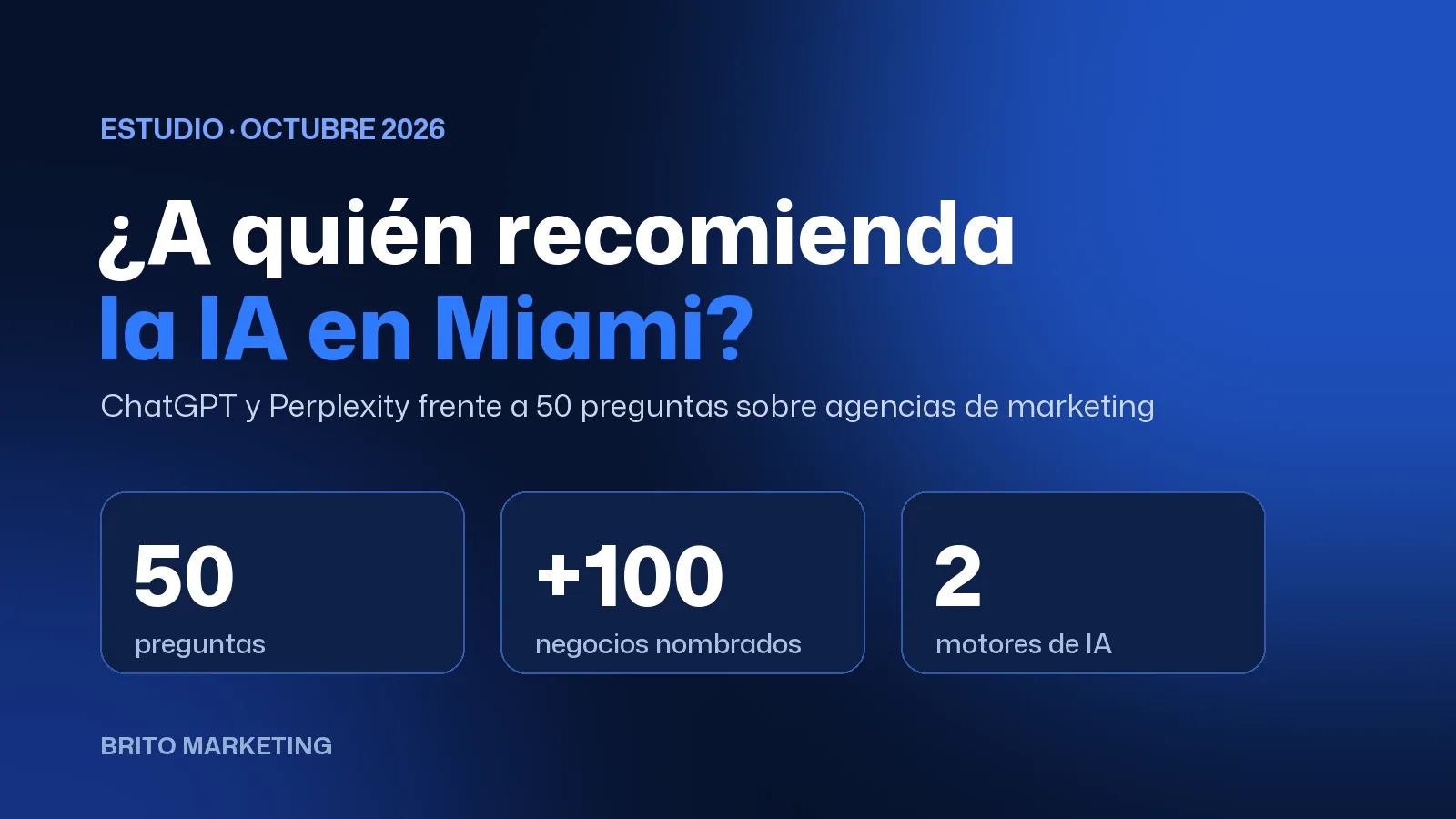
Study: Who ChatGPT and Perplexity Recommend When You Look for a Marketing Agency in Miami (October 2026)
We asked ChatGPT and Perplexity the same 50 questions, in English and Spanish. The AI named more than 100 different businesses, none in more than 4 answers, and for city searches it almost always picked someone from that city. Data, method and limits.

AI Marketing Without Losing the Human Voice
AI speeds up almost everything in marketing. But there's one thing it does badly, and your customers notice instantly.