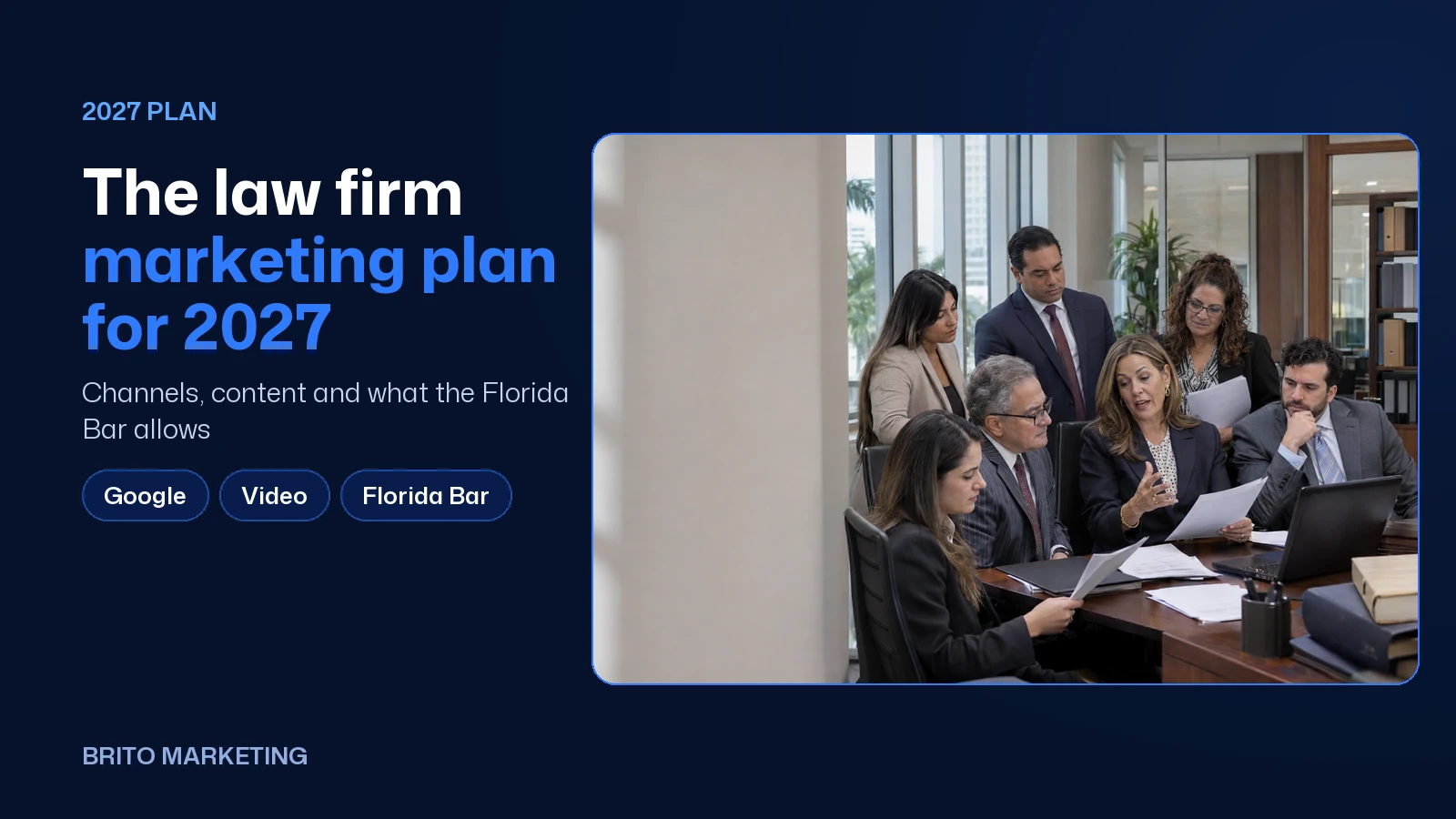
The 2027 Law Firm Marketing Plan: Channels, Content and What the Florida Bar Allows
A January-to-December calendar for your firm: which channel to work each month, when to film, when to ask for reviews, and how to fit the Florida Bar’s 20-day filing window into your campaigns.
Short answer
A 2027 law firm marketing plan runs one month ahead, because ads that require review go to the Florida Bar 20 days before they run. January covers the foundation, spring is for practice pages and video, summer for reviews and hurricane season, and fall for your AI policy and next year’s plan.
We’ve already written about what a law firm should be doing in 2027 to keep growing: Google, AI, reviews, follow-up and CRM. This one is about sequence. A firm with an active caseload doesn’t have time to do everything in January, and it doesn’t need to. What it needs is to know what each month is for, with every piece approved before it’s due. In Florida legal advertising, the Bar has a say in that timeline too.
The rule that sets the whole calendar
Unless an exemption in Rule 4-7.20 applies, every ad has to be filed with the Florida Bar at least 20 days before it’s first disseminated (Rule 4-7.19(a)). If you want a TV spot or a paid social ad live on February 1, it has to be filed by January 12. Your firm’s website, its social media pages and its YouTube videos aren’t filed, but they still follow the same rules. We walk through it, rule number by rule number, in Florida’s advertising rules for lawyers.
In practice, your plan has two columns: what goes out this month and what gets prepped for next month. The firms that feel the filing window as a delay are usually the ones writing the ad the same week they want it on air.
January to March: foundation, intake and practice pages
January is foundation month: one Google Business Profile for each office where you actually meet clients, under the category for your real practice, plus the same name, address and phone number on your website, in the Florida Bar directory and on Avvo or Justia. It’s also the month to get February and March ads filed. February is about intake. Call your own firm on a Tuesday at 7 p.m., in Spanish, and see what happens. The best ad in the world is wasted if the call it brings in goes nowhere.
March is for practice-area pages. Clio’s 2025 Legal Trends Report found that 14% of consumers have already used AI to answer legal questions and another 43% would. Those tools pull from pages that answer specific questions (“What do I do if the insurance company calls me after the crash?”), so each practice area deserves its own page in Spanish and in English, written for each audience, with no promises about outcomes.

April to June: video, reviews and hurricane season
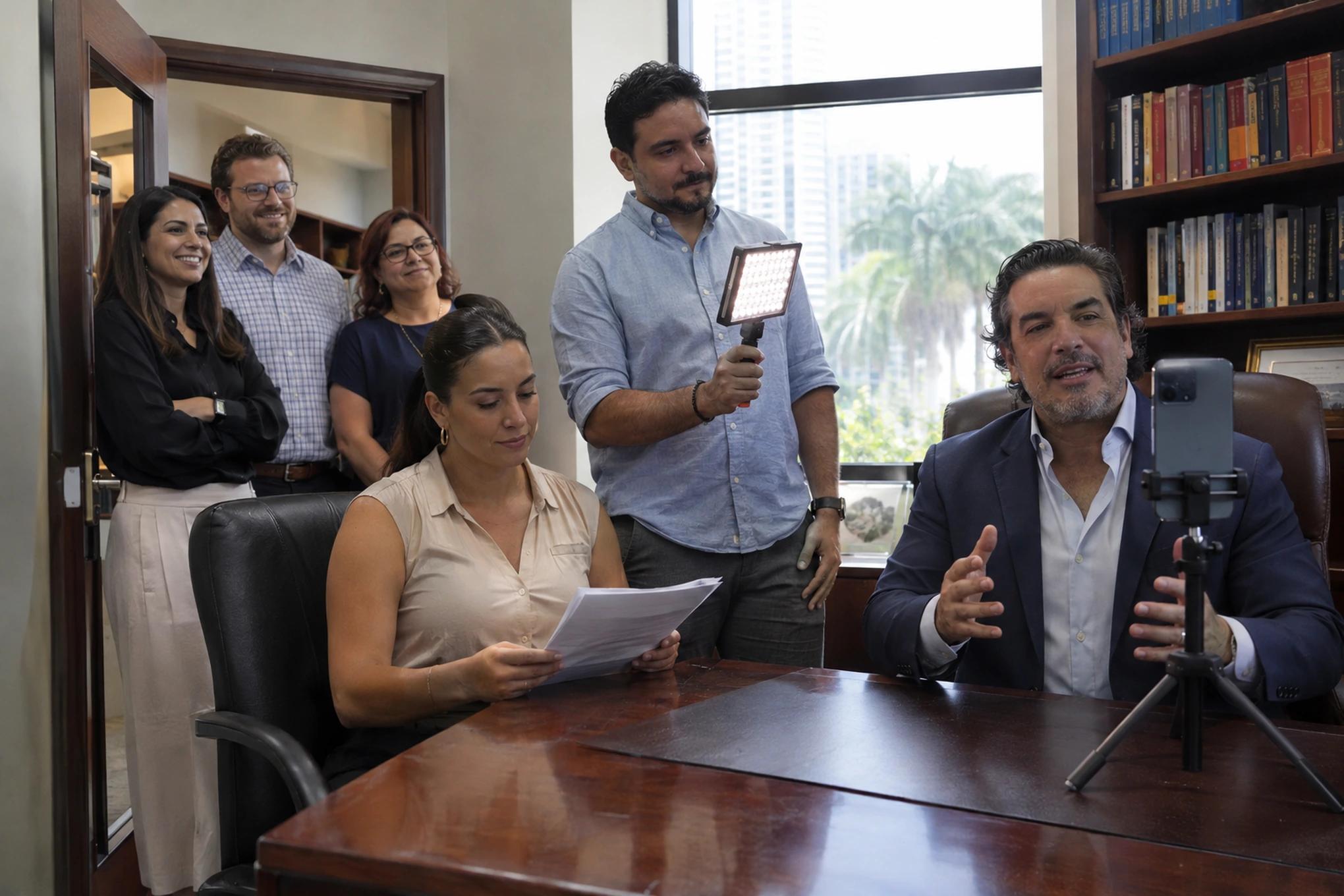
April is filming month. One morning gets you eight to ten short answers from an attorney at the firm, each in its own language, enough to post twice a week into the summer. Videos on your own social pages aren’t filed with the Bar, but if you plan to run one as a paid ad, count the 20 days. Actors and dramatizations need their disclaimers. If you want to see what a law firm commercial looks like without a single promise in it, watch the one we made for Hector Hernandez & Associates.
May is review month. At a firm, the right moment to ask is when a case closes and the client is grateful; here’s how to ask without making it awkward. Reply to every review, too. BrightLocal found that 42% of consumers are unlikely to use a business that never responds, and your replies should never reveal anything about the matter. June opens hurricane season, which runs from June 1 to November 30 according to the National Hurricane Center. If your firm handles property insurance claims, publish the educational content now, not after the storm.
Ready to apply this to your business?
July to September: track signed cases and speak to your community
July is your midyear review, and the question that matters is where the signed cases came from. That answer tells you where to put your budget and your time for the second half. August is a good month to update your website FAQs with everything the front desk has heard since January.
September 15 through October 15 is Hispanic Heritage Month. For a law firm, what works is introducing the team members who serve clients in Spanish and calmly answering, on video, the questions your Hispanic clients always bring. Keep in mind that required disclosures go in the language of the ad, and if the ad uses two languages, they go in both (Rule 4-7.12(c)).
October to December: AI, January ads and next year’s plan
October is a good time to put your firm’s AI use in writing. In Ethics Opinion 24-1, the Florida Bar allows lawyers to use it as long as they protect confidentiality, verify the work and follow the advertising rules, and a website assistant that takes information after hours has to make clear it isn’t a lawyer. November is for preparing and filing January ads before the holidays slow the office down. December closes out with holiday hours on Google and the year’s numbers.
| Month | Channels | Content and campaigns | What to prep for next month |
|---|---|---|---|
| January | Google profile, directories | A profile per office and matching info everywhere | File February and March ads |
| February | Phone, WhatsApp, website | After-hours intake test, in Spanish | Revised intake script |
| March | Website | One page per practice area in each language | List of questions to film |
| April | Instagram, YouTube Shorts, Facebook | Filming day: 8 to 10 short answers | File any videos that will run as paid ads |
| May | Text, email, Google | Reviews as each case closes; reply to all | Hurricane season content |
| June | Website, social, Google | Hurricane education if it fits your practice; closure plan | Signed cases by source |
| July | CRM | Midyear review by signed cases | Second-half budget adjustment |
| August | Website | FAQs updated with what came in since January | Hispanic Heritage Month pieces |
| September | Social, website | Hispanic Heritage Month: the team and questions in Spanish | Draft AI policy |
| October | Website, CRM | Internal AI policy and disclosure on the website assistant | Draft January ads |
| November | Text, Google | Reviews from the year’s closed cases | File January ads |
| December | Google, CRM | Holiday hours; year in review | 2028 plan built on the sources that signed cases |
What stays the same every month
- Every ad names at least one lawyer or the firm, plus the city of a real office (Rule 4-7.12(a)).
- Nothing that reads as a guarantee of an outcome (Rule 4-7.13(b)(1)), and no “the best” you can’t back up.
- Past results only when they can be verified and the client has given informed consent (Rule 4-7.13(b)(2)).
- A dated copy of every ad, saved for when you need it.
Where to start
- Open a calendar and mark, for every paid ad from January to March, the deadline to file it with the Florida Bar.
- Pull your last 20 new inquiries and write down how long each one waited for a first response.
- Name the person on your team who owns this plan, and give them one hour a week to review it.
A calendar like this looks simple on paper, right up until a trial lands on filming week and January’s ads never get filed. That’s why at Brito we run it all as one connected system: marketing, video we shoot ourselves, BritoCRM and AI all pointed at signed cases, in English and in Spanish. We’ve done it from Miami since 2006, with every piece checked against the Florida Bar rules and delivered in time to file. In Miami-Dade and Broward we come to your office; anywhere else, we meet by phone or video call. If you’d like to see how we work, take a look at our law firm marketing whenever it suits you.
Frequently asked questions
Do I have to file every social media post with the Florida Bar?
No. Your firm’s website, social media pages and YouTube videos aren’t filed, though they follow the same rules. What does get filed, barring an exemption, are ads such as TV spots or paid posts, at least 20 days before they first run.
Can I mention cases we’ve won in our content?
Only if the result can be objectively verified and the client has given informed consent, even when the case is public record. And never in a way that reads like a promise the next client will get the same outcome.
How often should we post each month?
Two videos a week on two platforms is plenty for most firms. Consistency across the whole year matters more than volume, and one filming day per quarter gives you more than enough material.
Is an AI assistant on the firm’s website worth it?
It can help with taking information and booking consultations after hours, as long as it clearly says it’s AI and not a lawyer, and doesn’t give legal advice. The Florida Bar’s Opinion 24-1 lays out those conditions.
Twenty years building brands in New York, Las Vegas and Miami, where he's based today. He leads a Miami team that shoots commercials on cinema cameras and runs proprietary AI infrastructure. He believes great marketing starts with truly understanding the customer — and that honesty, often frowned upon in this industry, is what separates partners from vendors.
View profile→Questions about your business?
The first conversation is an assessment, not a sales pitch. Let's talk.
Or explore our AI Advertising service
The 2027 Dental Marketing Plan, Month by Month
A January-to-December calendar for your dental practice: which channel to focus on each month, what to film, when to ask for reviews, and how to keep it all inside Florida’s dental advertising law.
The 2027 Marketing Plan for Medical Clinics
A January-to-December calendar for your clinic: insurance in January, no-shows in February, video in spring, flu shots in the fall and Medicare enrollment, with HIPAA covered at every step.