
The 20 Questions Your Website Must Answer for AI to Recommend You
A template you can run through your website in one afternoon: the 20 questions customers ask before they call, grouped into five blocks, where each answer belongs and how to write it so AI can use it.
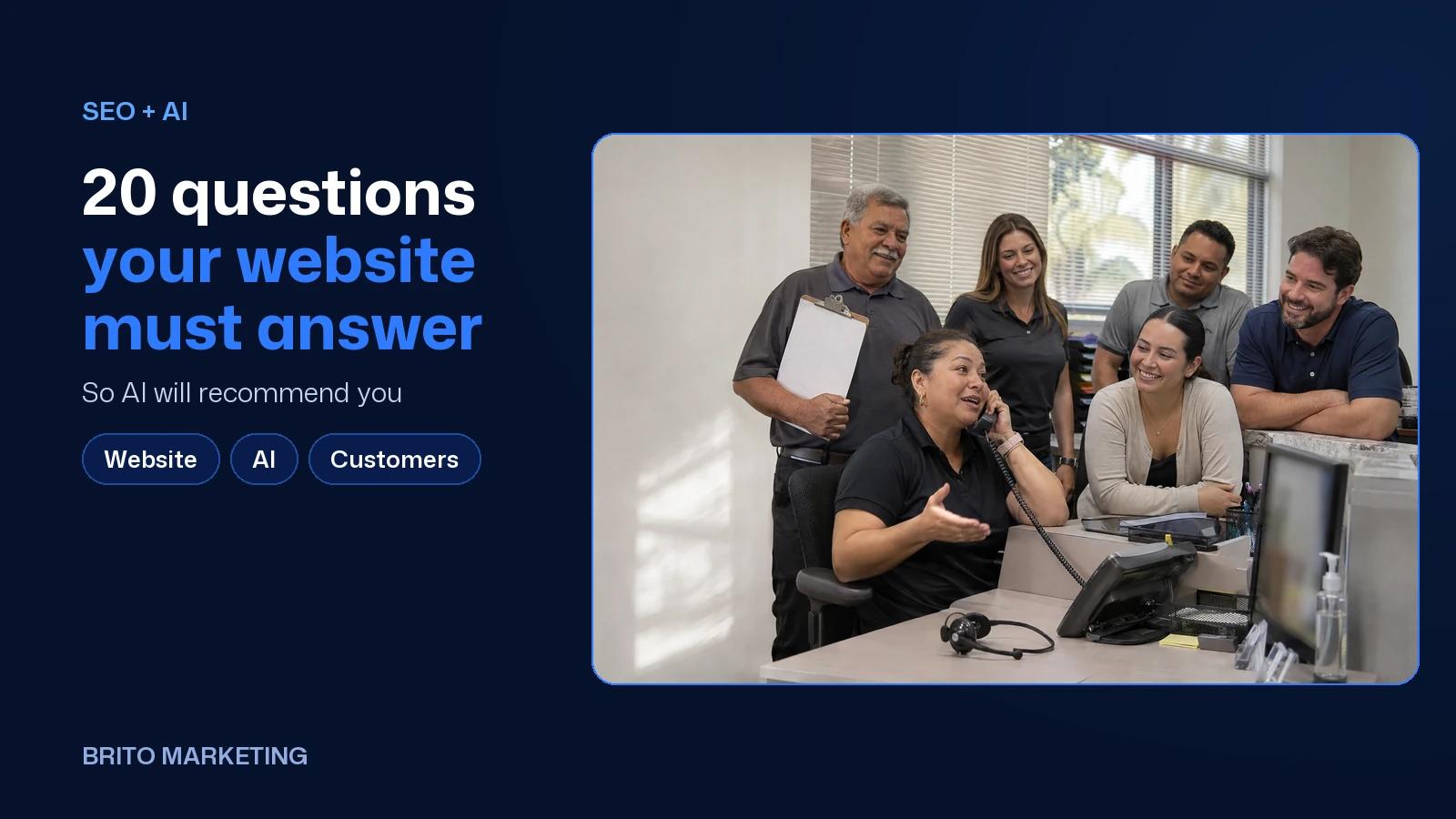
Short answer
Your website needs to answer, in plain text, what you do and who it’s for, where and when you work, how you work, what drives the cost and why people should trust you. That’s 20 questions in five blocks. If the answer isn’t on your site, AI goes looking somewhere else, or picks a business whose site has it.
When someone asks ChatGPT or Google “who fixes roof leaks in Kendall and works Saturdays?”, the AI has to find those answers written down somewhere. If your website just says “quality and service since 1998,” there’s nothing for it to grab. This list comes from the questions customers ask on the phone before they buy, organized so you can go through your site with a pen in hand.
Those numbers tell you two things. People search in full questions, and those are exactly the searches most likely to trigger an AI answer. And after checking your reviews, more than half head to your website to keep digging. If they don’t find what they need there, somebody else gets to answer.
Block 1: what you do and who it’s for
- 1. What services do you offer, exactly? Each one named the way people search for it, with its own page.
- 2. Who is it for? Homes or businesses, adults or kids, simple jobs or complicated ones. If there’s something you don’t do, say so.
- 3. What problem do you solve? Describe the moment people call you: “the AC quit on a Sunday.”
- 4. What makes you different? Use facts people can check: years in the trade, licenses, languages, specialties.
Block 2: where and when
- 5. Which cities or neighborhoods do you cover? Written out as text, not inside a map image.
- 6. What are your hours? Include weekends, holidays and whether you handle emergencies.
- 7. Which languages do you work in? If it’s English and Spanish, it should say so on the page.
- 8. Where do people find you? Your address, whether customers come to you or you go to them, and whether you offer video consultations.

Block 3: how you work
- 9. What happens after the first call? The steps, in order, until the job is done.
- 10. How long does it take? An honest range for the typical job and what tends to stretch it out.
- 11. What does the customer need to have ready? Documents, photos, measurements, insurance info, whatever applies.
- 12. What happens if something goes wrong? Your policy on fixes, revisions or complaints. In healthcare and law, no promised outcomes.
Block 4: the money
Plenty of owners would rather not post prices, and that’s fine. What doesn’t work is saying nothing at all, because “how much does it cost?” is one of the most common questions out there. You can explain how pricing works without naming a number.
- 13. What drives the price? What pushes it up or down: size, materials, urgency, complexity.
- 14. How do people pay? Payment methods and whether you offer financing or payment plans.
- 15. Do you take insurance? Key for healthcare, insurance and home repair: which plans and how claims work.
- 16. Is there a charge for the consultation or estimate? Say it plainly, whatever the answer is.
Ready to apply this to your business?
Block 5: why people should trust you
- 17. Who’s behind the business? Real names, titles and photos of the team.
- 18. What do other customers say? Recent reviews and, if you have them, case examples shared with the customer’s permission.
- 19. What licenses, insurance or certifications do you hold? With a number or link so people can verify them, where that applies.
- 20. How do I reach you, and what happens next? Phone, WhatsApp, a form, and how quickly you get back to people.
That last block is what Google and AI tools look at when deciding whether to trust you. We walk through it in what E-E-A-T is.

How to write each answer so AI can use it
Compare two answers to “Are you open Saturdays?” One says, “We work around your schedule.” The other says, “Yes, Saturdays from 8 a.m. to 2 p.m. in Miami-Dade and Broward; Sundays for emergencies only.” The second one can be quoted word for word. The first one helps nobody. That’s the rule for all 20.
- Put the question in the heading and the answer in the two or three sentences right below it, before any explanation.
- Use text, not images, videos or PDFs.
- Say the same thing on your site, your Google Business Profile and your directory listings. If they contradict each other, AI hesitates.
- Write it in English and in Spanish, by someone who actually speaks each language.
- Be specific, and when you give a number, give its source too, as we explain in content AI cites.
One technical request worth making to whoever builds your site: put your hours, address, phone number and service areas in the page’s structured data too, and make sure they match the visible text exactly. It isn’t a trick and it doesn’t replace the written answers. It just saves the software from guessing. If you’ve never heard of it, here it is explained for business owners.
And a quick test before you call an answer done: read it without the heading above it. If it still makes sense on its own, it works. If it says “Sure, absolutely” or “It depends,” it’s missing context, and AI won’t be able to quote it by itself.
| Block | Questions | Where it goes | Common mistake |
|---|---|---|---|
| What you do and who it’s for | 1–4 | Homepage and one page per service | Every service crammed onto one page |
| Where and when | 5–8 | Footer, contact page and each service page | Service areas only in a map image |
| How you work | 9–12 | Each service page | Jumping straight to “call us” |
| The money | 13–16 | Service pages and FAQ | Saying nothing about cost |
| Why trust you | 17–20 | Team, reviews and contact pages | Stock photos and no names |

Where to start
- Today: print the 20 questions and check off, page by page, which ones your site answers and which it doesn’t.
- This week: ask your front desk or your salespeople for the five questions they hear most and compare them with the list.
- This month: write the missing answers, starting with blocks 1 and 2, and make sure your Google profile says the same thing.
Answering 20 questions well, in two languages and across every page, is more work than it looks when you also have a business to run. At Brito we build the website, the content and the Google profile together, in English and in Spanish, connected to BritoCRM so the questions coming in by chat and phone feed back into your site. If you’re using these slower days to plan the year, you can start by building your plan in 2 minutes and see where it makes sense to begin.
Frequently asked questions
Do I have to post prices on my website for AI to recommend me?
You don’t need a number. What helps is explaining what drives the price, how people pay and whether estimates cost anything, because people ask that constantly and someone is going to answer it.
Can I just put all 20 on one FAQ page?
It helps, but it isn’t enough. Answers about a specific service work better on that service’s page, where AI can tie them to that service and that area. Save the FAQ page for what applies to the whole business.
How long until AI notices the changes?
There’s no set date. It depends on when the crawlers come back and on what your other sources say, and it usually takes weeks. In the meantime, those same answers are already helping every customer who lands on your site.
I’m a lawyer. Can I answer “what happens if something goes wrong”?
Yes, by explaining the process, how you keep clients informed and what their options are, without promising outcomes. Florida Bar rules don’t allow guarantees; our blog has a guide to those rules.
Twenty years building brands in New York, Las Vegas and Miami, where he's based today. He leads a Miami team that shoots commercials on cinema cameras and runs proprietary AI infrastructure. He believes great marketing starts with truly understanding the customer — and that honesty, often frowned upon in this industry, is what separates partners from vendors.
View profile→Questions about your business?
The first conversation is an assessment, not a sales pitch. Let's talk.
Or explore our Search + AI (SEO & AEO) service
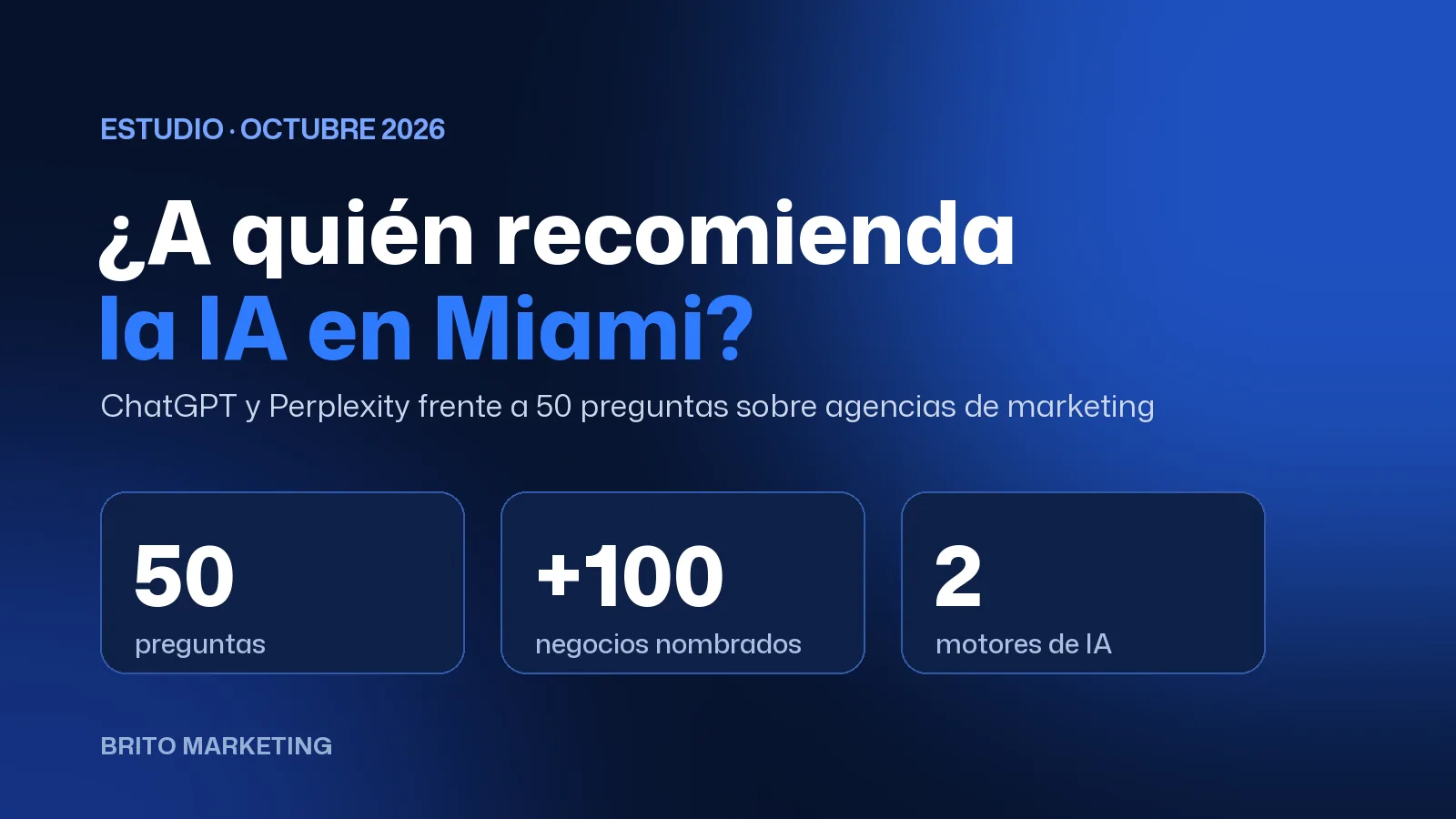
Study: Who ChatGPT and Perplexity Recommend When You Look for a Marketing Agency in Miami (October 2026)
We asked ChatGPT and Perplexity the same 50 questions, in English and Spanish. The AI named more than 100 different businesses, none in more than 4 answers, and for city searches it almost always picked someone from that city. Data, method and limits.

AI Marketing Without Losing the Human Voice
AI speeds up almost everything in marketing. But there's one thing it does badly, and your customers notice instantly.